
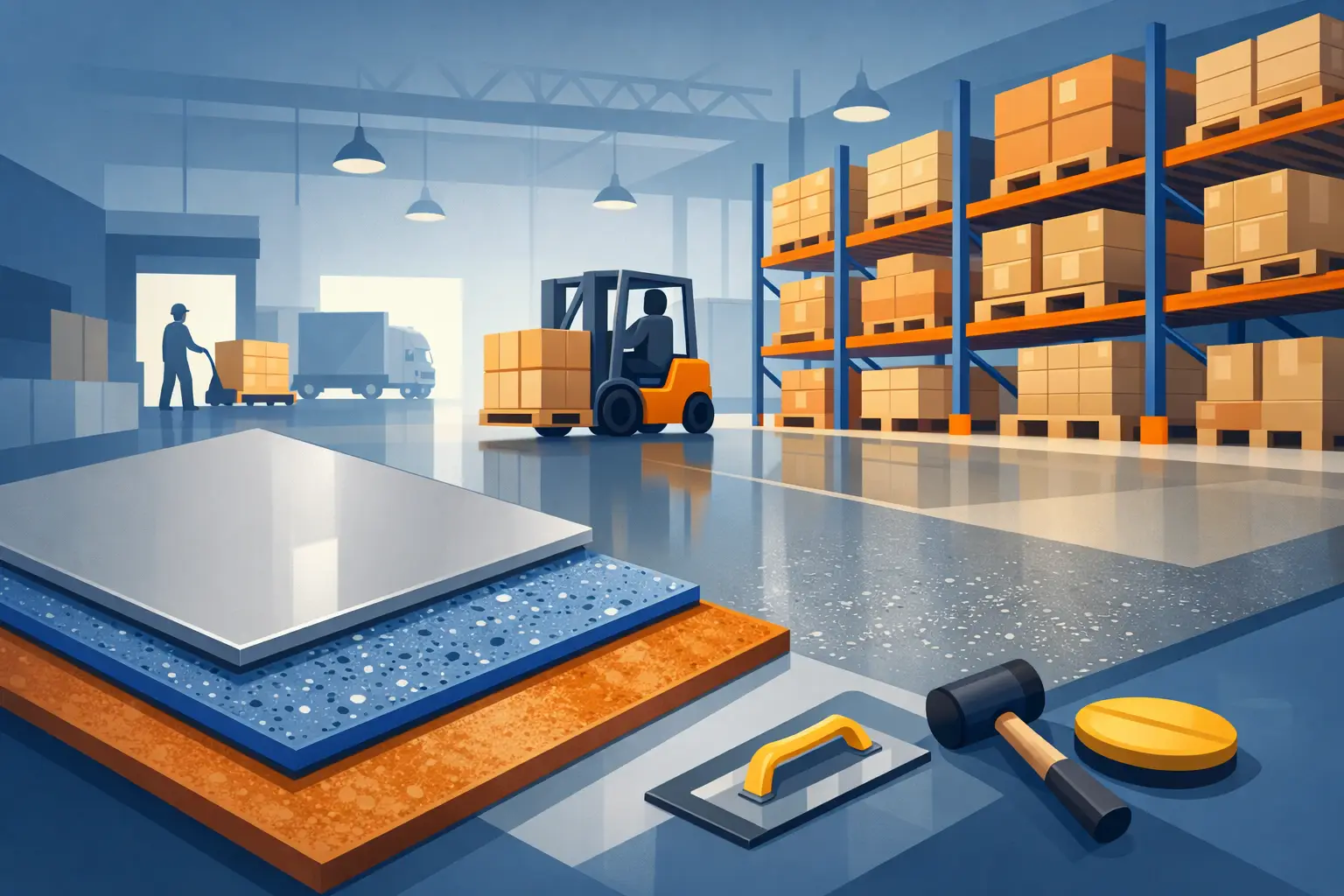
A warehouse floor usually fails long before the building does. It starts with dusting, tire marks, joint damage, moisture issues, or surface wear in traffic lanes. That is why choosing the best flooring for warehouses is not really about color or finish. It is about how the slab performs under forklifts, pallet jacks, storage loads, chemical exposure, and constant cleaning.
For most warehouse facilities, the right answer is not a soft floor, a decorative finish, or a cheap coating that looks good for six months. It is a hard-wearing system built around the actual conditions inside the space. In many cases, that means improving the concrete you already have instead of covering it with something that will peel, chip, or create maintenance headaches.
What is the best flooring for warehouses?
If you want the short answer, polished concrete is often the best flooring for warehouses because it delivers durability, low maintenance, strong abrasion resistance, and long-term value. But that does not mean it is always the only answer.
Some warehouses need densified and polished concrete for dry, high-traffic use. Others need resinous coatings in areas with frequent chemical spills, washdowns, or specialized sanitation demands. The best floor depends on how the building operates day after day, not what looks best in a product brochure.
Why warehouse flooring decisions go wrong
The biggest mistake is choosing based on upfront cost alone. A lower bid can become an expensive floor if it requires constant patching, recoating, shutdowns, or aggressive maintenance. Warehouse operators do not just pay for flooring once. They pay for it in labor, downtime, cleaning, repairs, and lost productivity.
Another common mistake is treating the whole warehouse as one environment. Shipping lanes, racking areas, loading zones, battery charging stations, and employee walkways do not all demand the same surface performance. A floor that works in a dry storage area may fail quickly in a section exposed to oils, acids, or standing moisture.
That is why experienced flooring planning starts with use conditions first. Traffic type, slab condition, moisture vapor, flatness, maintenance expectations, and safety targets all matter.
Polished concrete for warehouse floors
Polished concrete remains one of the strongest options for warehouse environments because it works with the slab instead of hiding it. Through grinding, densifying, and refining the surface with industrial diamond tooling, the floor becomes harder, tighter, cleaner, and easier to maintain.
In practical terms, that means less dusting, better resistance to tire wear, improved light reflectivity, and lower long-term maintenance costs. For warehouse operators, those are not cosmetic benefits. They directly affect cleanup time, visibility, and operational efficiency.
A properly polished floor also avoids one of the most common failures in industrial environments – surface delamination from topical systems. Because the finish is mechanically refined into the concrete rather than layered on top of it, there is no film to peel under traffic in the same way lower-grade coatings often do.
That said, polished concrete is not magic. If a slab has major moisture issues, significant structural cracking, contamination, or heavy chemical attack, surface prep and repair become critical. The quality of the existing concrete also matters. A weak slab cannot be polished into a high-performance floor without first addressing the underlying problems.
When coatings make more sense
There are warehouse zones where a coating or resinous system is the smarter choice. If the floor sees regular chemical spills, caustic cleaners, oils, or washdown conditions, polished concrete alone may not offer enough protection. In those cases, epoxy, urethane cement, or polyaspartic systems may be more appropriate.
Epoxy coatings are widely used because they can create a smooth, cleanable surface and offer solid chemical resistance. They also allow striping, color coding, and defined work zones. The trade-off is that epoxies are topical. If the slab was not prepared correctly, or if moisture vapor pressure is high, failure can happen fast.
Urethane cement is often stronger in harsher industrial settings, especially where thermal shock, moisture, and aggressive cleaning are factors. It is not always the first choice for a general dry warehouse because it can cost more and may offer a more utilitarian appearance. But in the right environment, it outperforms decorative or light-duty coatings by a wide margin.
Polyaspartic systems can be useful when speed matters and downtime must be minimized. They cure faster than many traditional systems, which can help active operations return to service sooner. The catch is that fast installation does not eliminate the need for proper surface preparation.
Comparing the main warehouse flooring options
Concrete polishing stands out for dry warehouses, distribution centers, and high-traffic logistics spaces where durability and low maintenance are top priorities. It holds up well under forklift traffic, reduces dust, and avoids many of the peeling issues associated with film-forming coatings.
Epoxy is a better fit where appearance, chemical resistance, and marked zones are important, but it requires strict prep and moisture evaluation. It can perform very well when installed correctly, though it usually needs more lifecycle attention than polished concrete.
Urethane cement is built for punishing conditions. If your facility includes wet processing, food-related use, or severe chemical exposure, it deserves serious consideration.
Basic paint or bargain sealers may look attractive from a budget standpoint, but they are usually the wrong choice for a serious warehouse. Under industrial traffic, they wear out quickly and often create a cycle of recurring repairs.
The slab matters as much as the finish
No flooring system performs better than the substrate underneath it. Existing concrete condition is one of the biggest factors in any warehouse floor decision. Surface softening, moisture transmission, curling, pitting, old adhesive residue, and joint deterioration all affect what can be installed and how well it will hold up.
This is where many projects get off track. Owners compare flooring types without first understanding the slab itself. Moisture testing, surface hardness assessment, and a realistic review of traffic patterns should happen before a system is specified. If they do not, the chosen floor may be blamed for problems that actually started in the concrete.
For older facilities in Los Angeles and Orange County, that step is especially valuable because slab condition can vary significantly from one warehouse to the next. A floor with years of patchwork repairs or moisture migration may need correction before polishing or coating even begins.
Safety, maintenance, and operating cost
Warehouse flooring should never be judged only by installation price. A surface that looks cheaper on day one can become the most expensive option over five years if it demands constant rework.
Polished concrete has a major advantage here. It does not require waxing, and routine maintenance is generally straightforward with the right cleaning program. That can reduce labor and material costs over time. It also improves reflectivity, which may help brighten the space and support visibility.
Slip resistance is more nuanced than many buyers expect. A glossy floor is not automatically unsafe, and a textured floor is not automatically safer in every condition. The key question is how the floor performs when dry, dusty, or exposed to contaminants. The answer depends on the finish, the environment, and the maintenance plan.
How to choose the best flooring for warehouses
Start with your real use case. Ask what the floor sees every day, not what you hope it will see after the project is done. Forklift traffic, rack load, impact, moisture, chemicals, and cleaning methods should drive the choice.
Then look at downtime. Some facilities can shut down sections in phases. Others need rapid turnaround with minimal disruption. That may influence whether a polished concrete process, a resinous system, or a hybrid approach makes the most sense.
Finally, think in lifecycle terms. The best flooring decision is usually the one that gives you the fewest problems over time, not the one with the smallest initial number on a proposal. A qualified concrete polishing and floor enhancement contractor can help match the slab, the operation, and the finish instead of forcing a one-size-fits-all answer.
For many warehouse owners and facility managers, the strongest long-term move is to invest in a floor that works harder, cleans easier, and holds up under pressure without constant attention. That is where a properly evaluated and professionally installed concrete flooring system earns its value long after the project is finished.
Clients We Service
We provide our concrete polishing and related services to a wide variety of clients. Some of the types of clients that we provide service to include:


