
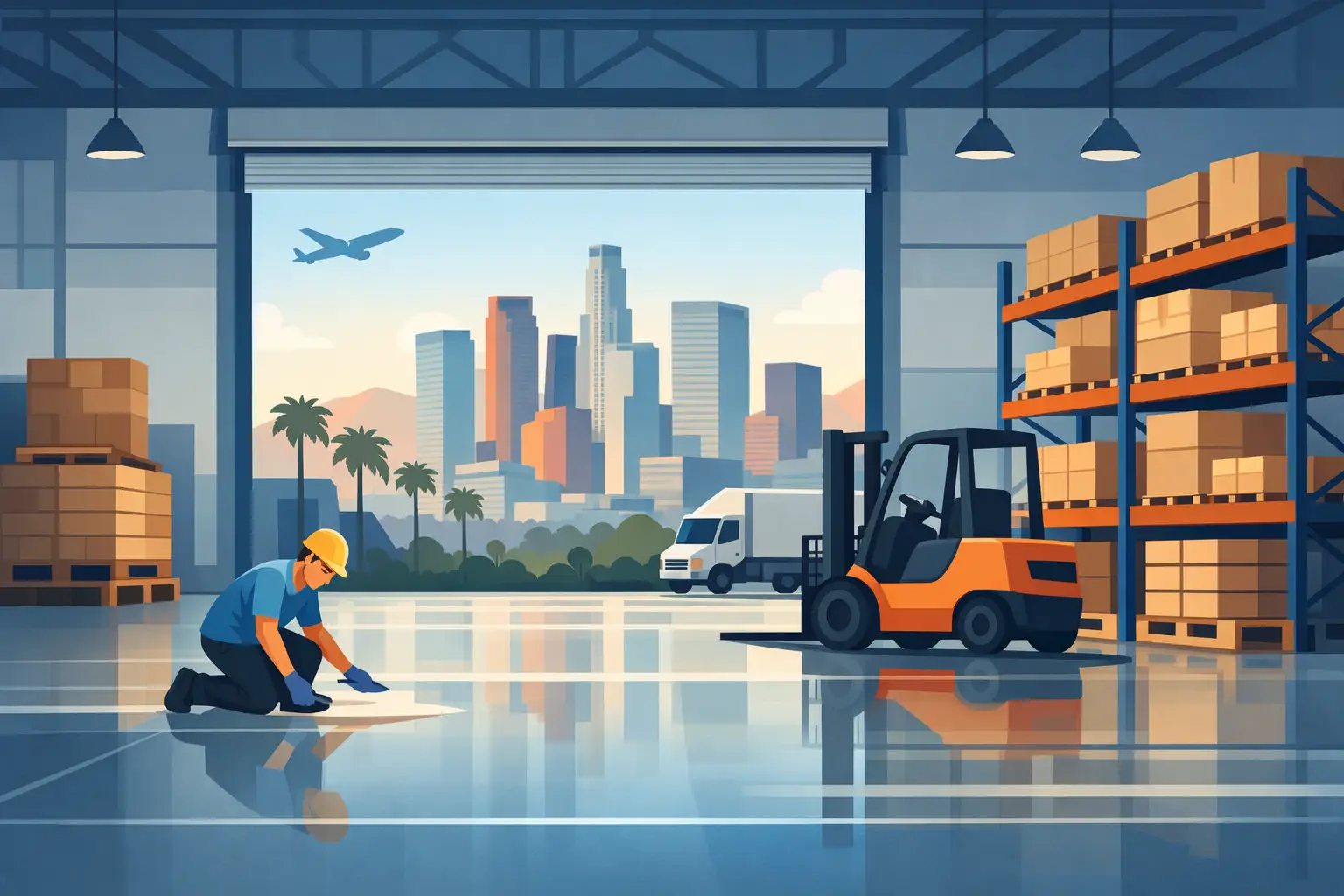
A warehouse floor is not a cosmetic afterthought. It is the surface carrying loaded forklifts, pallet jacks, racking traffic, dropped inventory, tire abrasion, cleaning chemicals, and the daily pressure of keeping operations moving. This Los Angeles warehouse flooring guide is built for decision-makers who need a floor that controls long-term costs without creating unnecessary shutdowns.
In Southern California, the right answer often starts with the concrete already under your building. A well-evaluated slab can frequently be ground, repaired, densified, polished, or protected rather than covered with a system that may eventually peel, chip, or require broad replacement. That does not mean polished concrete is right for every operation. The best flooring system depends on traffic, moisture conditions, cleanliness standards, chemical exposure, slip requirements, and the condition of the existing slab.
Start With How the Warehouse Actually Operates
Flooring decisions should be based on real use, not a generic product comparison. A distribution center with continuous forklift traffic has different needs than a light-storage facility, e-commerce fulfillment space, food-related operation, or customer-facing warehouse showroom.
Begin by assessing the weight and frequency of traffic. Forklift tires can expose weak concrete, failed coatings, rough joints, and surface defects quickly. Hard-wheel traffic is particularly demanding because it concentrates load and can create vibration, spalling, and joint damage. If trucks travel fixed paths every day, those lanes deserve special attention during floor preparation and system selection.
Next, consider what reaches the floor. Water, oils, battery acid, degreasers, hydraulic fluid, solvents, and stored chemicals each affect the recommendation. A floor that performs well in a dry general-storage warehouse may not provide adequate protection in a maintenance area or battery charging zone.
Finally, account for the people using the space. Marked pedestrian routes, loading areas, emergency egress paths, and work zones may need greater visual contrast or additional traction. Safety is not just a matter of choosing a textured finish. It also depends on proper cleaning procedures, drainage conditions, lighting, and a surface that stays predictable under normal use.
Evaluate the Existing Concrete Before Choosing a Finish
No high-performance flooring system can correct every slab issue by itself. The most reliable projects begin with a detailed review of the concrete, including its hardness, flatness, contamination, cracks, joints, coatings, moisture condition, and previous repairs.
Older Los Angeles warehouse slabs commonly show forklift wear, surface dusting, tire marks, patchwork repairs, and joint deterioration. These conditions are not automatic reasons to replace the floor. Diamond grinding can remove weak surface material and old coatings, while crack and joint repairs can restore a cleaner, more stable traffic surface. Where the slab is structurally sound, restoration is often more cost-effective than demolition.
Moisture testing is especially important. Moisture vapor moving through concrete can compromise certain coating systems if it is not addressed correctly. This is one reason surface preparation and moisture control cannot be treated as optional line items. A low bid that skips proper testing or preparation may look attractive at the start, then become expensive when coatings blister or delaminate.
Concrete hardness also matters for polished finishes. Softer slabs may require more grinding and densification to achieve consistent refinement. Harder concrete can polish beautifully but may reveal aggregate differently than expected. A professional test area is the best way to set realistic expectations for color variation, sheen, and aggregate exposure.
Polished Concrete for Durable, Low-Maintenance Performance
Polished concrete is one of the strongest long-term choices for dry warehouses, logistics facilities, offices within industrial buildings, retail storage spaces, and high-traffic work environments. The process uses progressively finer diamond grits to refine the concrete, followed by densifiers that strengthen the surface and help produce a tighter, more abrasion-resistant floor.
The result is not paint sitting on top of concrete. It is an enhanced concrete surface designed to resist dusting, improve light reflectivity, and simplify daily maintenance. A higher-gloss polish can brighten a large warehouse and reduce the need for excess lighting in some areas. For operations that prefer a more industrial appearance, a matte or satin finish can provide the same practical advantages with less reflectivity.
Polished concrete has trade-offs. It is not the best choice for every wet process, highly aggressive chemical environment, or area requiring a thick protective barrier between contaminants and the slab. It can also reveal the natural character of the concrete, including prior patches, aggregate variation, and color differences. For many warehouse owners, that honest industrial appearance is a benefit. For others, a topping or coating may deliver a more uniform visual result.
Coatings and Toppings When Extra Protection Is Needed
Coatings are often the better option when a warehouse needs chemical resistance, color-coded zones, decorative uniformity, or a more controlled texture. Epoxy and urethane systems can provide a protective layer that helps manage oils, chemicals, abrasion, and cleaning demands. The exact system should match the exposure, not simply the desired color.
For example, a general warehouse may benefit from a coating in maintenance bays, loading zones, battery rooms, or areas subject to frequent spills while retaining polished concrete through the main storage floor. This hybrid approach can control cost while placing the strongest protection where it matters most.
Cementitious toppings are another solution for slabs with widespread cosmetic damage, uneven repairs, or surface conditions that make a refined polish impractical. A topping creates a new wear surface that can be finished for a clean, consistent look. It is a larger investment than simple polishing, but it can be the right move when the existing slab is too compromised to meet appearance or performance expectations.
The key is not to assume a coating is automatically superior because it looks newer on day one. Coatings require excellent mechanical preparation and can need periodic renewal in high-abuse areas. Polished concrete typically has lower ongoing maintenance demands, but it cannot provide the same barrier protection as a properly specified chemical-resistant coating.
The Los Angeles Warehouse Flooring Guide to Safety and Downtime
For warehouse operators, the best floor is one that performs without disrupting shipping schedules, staffing, or customer commitments. Project planning should address phasing before work begins. Large facilities can often be divided into work zones, allowing operations to continue in adjacent areas while flooring crews complete preparation, repairs, and finishing.
A qualified contractor should discuss access routes, staging locations, dust-control measures, cure times, and return-to-service expectations upfront. Grinding and polishing equipment with effective dust collection can substantially reduce airborne debris during concrete preparation. That is especially valuable in active facilities where inventory protection and clean working conditions are priorities.
Slip resistance should be evaluated based on the intended finish and operating conditions. A mirror-like finish is not automatically unsafe, just as a heavily textured floor is not automatically safer. Surface traction changes with water, oils, debris, footwear, tire type, and cleaning methods. In areas with frequent wet exposure, a coating with an appropriate texture or a designated slip-conscious treatment may be the better choice.
Do not overlook joints and transitions. Warehouse joints absorb movement and carry repeated wheel traffic. Failed joint filler can turn into a recurring maintenance problem, create rough travel paths, and damage forklift wheels. Proper joint repair and filling are often among the highest-value improvements in an industrial flooring project.
Compare Cost by Service Life, Not Just Installation Price
The lowest initial price rarely represents the lowest cost over the life of a warehouse floor. A less expensive coating may require repairs or recoating in high-traffic lanes. An unprotected slab may continue to dust, stain, and deteriorate, raising cleaning costs and reducing the professional appearance of the facility. Full slab replacement is often the most disruptive and expensive option when restoration could have addressed the actual issue.
When comparing proposals, ask what surface preparation is included, how cracks and joints will be handled, whether moisture testing is part of the scope, what finish level is specified, and what maintenance the system will require. A clear proposal should explain the material or polishing process, the expected operational impact, and the limitations of the recommended system.
Los Angeles Concrete Polishing approaches warehouse floors as working assets, not generic square footage. The right solution should support your equipment, your safety requirements, your budget, and your timeline with proven concrete preparation and finishing methods.
Before committing to a warehouse flooring system, walk the facility with the people who see its daily problems firsthand. The forklift operator who avoids a damaged lane, the maintenance lead dealing with dust, and the manager responsible for downtime can reveal exactly where your floor needs to work harder.
Clients We Service
We provide our concrete polishing and related services to a wide variety of clients. Some of the types of clients that we provide service to include:


