
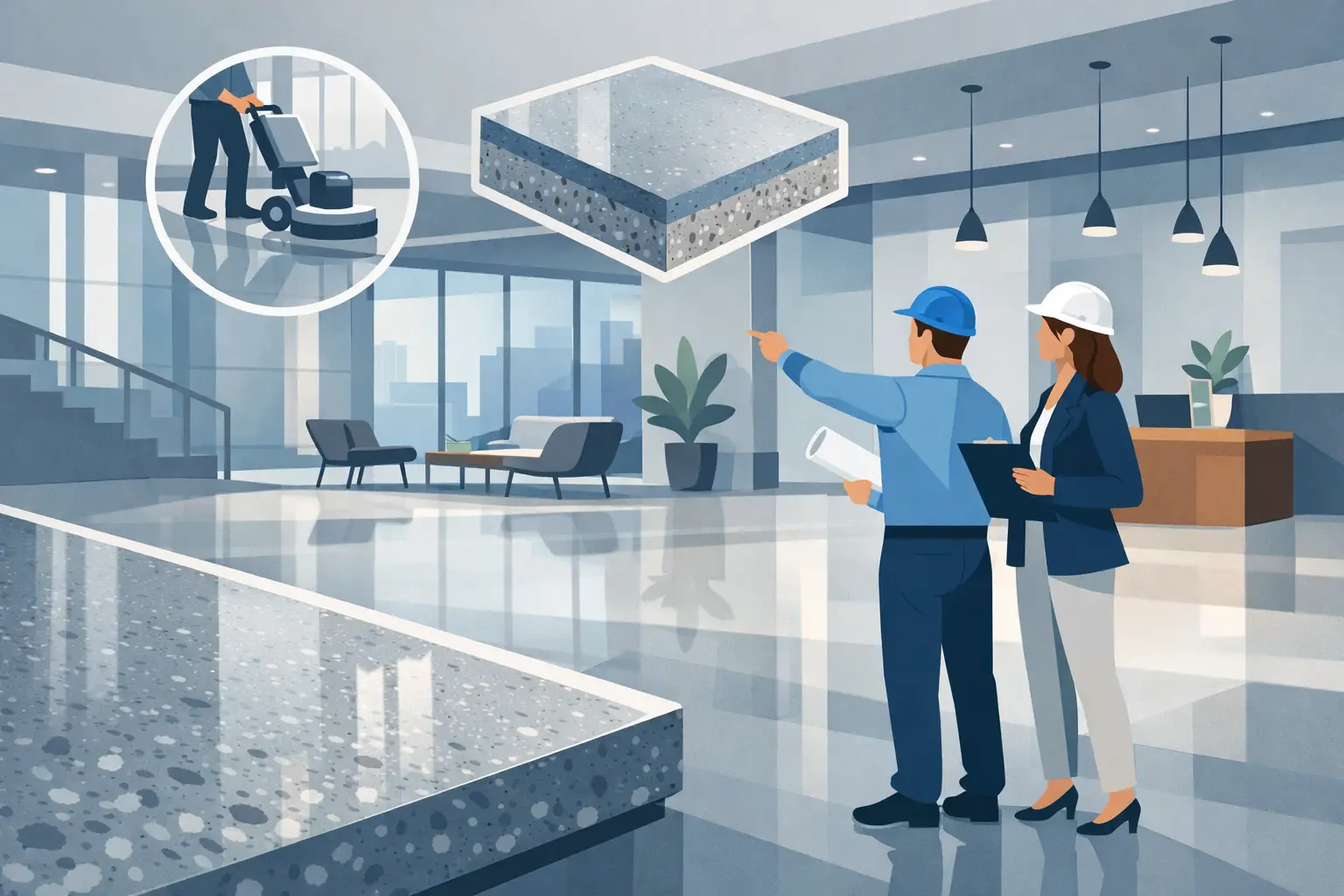
A floor can look clean on opening day and still be the wrong choice six months later. In commercial spaces, that mistake shows up fast – tire marks in a warehouse, worn finish at a retail entry, dusting in back-of-house areas, or constant maintenance costs that never seem to stop. This commercial polished concrete guide is built for owners, facility managers, and operators who need a floor that performs under pressure, not just one that photographs well.
Polished concrete has earned its place in warehouses, offices, retail stores, restaurants, showrooms, and modern residential lofts because it solves several problems at once. It improves light reflectivity, reduces maintenance, resists wear better than many surface-applied finishes, and gives existing concrete a cleaner, more refined appearance. But polished concrete is not one-size-fits-all. The right result depends on the slab you start with, how the space is used, and how the floor is specified before grinding even begins.
What a commercial polished concrete guide should actually cover
Too many articles reduce polished concrete to shine level and price per square foot. Serious buyers need more than that. A real commercial polished concrete guide should explain how polishing works, where it performs best, what can go wrong, and how to match the finish to daily traffic, maintenance expectations, and business operations.
At its core, polished concrete is a mechanical process. Contractors use progressively finer diamond abrasives to grind, refine, densify, and polish the concrete surface. That matters because the finish is created within the slab itself, not simply painted or rolled on top. The result is typically more durable and lower maintenance than many coatings, especially in environments with heavy foot traffic or rolling loads.
That said, the floor is only as good as the slab under it. If the concrete has moisture issues, extensive cracking, weak surface paste, old adhesive contamination, or major elevation changes, those conditions have to be addressed honestly. A polished finish can enhance a slab’s character, but it will not hide structural defects.
Where polished concrete makes the most sense
Commercial polished concrete performs best in spaces that need durability, easy cleaning, and a professional finish without the recurring upkeep of waxes or topical layers. Warehouses are a strong fit because polished concrete stands up well to forklifts, pallet jacks, and constant traffic while helping reduce dust. Retail stores benefit from the cleaner look and higher reflectivity, which can brighten the sales floor and support a more upscale appearance.
Office environments often choose polished concrete for a different reason. They want a modern, architectural finish that still holds up to rolling chairs, entry traffic, and janitorial routines. In restaurants and hospitality settings, polished concrete can work very well, but the details matter. Slip resistance, spill exposure, grease management, and cleaning protocols have to be considered early rather than treated as an afterthought.
Not every space is an automatic fit. If the slab is in poor condition or the environment involves constant chemical attack, aggressive thermal shock, or strict contamination control requirements, another system may be better. Strong contractors say that plainly because the right floor is the one that performs long after installation.
Understanding finish levels and aggregate exposure
One of the biggest specification mistakes is asking for a polished concrete floor without defining the look. Gloss level is only part of the decision. Aggregate exposure changes the appearance just as much.
Cream polish keeps the surface close to the top and preserves a more uniform, minimal look. Salt-and-pepper exposure cuts slightly deeper and reveals small sand particles, which is one of the most popular commercial options because it balances consistency and character. Full aggregate exposure grinds deeper into the slab and reveals larger stone, creating a more decorative finish, but it also depends heavily on what is inside the existing concrete.
Gloss levels usually range from matte to high gloss. A higher gloss can increase reflectivity and visual impact, but that does not automatically mean it is right for every project. Warehouses and industrial spaces often prioritize performance and ease of maintenance over maximum shine. Retail and showroom environments may want more visual pop. The best specification matches the brand, traffic pattern, and maintenance plan.
Cost depends on the slab, not just the square footage
Buyers often want a simple price, but polished concrete pricing is shaped by job conditions more than by raw size alone. Large open areas can be efficient. Small cut-up floor plans with tight corners, fixture removal, heavy patching, or phased work during business hours are different.
The biggest cost drivers are slab condition, desired finish, and project constraints. If the concrete has coatings, mastics, moisture problems, or surface damage, prep work increases. If the owner wants a high-gloss finish with deeper aggregate exposure, labor and tooling requirements increase. If the building must stay operational during installation, the schedule becomes more complex and the execution has to be tighter.
This is where experienced contractors separate themselves. The lowest bid is often based on assumptions that fail once grinding starts. A serious proposal accounts for substrate realities, moisture control, edge work, repairs, and realistic production rates. That protects both the schedule and the final result.
Maintenance is simple, but not zero
One reason polished concrete is such a strong long-term value is that it cuts out a lot of recurring floor maintenance. There is no wax to strip and reapply, and no coating film to peel in normal conditions. Daily or routine maintenance usually comes down to dry dust mopping, wet mopping with the right cleaner, and periodic auto-scrubbing in larger facilities.
Still, low maintenance is not the same as no maintenance. The wrong cleaning chemical can dull the surface. Embedded grit at entry points can act like sandpaper. Neglected spills can stain some slabs, especially if they are not properly protected. Entry mats, regular dust control, and a maintenance plan that fits the building matter more than many owners realize.
A polished concrete floor also benefits from realistic expectations. It is highly durable, but it is still concrete. It can show scratches under certain conditions, and natural variation in the slab is part of the finished look. For most commercial buyers, that trade-off is worth it because the floor ages with far less drama than many alternatives.
Moisture, repairs, and other issues that should be addressed early
If there is one point this commercial polished concrete guide should make clear, it is this: pre-job evaluation is where success starts. Moisture vapor transmission, joint condition, crack repair needs, and previous surface treatments all affect how the floor can be finished.
Moisture is especially important in Southern California properties with older slabs, occupied buildings, or spaces that have had floor failures before. Polishing itself is not a topical coating, which can be an advantage, but moisture-related conditions still need to be understood because they affect patching products, dyes, guards, and overall slab performance.
Cracks and joints also deserve a practical discussion. Some can be repaired and blended well. Others may remain visible, especially in older or heavily used slabs. That does not mean the floor is failing. It means the contractor is working with an existing concrete surface rather than covering it with an opaque material. Experienced commercial clients usually appreciate that honesty because it leads to better decisions.
How to plan a polished concrete project with less disruption
For active businesses, downtime matters as much as design. The strongest polished concrete projects are planned around operations, access, dust control, cure times for repairs, and phased work areas. In warehouses, that may mean sectioning the floor to keep inventory moving. In offices or retail spaces, it may mean night work, weekend scheduling, or strategic sequencing around customer traffic.
The contractor should define what areas need protection, how equipment will move, when noise is highest, and what level of access is required throughout the job. That planning is where polished concrete becomes a business decision, not just a finish selection.
In Los Angeles and Orange County, many owners also factor in appearance because the floor often has to do two jobs at once. It needs to perform under daily use and still support a clean, modern presentation. That is where an established specialist like Los Angeles Concrete Polishing brings real value – not by overselling shine, but by matching the polishing method, gloss target, and repair strategy to the way the property actually operates.
What to ask before approving the work
Before moving forward, ask what aggregate exposure is realistic for your slab, what repairs will remain visible, what gloss level is being specified, and how maintenance should be handled after completion. Ask whether moisture testing is needed. Ask how the work will affect operations. And ask what finish is best for your traffic, not which finish simply looks best in a sample photo.
The right polished concrete floor is rarely the flashiest one. It is the floor that holds up, cleans easily, reflects your standards, and stays cost-effective year after year. If you approach the project with clear performance goals and the right contractor, polished concrete can be one of the smartest flooring investments in a commercial property.
A good floor should make your building easier to run, not harder to maintain.
Clients We Service
We provide our concrete polishing and related services to a wide variety of clients. Some of the types of clients that we provide service to include:


