
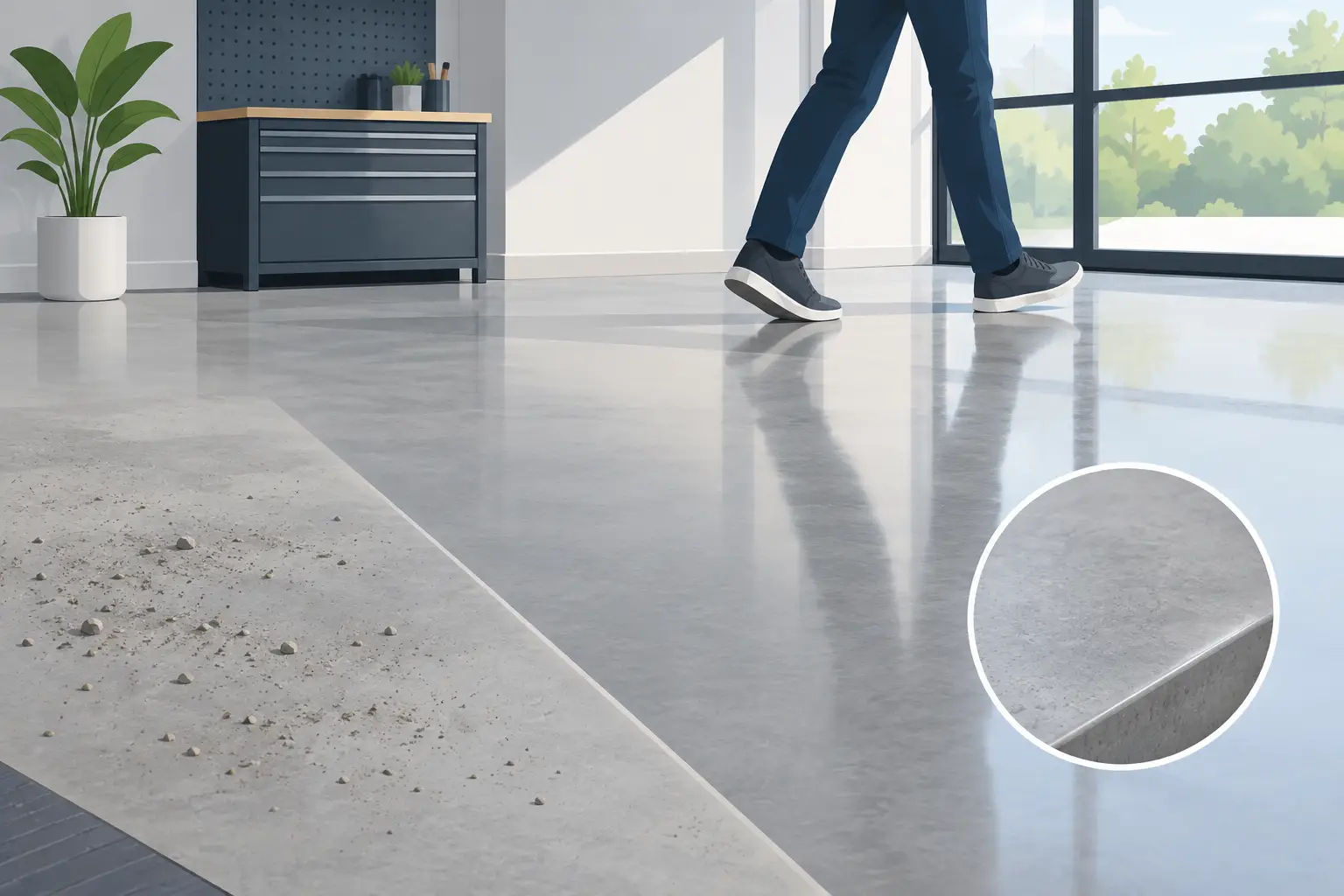
Concrete dust is not just a housekeeping problem. In a warehouse, it can settle on inventory, interfere with equipment, and create a poor impression for customers and inspectors. In a home or retail space, it can make an otherwise attractive concrete slab feel unfinished. Dust proof concrete floors address the source of the problem by strengthening and protecting the concrete surface itself.
For property owners and facility managers, the right solution can reduce daily cleaning, improve safety, and extend the useful life of an existing slab. But not every floor needs the same treatment. The condition of the concrete, moisture levels, traffic type, chemical exposure, and desired appearance all determine whether densification, polishing, a coating system, or a combination of methods is the right call.
Why Concrete Starts Producing Dust
Most concrete dust comes from a weak, porous surface layer. During placement and finishing, fine cement particles can rise toward the top of the slab. This weak layer, often called laitance, breaks down under foot traffic, forklifts, pallet jacks, carts, and routine sweeping. Older slabs may also dust because years of abrasion have worn away the stronger surface beneath.
The issue becomes more noticeable in industrial buildings, garages, storage rooms, manufacturing areas, and unfinished commercial spaces. A floor can look solid from a distance while releasing fine powder every time a tire turns or a box is dragged across it.
Moisture can make the problem worse. When vapor moves through a slab, it may weaken certain surface treatments or cause coatings to lose adhesion if the floor was not properly tested and prepared. That is why a dust-control project should begin with a real assessment, not a one-size-fits-all product application.
How Dust Proof Concrete Floors Are Created
A dust-proof floor is created by stabilizing the concrete surface and reducing its ability to shed particles. In many cases, that process starts with mechanical grinding. Diamond tooling removes weak laitance, old adhesive residue, failed coatings, stains, and inconsistent surface material until a sound concrete profile is exposed.
After preparation, a penetrating concrete densifier is often applied. Densifiers react with components in the concrete to form a harder, tighter surface. Rather than sitting on top like paint, a quality densifier works within the slab. This makes it especially valuable for facilities that want dust control without creating a film that can peel under traffic.
For a higher-performance and more refined result, the floor can then be honed and polished through progressively finer diamond grits. Polishing closes the surface further, improves reflectivity, and creates a finish that is easier to clean. The final gloss level can range from a practical low-sheen industrial finish to a high-gloss architectural surface for retail floors, offices, showrooms, lofts, and modern homes.
A penetrating guard may be used as the final protective step. Guards can help resist staining and simplify maintenance, particularly where spills, tire marks, or frequent cleaning are expected. The best system is not always the shiniest one. It is the one matched to the building’s daily demands.
Densified and Polished Concrete vs. Coatings
Densified polished concrete is an excellent option when the existing slab is in serviceable condition and the goal is a hard, long-lasting, low-maintenance surface. Because the finish is created through mechanical refinement rather than a thick topical layer, there is no coating film to delaminate in the traditional sense. It performs particularly well in warehouses, distribution areas, retail spaces, offices, garages, and residential interiors.
Coatings such as epoxy, urethane cement, polyaspartic, and resinous systems can also create dust-free floors. They are often the better choice when a facility needs a specific color, high chemical resistance, a more aggressive slip-resistant texture, or a seamless sanitary finish. Food-related operations, auto service areas, laboratories, commercial kitchens, and heavy chemical environments may benefit from a properly specified coating system.
The trade-off is that coatings demand more from surface preparation and moisture control. They can also require periodic renewal depending on traffic, impact, thermal movement, and chemical exposure. A polished concrete floor may show the natural variation of the slab, while a coating provides greater visual uniformity. Neither approach is automatically superior. The right choice depends on how the floor will be used and what failure risks matter most.
What a Professional Evaluation Should Cover
A contractor should look beyond surface dust before recommending a treatment. Hairline cracks, joint damage, old patches, oil contamination, moisture transmission, slab hardness, and flatness all affect the final result. A floor that has been repeatedly painted or coated may need extensive removal before it can be densified and polished correctly.
Traffic is equally important. Forklift lanes need a system that handles abrasion and turning pressure. Retail environments often need a balance of appearance, traction, and fast reopening. Offices and lofts may prioritize a clean, modern finish with minimal ongoing maintenance. In active facilities, project sequencing also matters. Work can frequently be divided into sections so operations continue with less disruption.
A proper evaluation should answer practical questions: Is the concrete structurally sound? Is moisture present at a level that affects treatment selection? Are chemical spills common? Does the floor need added texture for wet conditions? Is a light reflective finish desirable, or would a satin finish better conceal marks and daily wear?
Performance Benefits That Matter on the Job
When properly installed, dust-proof concrete delivers operational advantages that extend well beyond appearance. The floor becomes easier to maintain because cleaning removes surface debris instead of constantly collecting new concrete powder. This can reduce wear on cleaning equipment and keep dust from migrating into products, shelving, office areas, and mechanical systems.
Hardening the surface also improves abrasion resistance. While no floor is indestructible, densified and polished concrete holds up exceptionally well under routine foot traffic, carts, and many warehouse operations. It also reflects more available light at higher polish levels, which can improve visibility in large interior spaces.
Safety deserves careful attention. A dust-free floor reduces loose particulate that can be tracked across the building, but gloss alone does not define slip resistance. Surface profile, contaminants, cleaning methods, footwear, and whether the floor gets wet all play a role. In wet-prone areas, a lower sheen, traction additive, or a coating system designed for slip resistance may be the better specification.
Maintenance Keeps the Floor Performing
A dust-proof floor is low maintenance, not no maintenance. Dry dust mopping with clean pads removes abrasive grit before it can act like sandpaper. Wet cleaning should use a neutral cleaner appropriate for the selected system. Harsh acidic products, strong degreasers, and dirty mop water can leave films or gradually reduce the clarity of a polished surface.
Spills should be addressed promptly, especially oils, solvents, acidic liquids, and chemicals. Entry mats also help reduce the amount of grit carried in from outdoors. In warehouses, keeping forklift tires clean and repairing damaged joints before they worsen protects both the floor and vehicle traffic.
Over time, high-traffic paths may benefit from a maintenance polish or reapplication of a guard. This is typically far less disruptive and less expensive than allowing the slab to deteriorate until a major restoration is required.
When Existing Concrete Can Be Saved
Many dusty slabs can be restored without demolition. Even floors with old paint, surface wear, light spalling, or uneven appearance may be candidates for grinding, crack and joint repair, densification, and polishing. The key is recognizing when the concrete has enough integrity to support the intended finish.
Severely deteriorated slabs, extensive moisture damage, major settlement, or deep contamination may require more involved repairs or a topping before a final finish is installed. An experienced contractor will be direct about those limits. Promising a polished result over failing concrete is not a solution – it is simply postponing the problem.
For commercial and residential properties throughout Los Angeles and Orange County, Los Angeles Concrete Polishing evaluates the slab, traffic demands, and schedule before recommending a dust-control system. The goal is a floor that looks professional on day one and continues performing when the building is busy.
A dusty concrete floor rarely improves on its own. Address it while the slab can still be strengthened, and the result can be a cleaner, safer surface that works as hard as the rest of your property.
Clients We Service
We provide our concrete polishing and related services to a wide variety of clients. Some of the types of clients that we provide service to include:


