
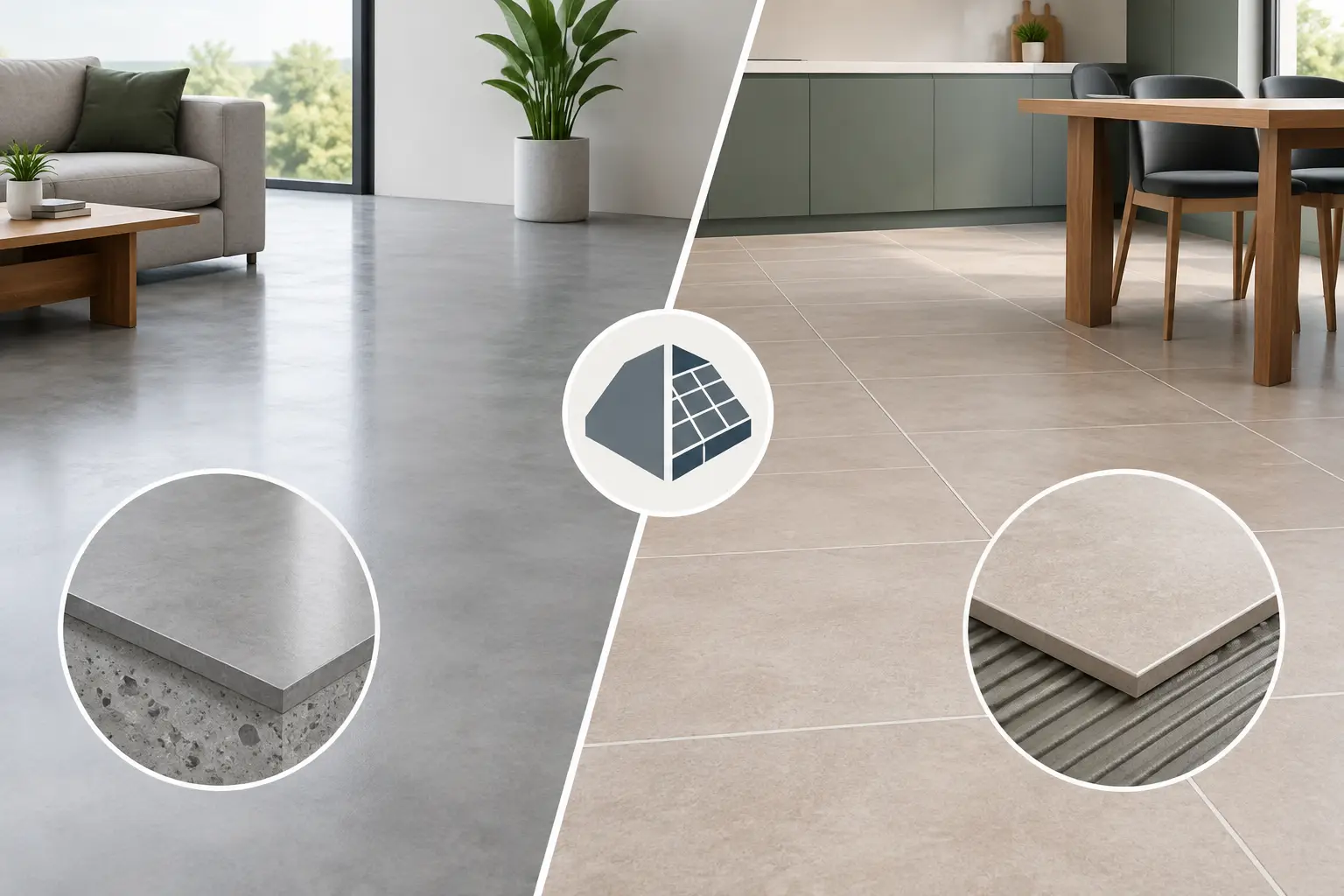
A warehouse aisle with forklift traffic has different flooring needs than a residential kitchen, but the same question often comes up during a renovation: concrete overlays versus tile. Both can change the look of a worn slab, deliver a finished surface, and fit a range of design styles. The stronger choice depends on what happens on that floor every day – traffic, moisture, impacts, cleaning routines, and the cost of taking the space offline.
For Los Angeles commercial properties, where fast project delivery and long-term operating costs matter, flooring should be evaluated as a working surface rather than a finish sample. A floor that looks right on day one but chips, loosens, stains, or demands constant repair can quickly become the more expensive option.
Concrete Overlays Versus Tile for Daily Performance
A concrete overlay is a cementitious topping installed over an existing prepared concrete slab. Depending on the system, it may be polished, stained, dyed, sealed, textured, or protected with a high-performance coating. It can correct cosmetic wear, cover minor surface imperfections, and provide a new finish without removing and replacing the entire slab.
Tile is a separate finish material installed over a prepared substrate using thinset or mortar, followed by grout at the joints. Porcelain, ceramic, quarry tile, and natural stone all have different strengths, but every tile floor relies on the condition of the substrate, the bond beneath the tile, and the integrity of its grout joints.
The difference is fundamental. An overlay creates a continuous surface that becomes part of the floor assembly. Tile creates a grid of individual pieces and joints. In high-traffic settings, that distinction affects maintenance, sanitation, appearance, and repair planning.
Durability Under Traffic and Impact
Tile can perform well in bathrooms, break rooms, entryways, and residential spaces with moderate traffic. Quality porcelain is hard, water-resistant, and available in an enormous range of colors and patterns. However, tile can crack when the slab below it moves, settles, or develops cracks. Dropped tools, rolling loads, pallet jacks, and concentrated impacts can also chip individual pieces.
A properly specified concrete overlay is often the better fit for offices, retail floors, warehouses, showrooms, lofts, and other spaces where continuous traffic is expected. The overlay system must be selected for the use case, not simply for appearance. High-build toppings and polished overlay systems can handle demanding foot traffic, while industrial areas may require additional protection against abrasion, chemicals, or heavy equipment.
No flooring system is immune to a failing slab. If there is active movement, hydrostatic pressure, or significant structural cracking, those conditions must be addressed before either tile or an overlay is installed. The best installers investigate moisture and substrate conditions first. Covering up a slab problem is not a flooring solution.
Moisture Is Often the Deciding Factor
Southern California properties are not exempt from moisture problems. Ground moisture can move through concrete slabs, especially in older buildings, ground-level spaces, and facilities with inconsistent vapor protection. That moisture can weaken adhesives, affect grout, create efflorescence, or cause tile to release over time.
Concrete overlays also require moisture evaluation. Some systems tolerate more vapor transmission than others, and many projects need a moisture-mitigation primer or specialized preparation process before installation. The advantage is that an experienced concrete flooring contractor can build the system around actual slab conditions rather than relying on standard tile-setting methods.
For wet locations, surface texture matters as much as water resistance. A glossy polished surface may be ideal for a lobby or retail showroom, while a commercial kitchen, pool-adjacent area, or exterior walkway may need a more slip-conscious texture and protective sealer. Tile is not automatically safer simply because it has grout lines, and polished concrete is not automatically slippery. Finish selection, cleaning practices, drainage, and contamination all matter.
Maintenance: Continuous Surface vs. Grout Joints
Maintenance is where many property owners see the operational difference between concrete overlays and tile. Tile faces are generally easy to wipe clean, but grout is porous unless properly sealed and maintained. Over time, grout can discolor, trap debris, absorb spills, and become the first visible sign of a tired floor. In food service, healthcare-adjacent spaces, restrooms, and heavily used break rooms, grout maintenance can become a recurring labor cost.
A sealed or polished concrete overlay has no grout grid. That makes daily sweeping, dust mopping, and routine machine cleaning more efficient across large areas. With the right densifier, guard, or protective coating, concrete flooring can also resist common stains and simplify ongoing care.
That does not mean overlays are maintenance-free. Abrasive dirt should be removed promptly, cleaning chemicals must match the floor system, and protective coatings may eventually need renewal. Still, for a large facility, maintaining one continuous surface is usually more predictable than repairing scattered tile and grout failures.
Repairs and Long-Term Appearance
Tile has one clear advantage: a damaged individual tile can sometimes be replaced without touching the rest of the floor. This works best when matching replacement material is available and surrounding tiles have not shifted. Years after installation, finding the same dye lot, texture, and size can be difficult.
Overlay repairs are more integrated but can require a skilled hand to blend. Small cracks, chips, or localized damage may be patched and refinished, yet a decorative stain pattern or high-gloss polished finish may need wider blending to make the repair less visible. For this reason, overlay systems should be specified with realistic expectations about the environment. A busy industrial floor should prioritize performance over a flawless, furniture-showroom appearance.
Cost and Downtime Are More Than Installation Price
Tile materials can range from economical ceramic to premium porcelain and natural stone. Labor costs rise with demolition, substrate leveling, layout complexity, edge details, and grout work. Tile can be a smart value in compact spaces with simple geometry, especially when the existing substrate is sound and the design calls for a distinct pattern.
Concrete overlays vary in cost based on slab repair, thickness, moisture control, finish level, coloring, polishing stages, and protective treatments. A basic functional topping is not priced like a decorative polished overlay. The right comparison is not tile price per square foot versus overlay price per square foot alone. Compare the full cost of preparation, expected maintenance, repair exposure, replacement cycle, and business interruption.
Downtime should carry real weight for retail stores, warehouses, offices, and occupied residential buildings. Removing old tile creates demolition debris and noise. New tile installation requires setting, grouting, and cure time. Overlay installation also requires mechanical surface preparation, often including diamond grinding, but it can eliminate some removal and disposal work when the existing slab is usable.
A professional site review should map the work around operations. Phased installation, off-hours scheduling, dust-control measures, and clearly planned cure periods can keep a project moving without unnecessarily shutting down the property.
When Tile Is the Better Choice
Tile remains a strong option when visual pattern is the priority, when a small room needs a practical water-resistant finish, or when a property requires a material that coordinates with existing tile installations. Bathrooms, backsplashes, residential laundry rooms, and compact hospitality spaces may benefit from tile’s broad design selection.
Choose tile carefully in high-load areas. Verify the tile’s rating, use appropriate movement joints, and do not treat grout as an afterthought. A low-cost tile installation on an unprepared slab is rarely a bargain.
When a Concrete Overlay Is the Better Choice
Concrete overlays are usually the more strategic choice when a property needs a durable, continuous floor with lower joint maintenance and a modern architectural finish. They are especially effective for retail spaces, offices, lofts, showrooms, warehouses, and commercial interiors where the existing concrete slab can be properly prepared.
The strongest overlay projects begin with substrate testing, crack assessment, moisture control, and a finish recommendation based on real use. Los Angeles Concrete Polishing uses professional diamond-grinding preparation and system-specific installation methods because the floor below the finish determines whether the finished surface performs.
Before choosing a material, walk the space as your staff, customers, tenants, or equipment will use it. The right floor is the one that still looks professional after the daily traffic, spills, cleaning, and impacts that your operation cannot avoid.
Clients We Service
We provide our concrete polishing and related services to a wide variety of clients. Some of the types of clients that we provide service to include:


