
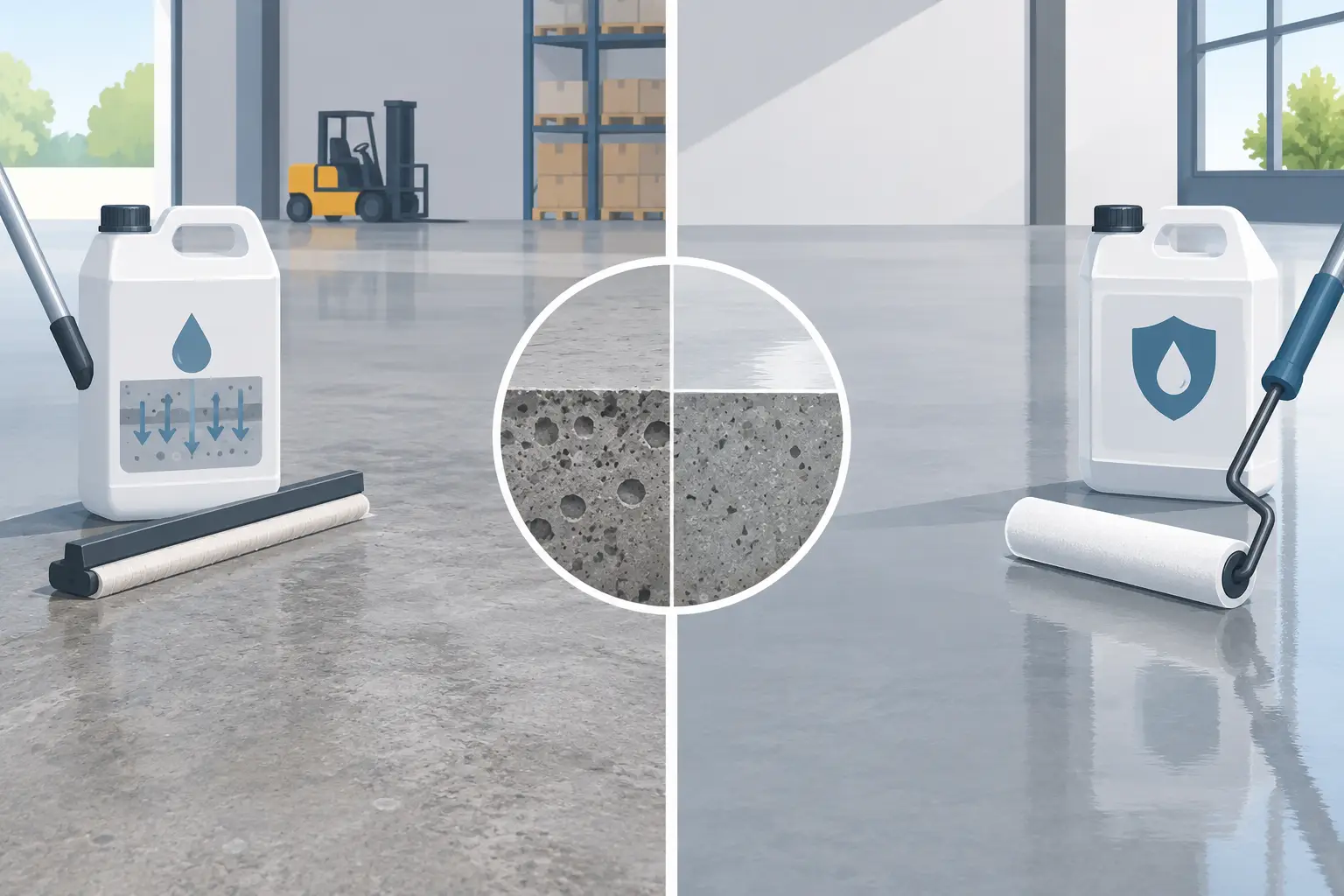
A warehouse floor can look clean on opening day and begin dusting, staining, or showing tire traffic within months if the protection system does not match the slab. The concrete densifier vs sealer decision is not simply a choice between two cans of product. It determines whether the floor is strengthened from within, protected by a surface film, or prepared for a polished finish that can stand up to daily use.
For Los Angeles commercial properties, the right answer depends on the concrete itself, the level of traffic, moisture conditions, cleaning practices, and the finish expected by tenants, employees, or customers. A densifier and a sealer can both improve a concrete floor, but they do fundamentally different jobs.
What a Concrete Densifier Does
A concrete densifier is a liquid hardener that penetrates into the concrete. Most professional-grade densifiers use silicate chemistry – commonly lithium, sodium, or potassium silicate – to react with available lime in the slab. That reaction creates additional mineral structure in the concrete pores, helping the surface become harder, tighter, and less prone to dusting.
Densifier is a core part of a true polished concrete process. After mechanical grinding exposes a clean, sound surface, densifier is applied at the proper stage and allowed to react before the floor is refined with progressively finer diamond tooling. The result is not a coating sitting on top of the slab. It is a hardened concrete surface with increasing clarity and reflectivity as polishing continues.
This matters in facilities with forklift traffic, pallet jacks, rolling carts, and constant foot traffic. A properly prepared and densified polished floor can resist abrasion far better than untreated concrete while remaining easy to maintain. Because there is no thick film to peel or flake, it is especially practical for warehouses, manufacturing areas, showrooms, offices, and modern residential interiors.
A densifier does have limits. It is not a complete stain-proofing system, and it does not create a waterproof membrane. Oils, acids, wine, chemicals, and standing water can still affect concrete, particularly if spills are left in place. Densifier makes the slab denser and more durable, but it does not turn porous concrete into an impermeable surface.
What a Concrete Sealer Does
A concrete sealer is designed primarily to protect the surface from liquids, contaminants, abrasion, and, depending on the product, UV exposure. Rather than chemically hardening the slab in the same way as a densifier, many sealers either form a protective film or penetrate the surface to reduce liquid absorption.
Film-forming sealers include acrylics, epoxies, urethanes, and polyaspartics. These systems can add color enhancement, gloss, chemical resistance, and a more noticeable protective layer. They are often the right choice when the floor needs a specific decorative appearance or when exposure to oils, chemicals, and frequent spills exceeds what bare polished concrete can reasonably handle.
Penetrating sealers, such as silane or siloxane systems, work differently. They soak into the concrete and help repel water and certain contaminants without creating a visible film. They are generally used where maintaining a natural, low-sheen appearance is more important than achieving a glossy decorative finish.
The trade-off is maintenance and eventual renewal. A coating or film-forming sealer can scratch, wear in traffic lanes, discolor, or delaminate if the substrate has moisture vapor issues or was not prepared correctly. A sealer is only as reliable as the concrete preparation beneath it. Grinding, crack repair, moisture testing, and profile selection are not optional details when a floor is expected to perform.
Concrete Densifier vs Sealer: The Key Differences
The clearest difference is where the protection lives. A densifier changes the near-surface structure of the concrete. A film-forming sealer places a protective barrier on top of it. One strengthens the slab itself; the other shields the slab from exposure.
That distinction affects appearance. Densified and mechanically polished concrete has a clean, refined look that comes from diamond polishing rather than a topical coating. Its gloss can range from a practical satin finish to a high-reflective shine. A sealer can also create sheen, but the visual effect comes from the product film and may change as that film wears.
It also affects repair strategy. If a polished, densified floor receives localized wear, scratches, or dull traffic paths, a professional can often re-polish and refine the affected area. With a coated floor, repairs may require recoating a larger section to prevent a visible patch or variation in gloss.
Neither option is automatically superior. A densifier is the better foundation for polished concrete and long-term abrasion resistance. A high-performance sealer or coating is often the stronger choice for aggressive chemical exposure, food and beverage spills, auto fluids, or areas that need a colored, broadcast, or highly decorative finish.
When Densifier Is the Better Choice
Choose densifier when the goal is to improve the concrete you already have rather than cover it. It is particularly effective for sound slabs that are dusty, soft at the surface, or being converted into polished concrete. Industrial facilities that want a durable, low-maintenance floor without recurring coating failure often benefit from this approach.
Densifier is also a smart fit where downtime must be controlled. Diamond grinding and polishing can be phased by room, aisle, or work zone, allowing many businesses to remain operational during the project. The exact schedule depends on access, slab condition, and finish level, but mechanical polishing typically avoids the lengthy cure cycles associated with some coating systems.
For offices, retail spaces, lofts, and high-end residential interiors, densified polished concrete offers a modern finish without adding a layer that can yellow or peel. It works best when the client appreciates the natural character of concrete, including subtle aggregate exposure, variation, patching, and existing slab movement. Polished concrete is refined, not artificial.
When Sealer Is the Better Choice
Sealer is usually the better route when contamination resistance is the priority. A commercial kitchen-adjacent space, automotive service area, laboratory, or production facility may need a system designed for specific chemicals and cleaning agents. In these settings, the right coating specification can protect the slab and simplify sanitation.
It is also the right choice when color is required. Epoxy, urethane, and polyaspartic systems can deliver solid colors, decorative flakes, quartz, and other design effects that densified concrete cannot provide. These systems can be built for slip resistance as well, although texture must be selected carefully. More texture can improve traction but may make cleaning more demanding.
Moisture deserves special attention. A sealer should never be selected solely because a floor appears dry. Concrete can emit moisture vapor long after installation, and pressure from below can cause certain coatings to blister or lose adhesion. Professional moisture evaluation helps determine whether the slab needs mitigation, a breathable system, or a different flooring strategy altogether.
Can You Use Both?
Yes, but the sequence and product compatibility matter. In polished concrete work, a densifier may be used during the grinding and polishing stages, followed by a stain guard or penetrating protector after the final polish. That combination preserves the natural polished appearance while adding practical resistance to spills and routine soiling.
A densifier can also be used before some coatings when the system manufacturer allows it, but this is not a universal rule. Certain densifiers may interfere with coating adhesion if applied at the wrong time or left improperly cleaned. A qualified contractor should specify the complete system rather than treating densifier and sealer as interchangeable add-ons.
Choosing for Your Property
Start with how the floor will be used, not with the shine level you saw in a photo. A distribution center has different demands than a boutique showroom. A residential garage has different exposure than a downtown office lobby. Consider traffic, spill risk, cleaning chemicals, moisture conditions, desired color, acceptable maintenance, and how much downtime the property can tolerate.
For a hard-working floor that needs lasting visual improvement, the strongest decision is usually made after inspecting the slab. Los Angeles Concrete Polishing evaluates surface condition, previous coatings, cracks, moisture, and operational needs before recommending polishing, densification, sealing, or a complete protective system.
A floor should not force you to choose between appearance and performance. Specify the protection around the way the space actually operates, then give the concrete the preparation it needs to earn its finish every day.
Clients We Service
We provide our concrete polishing and related services to a wide variety of clients. Some of the types of clients that we provide service to include:


