
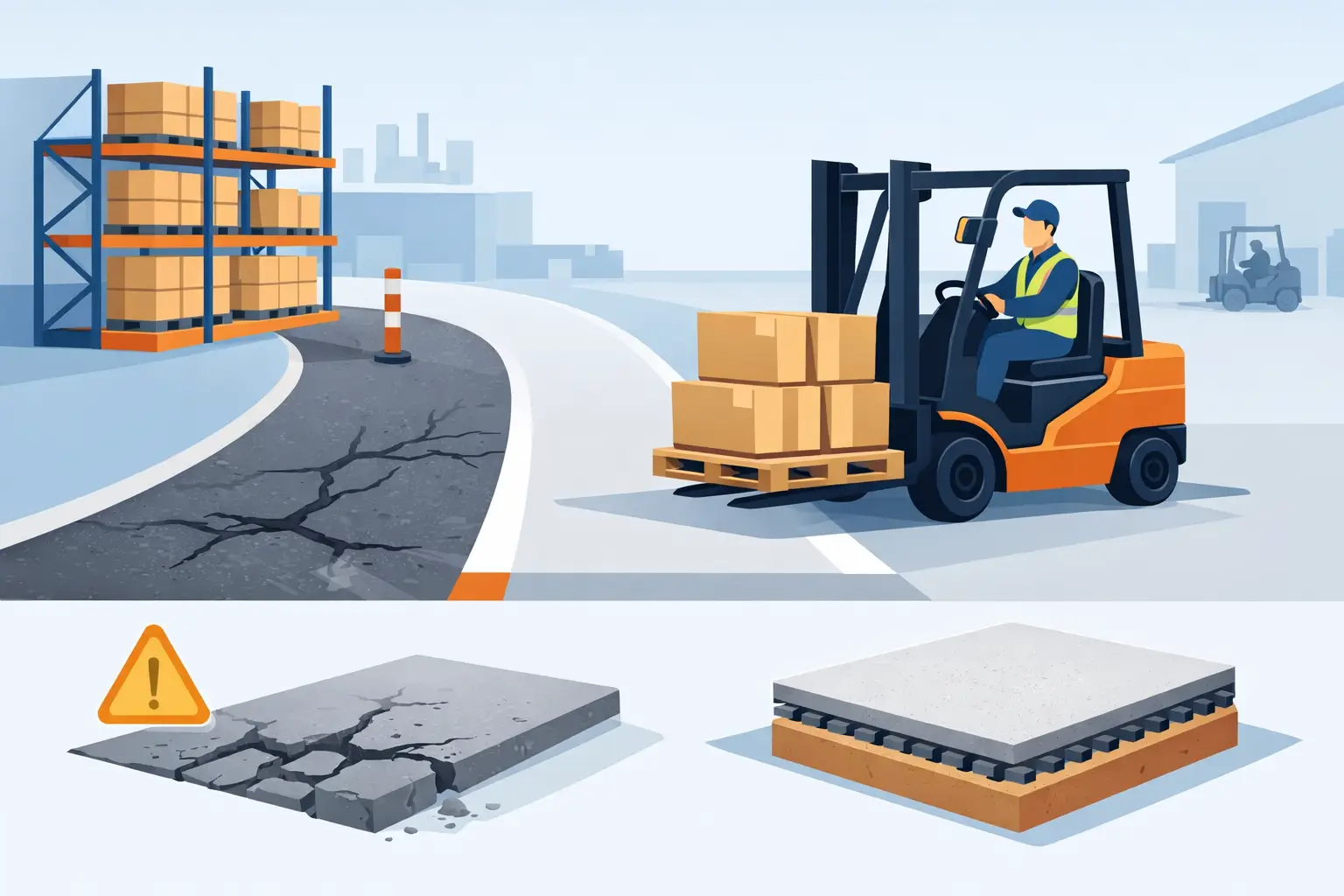
A forklift does not wear a floor evenly. Its turning tires grind at loading bays, its concentrated wheel loads stress slab joints, and a single damaged patch can quickly become a dust, trip, and maintenance problem. Effective forklift traffic floor solutions are built around the actual traffic pattern, slab condition, moisture exposure, and operational demands of the facility – not a one-size-fits-all finish.
For warehouses, distribution centers, manufacturing plants, and retail back rooms across Los Angeles and Orange County, the right concrete system reduces repairs, supports safer movement, and keeps the building looking professional under daily use. The strongest choice is not always the thickest coating or the highest gloss. It is the system that prepares the existing concrete correctly and holds up where forklifts work hardest.
Why Forklift Traffic Damages Concrete Floors
Forklifts place repetitive, concentrated force on relatively small contact points. Solid tires can be especially demanding because they transfer more vibration and pressure into the slab than pneumatic tires. Add loaded pallets, sharp turns, braking, and frequent travel through the same aisle, and even sound concrete can begin to show wear.
The first signs are often surface dusting, tire marks, spalling at joints, small divots, and worn traffic lanes. In more advanced cases, the floor develops cracks, delamination, curled slab edges, or coating failure. These issues do more than affect appearance. Loose concrete can damage wheels, create unstable travel paths, contaminate inventory, and increase cleanup time.
Forklift traffic also exposes weaknesses that existed before the equipment arrived. A slab with excess moisture, weak surface paste, improper joint repairs, or old coating residue will not perform well simply because a new finish has been applied over it. Surface preparation and moisture control determine whether a floor system lasts or becomes another recurring expense.
Forklift Traffic Floor Solutions Start With the Slab
Before selecting a finish, a qualified flooring contractor should evaluate the concrete itself. The age of the slab matters, but its present condition matters more. A newer slab can still have moisture issues or a weak surface, while an older slab may be an excellent candidate for restoration and polishing.
The evaluation should identify active cracks, failed joints, hollow or delaminated areas, oil contamination, previous coatings, and areas where water enters the building. It should also map forklift routes, battery charging stations, loading doors, staging areas, and tight turning zones. Those high-stress locations often need different treatment than open storage areas.
Moisture testing is particularly critical in Southern California facilities with slabs on grade. Vapor moving through concrete can push coatings loose from below, leaving blisters, peeling, or soft spots. When moisture is present, the correct response may include a vapor-mitigating primer, a breathable densified concrete finish, drainage corrections, or a different flooring system altogether.
Polished and Densified Concrete for High-Use Facilities
For many warehouses, polished concrete is one of the most cost-effective long-term forklift floor solutions. The process uses industrial diamond grinding to remove weak surface material, flatten irregularities, and refine the concrete. A liquid densifier then reacts within the slab to harden the surface and reduce dusting.
A polished or mechanically refined concrete floor is not a film sitting on top of the slab. That distinction matters under forklift tires. Because there is no thick surface layer to delaminate, the floor can offer dependable performance in dry, high-traffic environments when it is properly prepared and maintained.
Polished concrete also improves light reflectivity, which can make warehouse aisles, production areas, and showroom spaces brighter without changing the building’s lighting plan. It is easy to clean, resists tire marking better than untreated concrete, and provides a professional finish that works in industrial as well as customer-facing spaces.
The trade-off is that polished concrete is not the best answer for every condition. It does not eliminate structural cracking, and it may not provide the chemical protection required around aggressive acids, solvents, or process chemicals. A facility with significant chemical exposure or constant standing water may need a specialized resinous system instead.
The Right Gloss Level Is an Operational Decision
A high-gloss floor can be visually impressive, but forklift facilities do not always need the highest available sheen. A matte or satin refined finish can still be dense, cleanable, and attractive while making routine dust and tire residue less noticeable. The proper gloss level should reflect the building’s lighting, appearance goals, maintenance schedule, and traffic volume.
Slip resistance should also be considered based on real conditions. A dry warehouse aisle has different needs than a loading zone that sees rainwater, condensation, or tracked-in debris. Texture, cleaning procedures, and drainage all affect floor safety.
Resinous Coatings Where Protection Is the Priority
Epoxy, urethane, urea, and other resinous coatings can be excellent options when the floor needs a protective barrier against chemicals, oils, abrasion, and stains. These systems are often used in manufacturing areas, automotive facilities, commercial kitchens, equipment rooms, and loading areas with frequent spills.
The key is specifying the coating thickness and chemistry for the job. A thin decorative coating may look clean at installation but wear through quickly in a hard-turning forklift lane. A properly engineered industrial system can include a moisture-control primer, a heavy-build base coat, broadcast aggregate for traction, and a chemical-resistant topcoat.
Coatings bring trade-offs. They require exceptional surface preparation, including diamond grinding or shot blasting to create a reliable bond profile. They also need realistic cure-time planning. Some fast-cure systems can reduce downtime, while others require a longer installation window before forklifts can return to service.
Color can be a major advantage. Resinous floors can define pedestrian walkways, staging zones, safety boundaries, and work cells directly on the floor. In busy facilities, visual organization can support safer traffic flow and reduce the need for temporary markings that peel or fade.
Repair Joints and Spalls Before They Spread
Joint failure is one of the most common forklift-floor problems, especially where traffic repeatedly crosses slab transitions. The edges can chip away, leaving rough gaps that jolt equipment and worsen with every pass. Ignoring failed joints rarely saves money. It usually turns a targeted repair into a larger slab restoration project.
Professional repairs begin by removing weak concrete and creating clean, sound edges. High-strength repair materials are then installed and finished flush with the surrounding floor. In heavy forklift lanes, semi-rigid joint fillers can help support joint edges while still allowing the slab to move as intended.
Cracks need a more careful assessment. Some are dormant cosmetic cracks that can be filled and blended into a polished floor. Others indicate movement, settlement, or ongoing stress. A reliable contractor distinguishes between the two before recommending a rigid repair or coating system that could crack again.
Design the Floor Around Traffic, Not Just Square Footage
Two buildings with the same square footage can need very different floor systems. A warehouse storing lightweight packaged goods may have constant forklift traffic but limited point loading. A fabrication shop may have fewer trips but heavier equipment, metal debris, oils, and high-impact activity. The best specification follows the use case.
Pay close attention to turning areas. Forklift tires scrub the surface during tight turns, especially near rack ends, docks, and battery stations. These zones may need additional preparation, a more abrasion-resistant topcoat, or planned repairs before the finish is installed. Main travel lanes deserve the same scrutiny because minor surface wear becomes highly visible when repeated over thousands of daily passes.
Operational planning matters as much as material selection. The most effective projects are phased so that receiving, storage, and production can continue where possible. Clear work-zone boundaries, cure schedules, and communication with warehouse staff help minimize disruption without rushing critical preparation steps.
Maintenance That Protects the Investment
Even the highest-quality forklift floor needs a practical maintenance plan. Dust and abrasive grit act like sandpaper beneath tires, so regular sweeping or auto-scrubbing is not cosmetic housekeeping. It directly protects the finished surface.
Use cleaning products suited to the installed system. Harsh degreasers may dull polished concrete or weaken certain coating finishes over time. Address chemical spills promptly, keep loading doors and drains functioning, and inspect joints before small edge failures spread. Tire condition matters as well: damaged wheels and embedded debris can leave marks or accelerate wear.
Los Angeles Concrete Polishing approaches industrial flooring as a performance system, combining diamond preparation, concrete repair, moisture evaluation, and finish selection based on how the facility actually operates. That approach protects both the slab and the business relying on it.
A floor should make forklift operations easier, not become another item on the maintenance backlog. When traffic patterns, moisture conditions, repairs, and finish requirements are addressed before installation, the result is a cleaner, safer surface built to keep working shift after shift.
Clients We Service
We provide our concrete polishing and related services to a wide variety of clients. Some of the types of clients that we provide service to include:


