
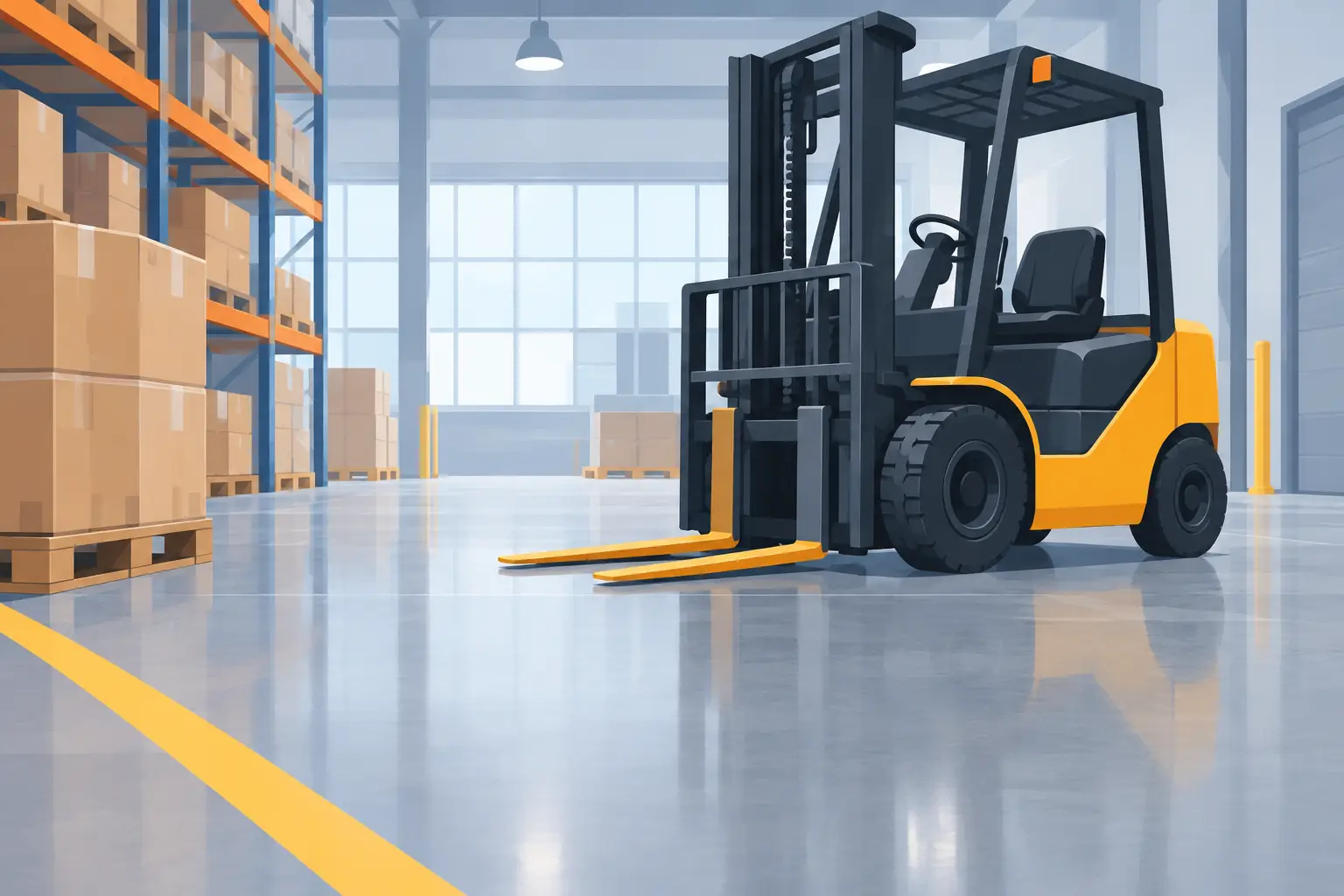
A warehouse floor can look acceptable on opening day and still become an expensive liability within a year. Forklift turns grind down weak surfaces, dropped inventory chips coatings, moisture pushes finishes loose, and dust from deteriorating concrete spreads through the facility. The right industrial flooring is not simply a finish. It is a working surface engineered around traffic, cleaning practices, safety expectations, and the cost of downtime.
For Southern California property owners and facility managers, polished concrete is often one of the strongest long-term answers. It improves an existing slab rather than covering it with a system that may eventually peel, delaminate, or require frequent replacement. But it is not the right answer for every environment. The best floor begins with an honest assessment of what the space demands.
What Industrial Flooring Must Handle
Industrial facilities put flooring under conditions that decorative surfaces rarely face. A distribution center may receive constant pallet-jack and forklift traffic. A manufacturing area may face oils, coolants, chemicals, and heavy equipment. Retail stockrooms, commercial kitchens, auto facilities, and loading zones each introduce their own forms of abrasion, impact, and contamination.
That is why material selection should never start with color alone. A floor must perform under the actual daily load, not the lightest use anticipated during the sales process. The questions that matter are practical: What moves across the floor? How often is it cleaned? Are chemicals present? Does the slab have moisture issues? Can the operation tolerate closures for installation or repairs?
A high-performing surface also needs to support safety. Slip resistance depends on more than whether a floor has a glossy appearance. Surface profile, contaminants, water exposure, cleaning products, drainage, and footwear all affect traction. The right finish balances cleanability and appearance with the conditions employees and visitors face every day.
Why Polished Concrete Performs in Industrial Settings
Polished concrete transforms the concrete slab itself through mechanical grinding, densification, and diamond polishing. The process removes weak surface material, refines the slab, and hardens it with a penetrating densifier. Depending on the selected level of refinement, the finished floor can range from a low-sheen, practical surface to a high-gloss architectural finish.
For many warehouses, offices, retail spaces, and light-manufacturing facilities, this approach offers a significant advantage: there is no thick topical layer to separate from the concrete under heavy traffic. A properly prepared and polished slab resists dusting, handles abrasion well, and is straightforward to maintain with routine sweeping and appropriate auto-scrubbing.
Polished concrete also reflects available light. In large facilities, that can make aisles, work areas, and showrooms feel brighter without adding another flooring material. It is a useful operational benefit, especially in spaces where visibility, housekeeping, and a professional appearance affect the customer or employee experience.
The trade-off is that polishing works with the slab that already exists. Cracks, old patchwork, aggregate exposure, and variations in concrete placement may remain visible or become more pronounced after grinding. For clients who need a perfectly uniform color or a fully concealed surface, a high-build coating or cementitious topping may be the better system.
The Value of Mechanical Preparation
Industrial floor performance is won or lost before the final finish is applied. Grinding removes failed coatings, adhesives, contaminants, weak concrete, and uneven surface areas. It creates the profile needed for coatings and toppings, while polished-concrete work progresses through a controlled series of diamond grits.
Skipping proper preparation is one of the most common reasons floors fail early. A coating can look excellent immediately after installation, yet peel under forklift traffic if the slab was not mechanically profiled or if moisture vapor was ignored. Experienced contractors assess the concrete first, then build the flooring system around its actual condition.
Choosing the Right Industrial Flooring System
No single system is the automatic best choice. The right recommendation depends on use, budget, timeline, and the state of the concrete.
Polished concrete is an excellent fit for warehouses, retail stores, offices, lofts, showrooms, and many commercial spaces seeking a durable, low-maintenance surface with a refined appearance. It is particularly attractive when the existing slab is structurally sound and the owner wants to avoid recurring coating replacement cycles.
Epoxy and urethane coatings can be a better fit where chemical exposure, color coding, sanitation requirements, or a distinct nonporous surface are priorities. These systems can create bright, uniform finishes and can be designed for particular operational needs. However, they require serious surface preparation, moisture testing, and attention to cure time. They also may need repair or renewal in high-impact traffic paths.
Cementitious toppings and overlays are valuable when a slab is badly worn, uneven, or visually inconsistent. They provide a new surface that can be polished, stained, or protected with a coating. This option adds cost and installation time, but it can save a floor that is not a strong candidate for direct polishing.
Concrete sealing and protective enhancement can serve facilities that need practical dust control and improved stain resistance without the expense of a fully polished finish. This is often a smart middle ground for utility spaces, back-of-house areas, and properties preparing for lease turnover.
Moisture Control Cannot Be an Afterthought
Moisture vapor moving through concrete is a major concern in industrial flooring, particularly for topical coatings. Even a slab that appears dry can transmit enough vapor to interfere with adhesion. The result may be bubbling, whitening, blistering, or complete delamination.
A professional evaluation should include moisture-related testing and a review of the slab’s age, condition, previous coatings, drainage, and surrounding environment. If elevated moisture is present, the project may require a moisture-mitigation system or a flooring approach that is more tolerant of vapor transmission.
Polished concrete can be advantageous because it does not rely on a thick, impermeable film at the surface. Still, moisture matters for every project. It can affect repairs, joint conditions, coatings, and the long-term behavior of the concrete itself. Addressing it early protects the budget and prevents surprise delays once work begins.
Plan Around Downtime, Not Just Installation Cost
The least expensive initial quote is not always the lowest-cost floor. Facility managers should account for closure time, moving equipment, lost production, disruption to tenants, maintenance labor, and the expected service life of the system.
A floor that requires frequent patching or recoating may create repeated interruptions in busy traffic lanes. By comparison, a mechanically polished floor often has a higher upfront investment than basic sealing but can reduce long-term maintenance demands. The right choice depends on how hard the area works and how costly it is to take that area out of service.
Phased scheduling can reduce operational disruption. Large warehouses and active commercial properties can often be completed in sections, keeping access routes, storage areas, or customer-facing zones available whenever possible. Clear project planning should identify curing periods, equipment staging, dust-control procedures, and any areas that must remain operational.
Details That Protect Long-Term Performance
Even the best flooring material needs realistic maintenance. Dirt and grit act like sandpaper under wheels and shoes, so frequent dry debris removal is essential. Spills should be addressed promptly, especially oils, acids, solvents, and harsh cleaning chemicals. Use cleaning products suited to the selected floor system rather than assuming one degreaser works for every surface.
Joints and cracks also deserve attention. Some cracking is normal in concrete and may be part of the floor’s character, particularly in polished slabs. Active movement, wide cracks, damaged joints, and spalling should be evaluated before finishing work begins. Repair methods must match the type of movement and the traffic the area will receive.
For Los Angeles and Orange County facilities, a contractor with real local experience can make a meaningful difference. Slab conditions vary widely across older industrial buildings, converted retail spaces, new construction, and high-traffic commercial properties. The strongest recommendations come from evaluating the site, not from applying the same finish to every floor.
A floor should make daily operations easier, not add another recurring problem to the maintenance schedule. Start with the traffic, moisture, safety, and appearance demands of the space, then select an industrial flooring system built to meet them year after year.
Clients We Service
We provide our concrete polishing and related services to a wide variety of clients. Some of the types of clients that we provide service to include:


