
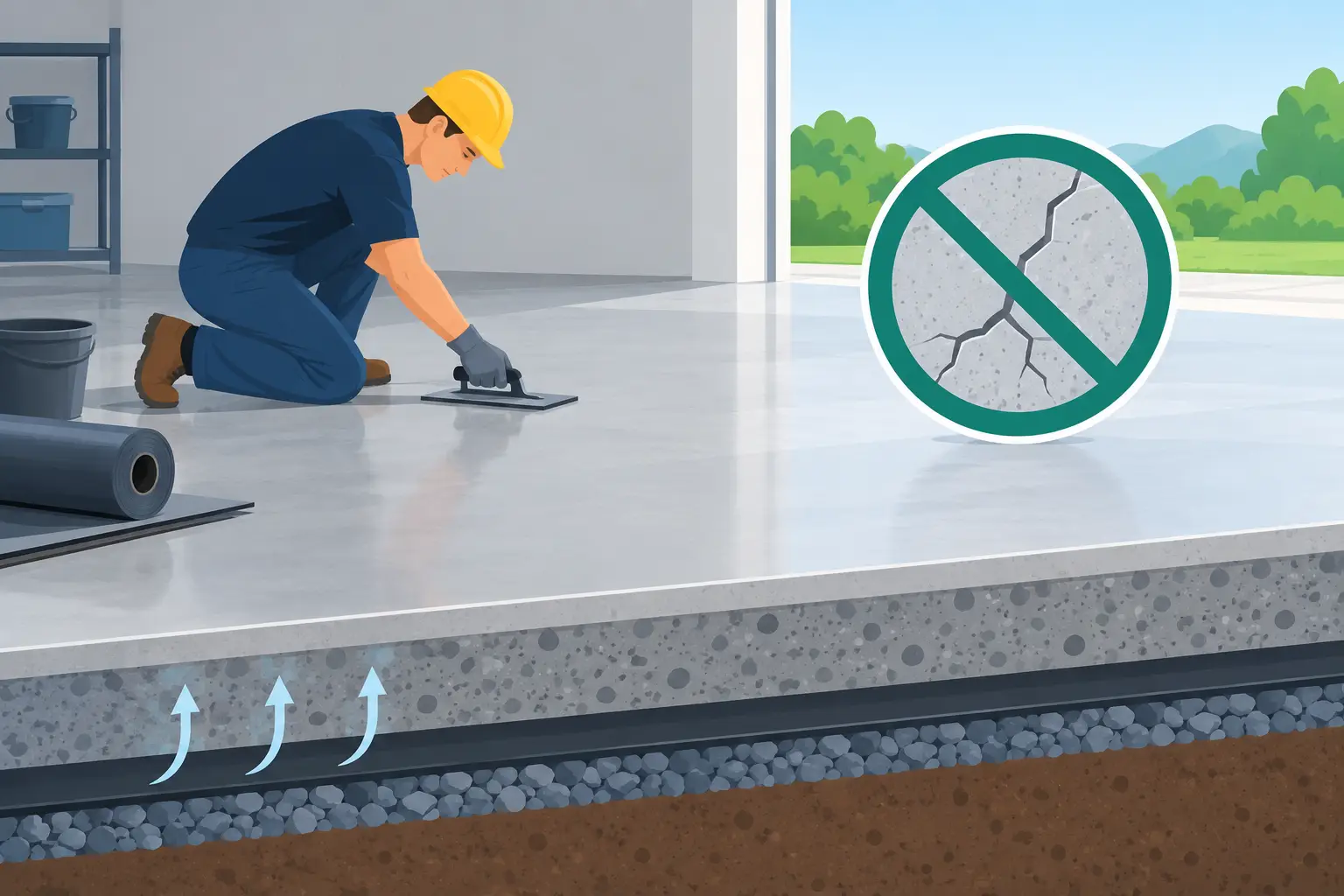
A warehouse slab can look perfect on Friday and show a new hairline crack by Monday. In many cases, the concrete was not “bad” – it was placed, cured, jointed, or exposed to moisture without a plan for how the floor would move. To prevent concrete floor cracking, property owners need to address the entire system below, within, and above the slab, not simply patch visible damage after it appears.
Concrete naturally shrinks as it cures, expands and contracts with temperature changes, and responds to loads, moisture, and soil movement. The goal is not to promise a crack-free slab under every condition. The goal is to control where cracking occurs, reduce the forces that cause it, and protect the finished floor from premature failure.
Why Concrete Floors Crack in the First Place
Most floor cracks trace back to one or more predictable conditions. Drying shrinkage is a major cause. As water leaves fresh concrete, the slab reduces slightly in volume. If that movement is restrained by walls, columns, rebar, footings, or friction against the base, internal stress builds until the concrete relieves it through a crack.
Moisture is another serious concern, especially for slabs that will receive coatings, toppings, or polished finishes. Excess moisture vapor moving through the slab can weaken adhesive bonds, create blisters in coatings, and contribute to surface deterioration. In Southern California, a dry climate does not eliminate moisture risk. Irrigation, plumbing leaks, vapor transmission, drainage problems, and changing site conditions can all affect a concrete floor.
Other common causes include inadequate subgrade preparation, poorly timed control joints, overwatering the mix, rapid surface drying, heavy point loads, forklift traffic, and improper curing. A thin slab may also be asked to carry loads it was never designed to support. The repair strategy depends on the cause, which is why a professional evaluation matters before grinding, filling, coating, or polishing a cracked floor.
Prevent Concrete Floor Cracking Before the Pour
The most cost-effective crack prevention happens before the truck arrives. A high-performance floor begins with the soil and base underneath it.
Start With a Stable, Compacted Base
Concrete cannot compensate for unstable soil. If the subgrade contains soft spots, loose fill, organic material, or poorly compacted areas, sections of the slab can settle at different rates. That differential movement creates cracking and, in severe cases, uneven panels or slab curling.
The base should be graded, compacted, and appropriate for the building’s intended use. A residential loft conversion has different loading demands than a distribution warehouse with pallet jacks, racking, and frequent forklift traffic. For commercial projects, the slab design should account for wheel loads, rack layouts, machinery, impact areas, and expected traffic patterns from the beginning.
Control Moisture Below the Slab
A properly selected and installed vapor retarder helps limit moisture migration from the ground into the concrete. The exact assembly depends on the project, local conditions, slab design, and final flooring system. It is especially relevant where polished concrete, resinous coatings, cementitious toppings, or adhesive-installed finishes are planned.
Site drainage matters just as much. Water should move away from the building rather than collecting near the perimeter. Exterior grades, downspouts, landscaping irrigation, and plumbing penetrations all deserve attention. A floor system is only as dependable as the moisture management around it.
Use the Right Mix and Slab Thickness
More water makes concrete easier to place, but it also increases shrinkage and can reduce surface strength. A well-designed mix uses the lowest practical water content while maintaining workability. Contractors can use admixtures and mix adjustments to meet placement needs without relying on excess water at the jobsite.
Slab thickness and reinforcement must match the use of the space. Reinforcement helps hold cracks tightly together, but it does not eliminate shrinkage cracking on its own. For demanding facilities, the design should be based on actual operational loads rather than a generic residential slab specification. That upfront discipline protects the budget later.
Joints Are Planned Crack Locations
Control joints are one of the most important tools used to prevent concrete floor cracking. They create a weakened plane in the slab, encouraging shrinkage cracks to form in a straight, planned line rather than randomly across the floor.
Joints must be laid out at appropriate spacing, cut to the proper depth, and installed at the right time. If saw cuts are delayed, the slab may crack before the joint can guide the movement. If joints are too far apart or interrupted by columns, re-entrant corners, floor drains, or irregular room shapes, random cracks become more likely.
Joint layout should be coordinated with the building plan and the final floor appearance. In a polished concrete showroom or modern residential space, joints remain part of the design. In warehouses and industrial spaces, joints must also handle wheeled traffic and be protected with suitable semi-rigid filler when the slab has sufficiently stabilized. Filling joints too early can lead to adhesion problems or filler separation as the concrete continues to shrink.
Isolation joints serve a different purpose. They separate the slab from walls, columns, equipment pads, and other fixed elements that could restrain movement. Skipping this detail is a common way to create stress concentrations around penetrations and structural features.
Curing Determines Surface Strength and Crack Resistance
Concrete needs controlled moisture and temperature conditions during its early curing period. When the surface dries too quickly, it can shrink faster than the concrete below it. The result may be shallow map cracking, dusting, weak surface paste, or visible craze cracks that become more apparent after polishing.
Wind, heat, and low humidity can accelerate surface moisture loss. That is particularly relevant on large Southern California placements, open warehouse projects, and exterior-adjacent slabs. Contractors should plan the pour around weather conditions, use appropriate curing methods, and avoid finishing practices that trap bleed water or weaken the surface.
Curing compounds, wet curing, or other specified methods can be effective, but the final flooring system matters. Some curing compounds can interfere with coatings, densifiers, adhesives, or decorative treatments if they are not compatible or properly removed. The right approach is not simply “use more cure.” It is to select a curing process that supports both slab performance and the planned finish.
Protect the Floor After Construction
A new slab is not ready for unlimited traffic the moment it looks hard. Early overloading, sharp impacts, and heavy equipment can damage edges, widen joints, and create cracks before the concrete reaches its intended strength. Construction schedules should respect cure time and traffic limits.
Once the building is occupied, maintenance plays a direct role in crack control. Keep expansion and control joints clean, repair failing joint filler before edges break down, and address water intrusion quickly. Forklift routes and loading areas should be inspected regularly because repetitive hard-wheel traffic can chip joint edges and turn a manageable maintenance issue into a larger repair.
For polished concrete floors, routine dust mopping and pH-neutral cleaning help preserve the surface. Avoid harsh chemicals that can attack sealers, stain the slab, or leave residues that reduce appearance and traction. A polished floor is durable, but it is not maintenance-free.
When a Crack Can Be Repaired and When It Needs Investigation
Not every crack is a structural emergency. Fine, stable shrinkage cracks may be repaired, filled, blended, or incorporated into the character of a polished concrete floor. Hairline cracks often become less noticeable after professional grinding, densifying, and refinement, although no responsible contractor should guarantee they will disappear completely.
Cracks that are widening, offset vertically, admitting water, or showing movement deserve closer attention. A crack with one side higher than the other can indicate settlement, curling, or movement beneath the slab. Repeated cracking in the same area may point to an unresolved moisture, drainage, loading, or subgrade problem. Covering that condition with a coating or topping without correcting the source can lead to failure.
The right repair may involve crack routing and filling, joint restoration, slab stabilization, grinding to remove trip hazards, moisture mitigation, or a decorative topping system. The best option depends on whether the priority is structural performance, cleanability, appearance, chemical resistance, or minimal downtime.
Plan the Finish Around Real-World Use
Floor finishes do not prevent structural slab movement, but the right system can improve durability and simplify maintenance. Densified and polished concrete offers a hard, refined surface with excellent wear resistance for many retail, office, warehouse, and residential settings. High-build coatings can provide added chemical resistance, color, and easier cleanup where the slab is properly prepared and moisture conditions are controlled.
Los Angeles Concrete Polishing evaluates each floor based on its condition, expected traffic, moisture profile, and finish goals. That approach is critical because a polished concrete floor, epoxy system, and cementitious overlay each respond differently to cracks and movement.
The strongest results come from treating crack prevention as a lifecycle decision. Build on stable ground, manage moisture, use properly designed joints, cure the slab correctly, and repair movement-related issues before they spread. A concrete floor will always move to some degree – a professionally planned floor gives that movement a controlled place to go while keeping your operation safer, cleaner, and ready for years of service.
Clients We Service
We provide our concrete polishing and related services to a wide variety of clients. Some of the types of clients that we provide service to include:


