
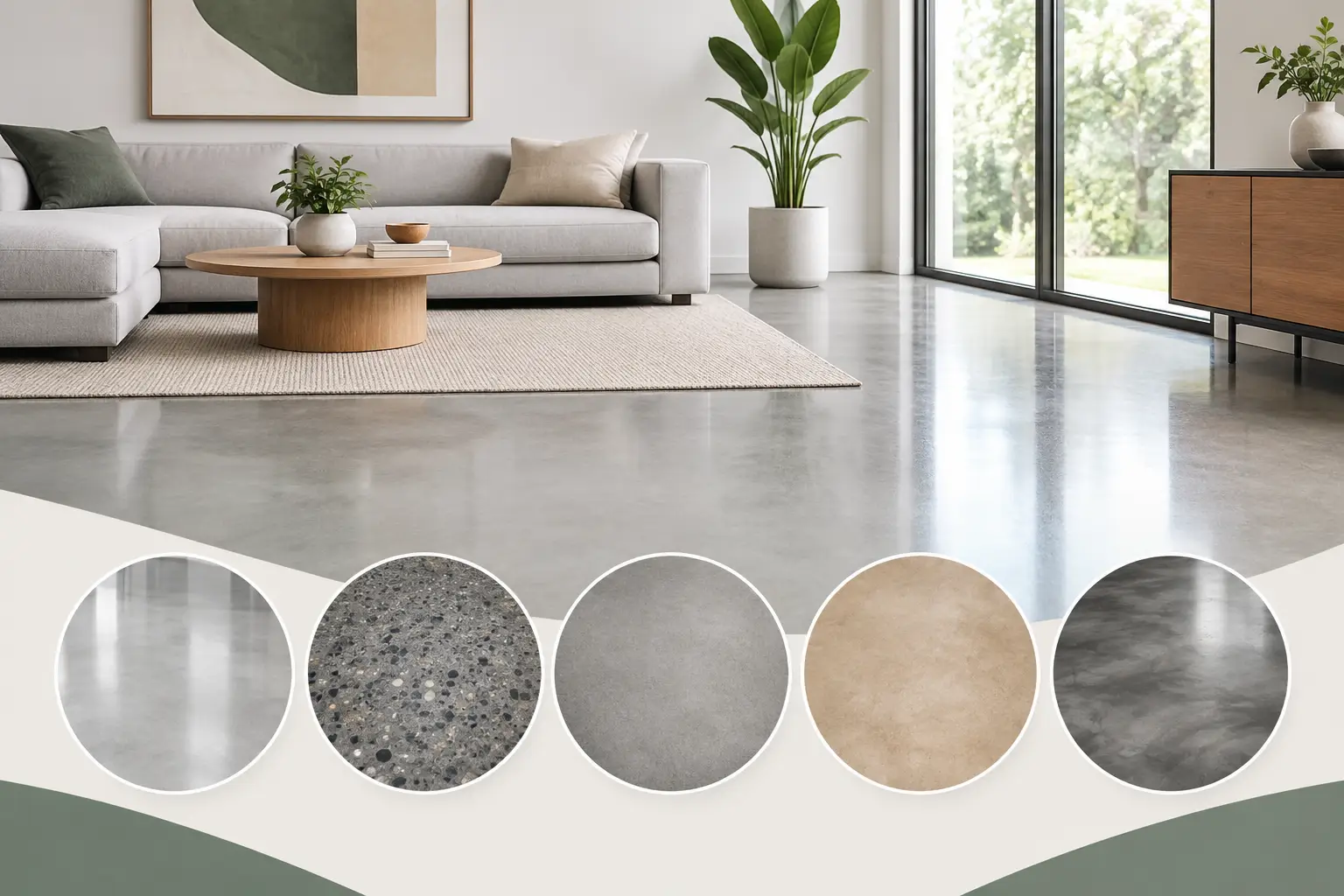
A concrete slab can be one of the strongest design assets in a home – or one of its most expensive disappointments. The difference is preparation, moisture conditions, and selecting from the best residential concrete floor finishes based on how the room will actually be used. A bright Los Angeles loft, a busy family kitchen, a garage with hot tires, and a shaded patio do not need the same flooring system.
Concrete is durable by nature, but it is also porous. It can absorb moisture, show old adhesive marks, crack as a structure moves, and wear unevenly if the surface is not properly prepared. The right finish improves appearance while giving homeowners a floor that is easier to clean, more resistant to daily wear, and built around the realities of the slab beneath it.
The Best Residential Concrete Floor Finishes at a Glance
For many homes, mechanically polished concrete delivers the best long-term balance of appearance, durability, and maintenance. It uses industrial diamond tooling to refine the existing slab, then hardeners and densifiers to strengthen the surface. The result can range from a soft satin finish to a high-gloss floor with a clean, modern look.
That said, polished concrete is not automatically the right answer for every home. Epoxy excels in certain garages and utility spaces. Grind-and-seal systems offer a lower initial cost and greater color flexibility. Decorative overlays can transform a slab that is too damaged or inconsistent to polish well. A professional evaluation should begin with the concrete itself, not with a color chart.
1. Mechanically Polished Concrete
Polished concrete is the premium choice for homeowners who want to expose and improve the existing slab rather than cover it. Contractors progressively grind the concrete with diamond abrasives, apply a densifier to harden the surface, and continue polishing to the selected sheen. The process is mechanical, not simply a shiny coating applied on top.
Its biggest advantage is longevity. Because the finish is worked into the slab, there is no thick film to peel or delaminate. Properly polished floors hold up well in living rooms, kitchens, hallways, entryways, basements, and open-plan interiors. They are especially effective in contemporary homes, converted warehouses, and lofts where concrete is part of the architectural character.
A satin or matte polish is often the smart residential choice. It reflects light without showing every footprint and can provide a more understated appearance than a high-gloss showroom floor. Higher gloss levels create more visual impact, but they also reveal surface variation, cleaning patterns, and imperfections more readily.
Polished concrete does have limits. Deep cracks, extensive patching, soft concrete, old thin-set residue, and uneven aggregate exposure may remain visible after grinding. Those details can look intentional in an industrial-style home, but homeowners expecting a perfectly uniform surface may be better served by an overlay or coating system.
2. Grind and Seal Concrete
Grind and seal begins with mechanical grinding to remove contamination, old coatings, or weak surface material. Instead of continuing through the full polishing sequence, the contractor applies a protective topical sealer. The sealer may be clear, tinted, matte, satin, or glossy, depending on the desired finish.
This system is popular because it produces a refined concrete appearance at a lower upfront cost than full polishing. It also gives homeowners more control over color. Water-based stains, dyes, and decorative effects can be incorporated before sealing, allowing a plain slab to take on a warmer or more customized look.
The trade-off is maintenance. A topical sealer is a sacrificial wear layer, meaning it will eventually need reapplication in traffic paths. Pets, chair legs, gritty debris, and frequent wet mopping can dull or scratch the surface over time. In a bedroom or low-traffic living area, that may be a perfectly reasonable compromise. In a heavily used kitchen or main entry, a quality polished floor usually offers better long-term value.
3. Epoxy Floor Coatings
Epoxy is one of the best residential concrete floor finishes for garages, workshops, storage areas, and utility rooms when the slab is dry, properly prepared, and the coating system is matched to the conditions. It creates a protective film that can resist many stains, chemicals, tire marks, and abrasion better than bare concrete.
Homeowners can choose from solid colors, decorative flake systems, metallic effects, and quartz broadcasts. Full-flake garage floors remain a strong choice because they disguise dust and minor debris while creating a finished, professional appearance. A properly installed system is far more durable than a basic paint-from-the-store application.
However, epoxy is not a cure for moisture problems. Vapor pressure coming through the slab can cause blistering, peeling, or delamination if the concrete has not been tested and prepared correctly. Garages in particular need careful profiling, crack repair, edge preparation, and a moisture-tolerant primer where conditions require it. For exterior spaces, epoxy is usually not the best choice because direct UV exposure can cause yellowing or degradation unless a suitable UV-stable topcoat is used.
4. Decorative Concrete Overlays and Microtoppings
An overlay gives homeowners a fresh canvas when the original slab is badly stained, patched, uneven, or visually unsuitable for polishing. A cement-based overlay or microtopping is applied over prepared concrete in a controlled thickness, then colored, textured, sealed, or polished depending on the system.
This option works well when the goal is a more uniform, design-forward finish. It can create a smooth minimalist surface, a subtle hand-troweled movement, or a decorative texture that better suits the room. Overlays are often used in kitchens, living spaces, retail-inspired interiors, and residential renovations where existing concrete has too many repairs to become an attractive exposed floor.
Preparation still determines success. The existing slab must be sound, clean, and mechanically profiled so the overlay can bond correctly. Cracks may need repair, but no rigid coating can guarantee that structural movement will never telegraph through later. A qualified contractor will explain where crack control is realistic and where it is not.
5. Stained and Sealed Concrete
Concrete stains and dyes offer color without hiding the character of the slab. Acid stains create mottled, variegated effects through a chemical reaction with the concrete, while water-based stains and dyes provide a wider range of more predictable colors. After coloring, the floor receives a protective sealer.
This can be an excellent finish for homeowners who appreciate variation rather than uniformity. It is often used in casual living areas, finished basements, and covered patios. The visual result depends heavily on the concrete’s age, porosity, repairs, and prior exposure to adhesives or contaminants. Samples and test areas matter because the final color can be impossible to predict from a brochure alone.
Like grind and seal, stained concrete relies on the sealer for protection. Expect periodic maintenance, especially in direct sunlight, wet areas, or high-traffic rooms. Additive choices can also improve slip resistance where needed without making the surface feel aggressively textured.
How to Choose the Right Finish for Your Home
Start with the room’s demands. A polished concrete kitchen needs resistance to daily foot traffic, spills, and chair movement. A garage needs chemical resistance and protection from tire traffic. A bathroom needs moisture awareness and a finish selected with traction in mind. An outdoor patio needs a UV-stable system designed for weather exposure rather than an interior coating adapted beyond its limits.
Then assess the slab honestly. If the concrete is structurally sound with attractive aggregate potential, polishing can deliver an exceptional permanent floor. If it has heavy patching, widespread imperfections, or old flooring damage, a decorative overlay may create a more controlled outcome. If the project needs color, stain and seal or a coating system may make more sense.
Budget should include lifecycle cost, not just installation day. A low-cost sealer can be appropriate, but it may require recurring maintenance. A higher-investment polished floor may reduce future coating replacement costs and provide decades of service when properly cared for. The best value is the finish that performs for the space without asking the homeowner to accept avoidable upkeep.
Preparation Is What Separates a Floor From a Problem
No finish outperforms poor surface preparation. Professional concrete flooring work begins with evaluating moisture, slab condition, contamination, cracks, previous coatings, and levelness. Diamond grinding is not merely cosmetic. It opens the concrete, removes weak material, creates the correct surface profile, and prepares the slab to accept a coating, overlay, or polishing sequence.
For homeowners in Los Angeles and Orange County, this assessment is particularly valuable in renovations. Older slabs may carry adhesive residue, moisture issues, paint, or repairs hidden beneath carpet, tile, or laminate. Los Angeles Concrete Polishing approaches these conditions with the right equipment and proven process rather than treating every slab as a one-size-fits-all installation.
A great concrete floor should feel intentional the day it is completed and practical years later. Choose the finish around the slab, the room, and the maintenance you are willing to perform, then insist on proper preparation before any material goes down.
Clients We Service
We provide our concrete polishing and related services to a wide variety of clients. Some of the types of clients that we provide service to include:


