
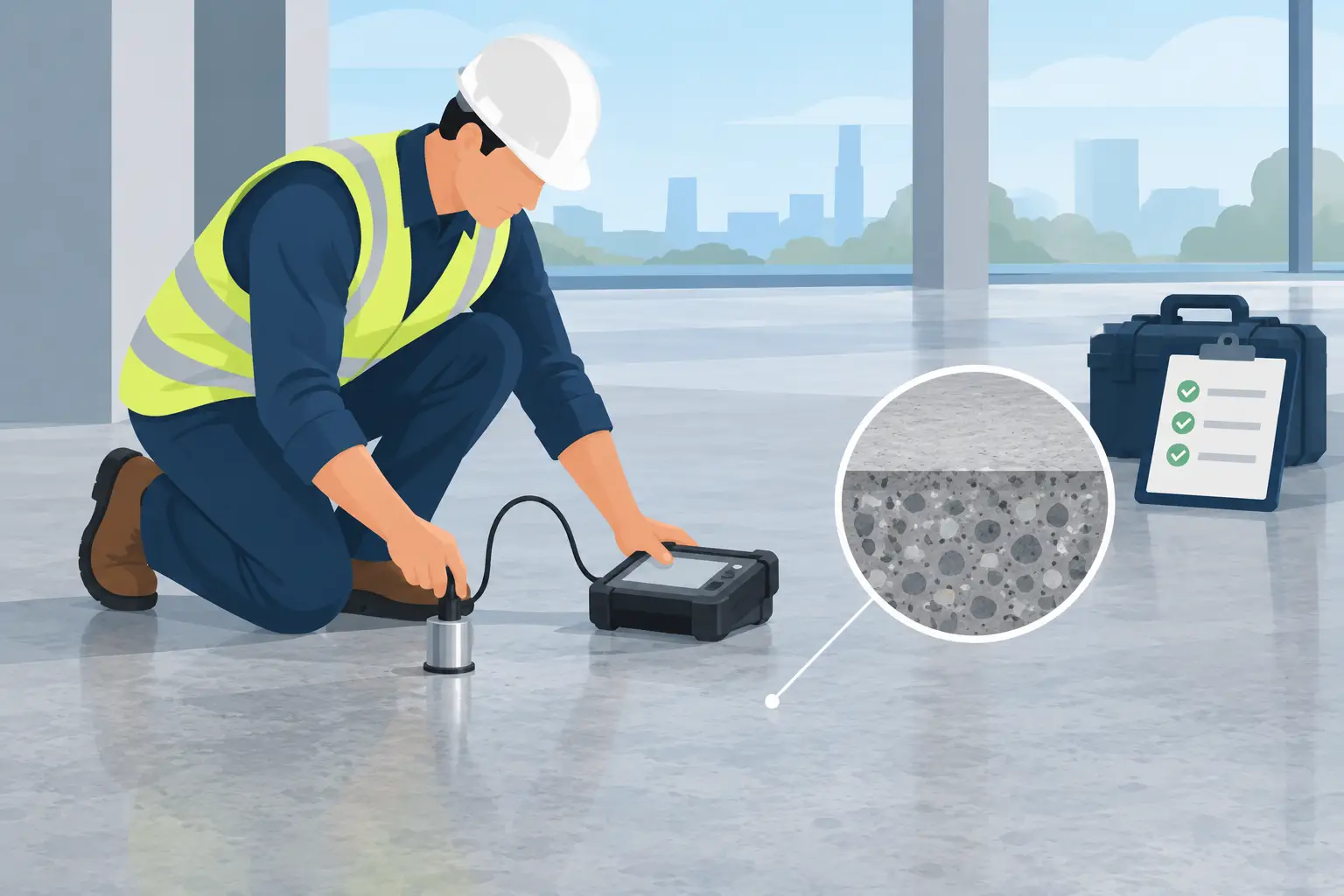
A floor can look sound and still be a poor candidate for polishing, coatings, or a new finish. This concrete slab testing guide explains what must be verified before equipment arrives, materials are ordered, and a project schedule is committed. For warehouses, retail spaces, offices, industrial facilities, and modern residential interiors, early testing is how owners avoid peeling coatings, uneven sheen, moisture damage, and costly downtime.
The slab is the foundation of every successful concrete floor system. Its condition determines whether the right answer is diamond polishing, a topical coating, a cementitious topping, localized repair, or a different approach altogether. A qualified contractor does not guess based on appearance alone.
Why Concrete Slab Testing Comes First
Concrete is not a uniform material. It can vary substantially across one building because of placement methods, curing conditions, past repairs, vapor movement, traffic wear, contaminants, and the age of the structure. A bright, clean surface may conceal moisture pressure or weak near-surface paste. Conversely, an older slab with stains and cosmetic cracks may have excellent structural integrity and polish into an exceptional floor.
Testing protects the budget and the finish. It helps define surface-preparation requirements, confirms whether a specified coating is appropriate, identifies areas needing repair, and reduces surprises after work begins. In active Southern California facilities, it also supports better phasing. When decisions are made before mobilization, operations can stay moving with less disruption.
Testing is especially critical when a slab will receive a moisture-sensitive finish. Polished concrete is mechanically refined and densified, so it generally handles vapor movement differently than a film-forming coating. Epoxy, urethane cement, and many decorative overlays have their own moisture limits and preparation requirements. The right system depends on measured conditions, not a sales promise.
Concrete Slab Testing Guide: What to Evaluate
A complete evaluation combines visual investigation, field testing, and project-specific documentation. No single number can tell the whole story. Moisture may be acceptable while surface tensile strength is poor, or flatness may be suitable for storage yet inadequate for a high-gloss polished floor with demanding visual expectations.
Moisture Vapor and Internal Relative Humidity
Moisture is one of the most common causes of floor-finish failure. Water vapor naturally moves through many concrete slabs, particularly slabs on grade. If that vapor is trapped beneath an incompatible coating or flooring adhesive, it can contribute to blistering, delamination, discoloration, or adhesive breakdown.
The most reliable assessment for many flooring decisions is in-situ relative humidity testing. Small holes are drilled to the required depth, test probes are installed, and readings are taken after the prescribed equilibration period. This method measures moisture conditions within the slab rather than only at its surface.
Calcium chloride testing may also be used when a product manufacturer or project specification calls for a moisture vapor emission rate. It can provide useful information, but it is a surface-based test and should not be treated as interchangeable with internal relative humidity results. A professional evaluation matches the method to the proposed floor system and follows the applicable test standard and manufacturer limits.
If moisture readings are high, the project is not automatically stopped. Options may include allowing more drying time, selecting polished concrete, using a compatible moisture-mitigation system, or specifying a material designed for the measured conditions. Each option affects cost, schedule, appearance, and long-term maintenance.
Surface Profile, Hardness, and Soundness
A concrete slab must have a surface that can accept the intended finish. Coatings typically need a defined concrete surface profile so the material can mechanically bond. Diamond grinding, shot blasting, or other preparation methods may be selected based on the coating type, slab condition, and required profile.
For polishing, the key question is whether the slab has sufficient sound material to refine. Contractors often perform scratch tests, test grinds, and close visual inspections to understand the cream layer, aggregate exposure potential, hardness variation, and prior surface treatments. A floor that is too soft can consume more diamonds and produce a different visual result than a dense, hard slab.
Pull-off testing may be appropriate where bond strength is a concern, particularly before installing overlays or coatings. This test evaluates the tensile strength of the prepared surface and can reveal weak paste, hidden bond breakers, or a failing previous coating. A slab can be structurally strong yet have a fragile top layer that must be removed before a new system is installed.
Flatness, Levelness, and Floor Geometry
Flatness and levelness are often confused, but they answer different questions. Flatness describes local smoothness and affects how a floor looks, feels, and performs under wheeled traffic. Levelness describes overall slope or elevation change. Both matter, but their importance changes with the use of the space.
A distribution warehouse with narrow-aisle equipment may demand tighter tolerances than a residential loft. A polished concrete showroom may need extra attention to visible transitions, patching, and reflected light, even when the floor meets functional flatness requirements. Existing drainage slopes may be intentional in a commercial kitchen, wash bay, or exterior-adjacent area and should not be ground away without a clear plan.
Floor profiling equipment can document flatness and elevation changes across large spaces. Straightedges, laser measurements, and test areas also help determine where grinding, patching, or topping work may be necessary. The goal is not always a perfectly level slab. The goal is a floor geometry that supports the building’s intended use and the selected finish.
Cracks, Joints, Curling, and Movement
Cracks are normal in concrete. The practical question is whether they are dormant, actively moving, widening, or associated with settlement and slab distress. Hairline shrinkage cracks may be acceptable as part of the finished character of polished concrete. Larger cracks, displaced cracks, and cracks with moisture staining need closer investigation.
Control joints and construction joints also require a finish-specific decision. Filling joints can create a cleaner look and reduce edge damage in traffic lanes, but rigid fillers can crack if joints are designed to move. In forklift areas, semi-rigid joint fillers may protect joint edges while allowing for expected movement characteristics. For decorative floors, joint treatment should be discussed before polishing begins because filled joints remain visible.
Curling at slab edges can create unevenness, wheel impact, and coating wear. It may require grinding or repair, but aggressive grinding can expose aggregate and change the floor’s appearance. This is where a small sample area is valuable: it makes the trade-off visible before the full floor is committed.
Contaminants and Previous Treatments
Oil, grease, curing compounds, paint, adhesives, sealers, hardeners, and cleaning chemicals can all interfere with bonding or alter polishing results. A water-drop observation, visual review, test grinding, and targeted adhesion testing can help identify the problem. In industrial facilities, contamination is often concentrated around equipment pads, loading areas, battery charging stations, and maintenance bays.
Surface contaminants are not always solved with detergent. Some materials penetrate deeply and require mechanical removal, specialized cleaning, or a flooring system engineered to tolerate the remaining condition. A competent contractor will identify the realistic preparation scope rather than assuming every stain will disappear.
How to Use Test Results to Select a Floor System
The best floor system is the one that fits the slab and the operation. A dense, relatively sound slab with acceptable repairs may be a strong candidate for polished concrete, offering low maintenance, excellent light reflectivity, and long service life. Areas exposed to oils, chemicals, or repeated wet processes may be better served by a properly prepared resinous system or urethane cement installation.
Where appearance is the priority but the existing slab is heavily damaged, a decorative topping can create a more consistent canvas. That choice adds material cost and may affect door clearances, transitions, and cure time. Where the budget is tight, targeted grinding and repair may extend service life without pretending the floor will look like a new architectural slab.
Request a written testing and preparation plan before approving work. It should identify the proposed tests, the areas to be sampled, the acceptance criteria for the selected material, expected repairs, and any conditions that could change scope. For large facilities, test several zones rather than relying on a single reading near an exterior wall or interior column.
When to Call a Concrete Flooring Specialist
Bring in a specialist before finalizing the finish, not after a coating has failed or a polishing crew has started grinding. This is particularly valuable for older buildings, slabs with recurring moisture problems, high-traffic operations, and projects where downtime carries a real cost.
Los Angeles Concrete Polishing evaluates the actual slab condition before recommending a solution, whether the right path is diamond polishing, corrective grinding, a topping, or protective enhancement. The objective is straightforward: a floor that performs under the traffic, cleaning routine, and visual demands of the space.
A tested slab gives every project a more honest starting point. It replaces assumptions with a clear path to a durable floor, and that is the best time to make the decisions that protect your investment.
Clients We Service
We provide our concrete polishing and related services to a wide variety of clients. Some of the types of clients that we provide service to include:


