
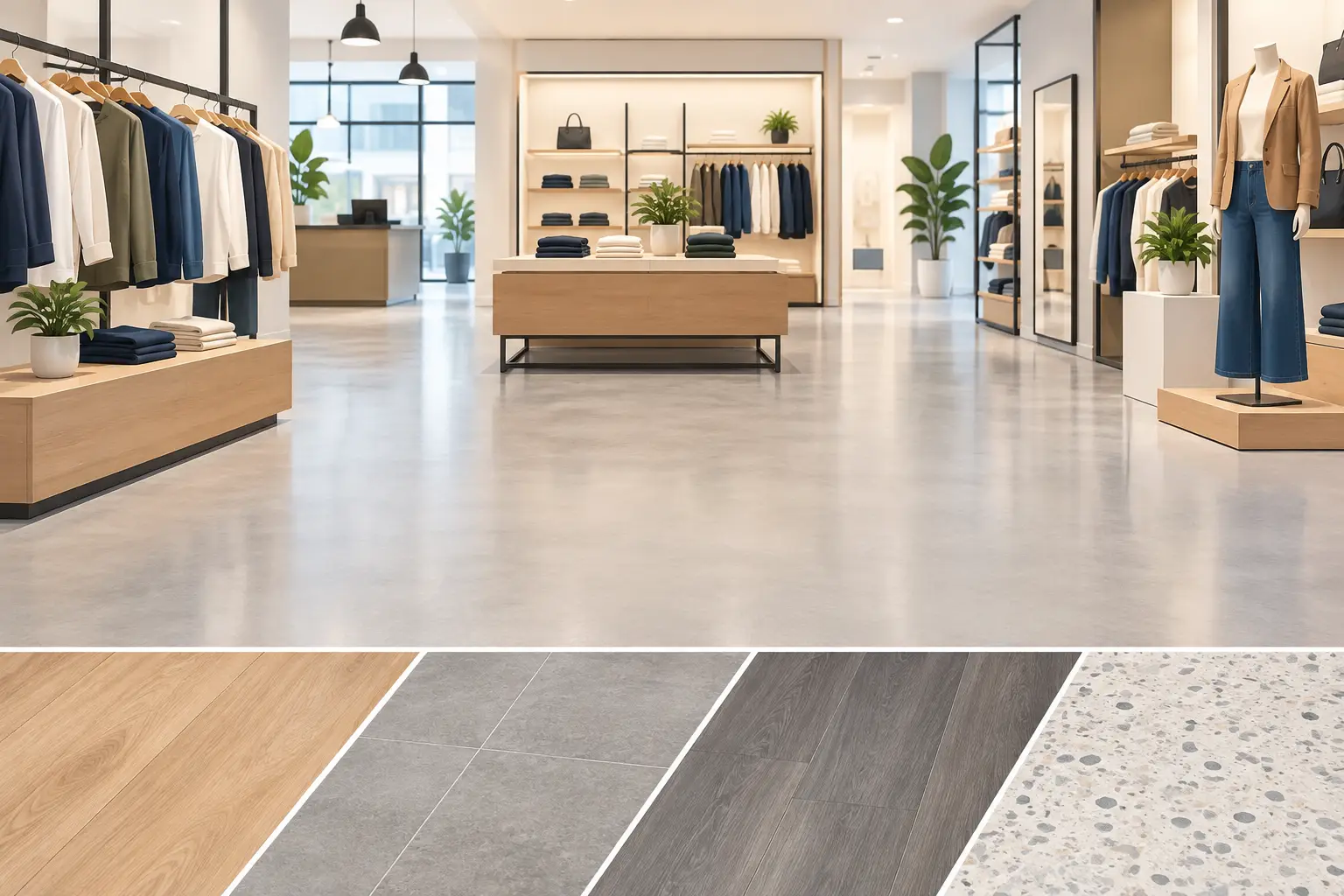
A retail floor gets judged before a customer reads a price tag. Scuffs at the entrance, stained grout near the checkout, or peeling coating in a main aisle can make an otherwise well-run store feel neglected. The best floors for retail stores do more than look sharp on opening day. They stand up to foot traffic, carts, rolling fixtures, spills, cleaning chemicals, and the daily pressure of operating a business.
For most retail owners, the right choice comes down to a practical balance: the floor must support the brand, fit the budget, protect customer safety, and avoid creating a maintenance problem that drains time and money. There is no single material that wins every project. A luxury boutique, a grocery market, and a high-volume warehouse showroom have very different demands.
What Retail Flooring Must Handle
Retail flooring is a working surface, not just a design finish. It has to perform through busy weekends, deliveries, merchandise resets, wet-weather traffic, and repeated cleaning. In Los Angeles and Orange County, many stores also contend with concrete slab moisture, which can cause adhesives, vinyl, and coatings to fail if the floor is not properly tested and prepared.
Before selecting a finish, consider the expected traffic pattern. Entrance zones, checkout lanes, fitting rooms, stock areas, and service counters rarely wear at the same rate. A floor that works beautifully in a low-traffic display area may not survive repeated cart turns at a register.
The strongest retail flooring decisions account for five factors: daily traffic, moisture conditions, cleaning requirements, slip resistance, and the visual standard the store needs to maintain. Initial installation cost matters, but lifecycle cost matters more. A less expensive floor that needs frequent replacement is rarely the bargain it appeared to be.
Best Floors for Retail Stores by Use and Performance
Polished Concrete for High-Traffic Retail
Polished concrete is one of the best-performing options for retail stores built on an existing concrete slab. Rather than covering the slab with a material that can peel, delaminate, or wear through, diamond grinding and polishing refine the concrete itself. The result is a dense, durable surface with a clean, modern appearance and low long-term maintenance needs.
This option is especially effective for apparel stores, showrooms, furniture retailers, fitness retail, supermarkets, galleries, and mixed-use commercial spaces. It can be finished in a range of gloss levels, from a subtle satin appearance to a high-reflective shine. Densifiers help harden the surface, while guard products can improve stain resistance and simplify routine cleaning.
Polished concrete is not automatically slippery because it has a shine. Slip performance depends on the finish, surface condition, contaminants, cleaning practices, and whether the floor is wet. A qualified contractor can recommend an appropriate level of traction for entryways, food-service zones, and other areas exposed to moisture.
The trade-off is that concrete has character. Existing cracks, aggregate exposure, prior patches, and color variation may remain visible depending on the desired finish. For many retailers, that industrial-modern look is a feature. For brands seeking a perfectly uniform floor color, a decorative topping or coating may be the stronger choice.
Luxury Vinyl Tile for Design Flexibility
Luxury vinyl tile, often called LVT, gives retailers a wide range of wood, stone, and patterned visuals. It is softer underfoot than concrete or tile, which can be valuable for stores where associates spend long shifts standing at counters or in sales areas. Individual planks or tiles can also be replaced when damaged.
LVT works well in boutiques, salons, specialty shops, and retail spaces where warmth and visual detail carry more weight than industrial-level durability. The critical issue is substrate preparation. The concrete below must be smooth, dry, and properly tested for moisture. If moisture vapor moves through the slab, adhesives can break down and planks can lift or separate.
LVT can be a smart retail finish, but it should not be selected simply because it is fast to install. Heavy rolling loads, sharp fixture legs, direct sunlight, and aggressive cleaning can shorten its service life. A commercial-grade product and professional moisture control plan are essential.
Epoxy and Resinous Coatings for Utility Areas
Epoxy coatings create a continuous, protective surface over concrete. They are highly useful in stockrooms, back-of-house areas, automotive retail, pet supply stores, beverage zones, and spaces where spills or chemicals are part of normal operations. Depending on the system, coatings can be customized for color, texture, chemical resistance, and traffic requirements.
A broadcast system with decorative flakes can create a durable, easy-to-clean finish with better texture than a smooth coating. Quartz systems are another strong choice for areas requiring added abrasion resistance and a more slip-conscious finish.
The limitation is preparation and moisture. Coatings depend on a sound bond to the concrete. If the slab has moisture issues, contamination, weak concrete, or improper surface profiling, the coating may blister or delaminate. The best epoxy floor is only as reliable as the grinding, repair, moisture testing, and installation work beneath it.
Porcelain Tile for Wet or Brand-Forward Spaces
Porcelain tile remains a strong retail flooring option where water resistance, design control, and a premium appearance are priorities. It is common in cosmetics stores, food retail, malls, restrooms, and front-of-house areas where a refined visual presentation matters. Quality porcelain resists stains and scratches well, and textured products can provide useful traction in wet zones.
Tile does have weak points: grout lines and breakage. Grout requires cleaning and periodic maintenance, while dropped objects or shifting substrates can crack individual tiles. Tile also tends to be harder underfoot and can add significant labor cost if the existing slab requires leveling.
For a small, highly designed sales floor, porcelain may justify its cost. For a large-format store with nonstop traffic and frequent fixture changes, polished concrete may deliver a better long-term return.
Sheet Vinyl and Rubber for Specialized Retail
Sheet vinyl offers a continuous, water-resistant surface with few seams, making it useful in pharmacies, medical retail, grocery support areas, and shops that need easy sanitation. Rubber flooring can reduce fatigue and provide traction in certain specialty settings, including sports retail and checkout work zones.
These materials are purpose-driven rather than universal. Sheet vinyl can be vulnerable to gouges and adhesive failure if moisture is ignored. Rubber may show marks, react to some cleaners, and may not suit a luxury retail aesthetic. Still, both can solve specific operational problems when selected for the right area.
Match the Floor to the Store, Not the Trend
A floor should reinforce how the business operates. A minimalist clothing store may benefit from polished concrete with a refined satin finish that makes displays and lighting stand out. A high-end cosmetics retailer may need porcelain tile or a decorative seamless topping that supports a controlled color palette. A discount retailer with heavy carts and constant stocking may need dense polished concrete in the sales area and a protective coating in the stockroom.
Do not overlook transitions. The entry zone usually receives the most abrasive dirt and moisture, so it may need walk-off mats, a more textured finish, or a separate flooring material. Back rooms need performance first. Customer-facing floors need performance and presentation.
The Installation Details That Protect Your Investment
Flooring failures are often blamed on the visible material when the real issue started below the surface. Moisture testing, crack repair, concrete grinding, slab leveling, and contaminant removal are not optional extras. They are the work that determines whether the finished floor performs.
For existing concrete, a professional evaluation should identify coatings, adhesives, oil contamination, spalling, moisture vapor, and uneven areas before a final flooring system is specified. This is particularly valuable in older retail centers, converted warehouses, and tenant-improvement projects with unknown slab conditions.
Downtime also deserves direct attention. Polished concrete can often be completed in phases, allowing certain parts of a store to remain operational. Coatings may require cure time before heavy traffic resumes. Tile installations can take longer because of substrate preparation, setting, grout, and cure schedules. The right contractor plans around business operations instead of treating them as an afterthought.
Choose a Floor That Keeps Earning Its Place
The best retail floor is the one that stays attractive after thousands of customers, repeated cleanings, and years of changing displays. For many Southern California retailers, professionally polished concrete delivers the strongest mix of durability, appearance, and low maintenance. Other spaces may be better served by LVT, porcelain, or resinous coatings in targeted areas.
Start with the slab, the traffic, and the way the store actually operates. A qualified flooring specialist can turn those realities into a finish that looks right on day one and continues to represent the business well long after the grand opening.
Clients We Service
We provide our concrete polishing and related services to a wide variety of clients. Some of the types of clients that we provide service to include:


