
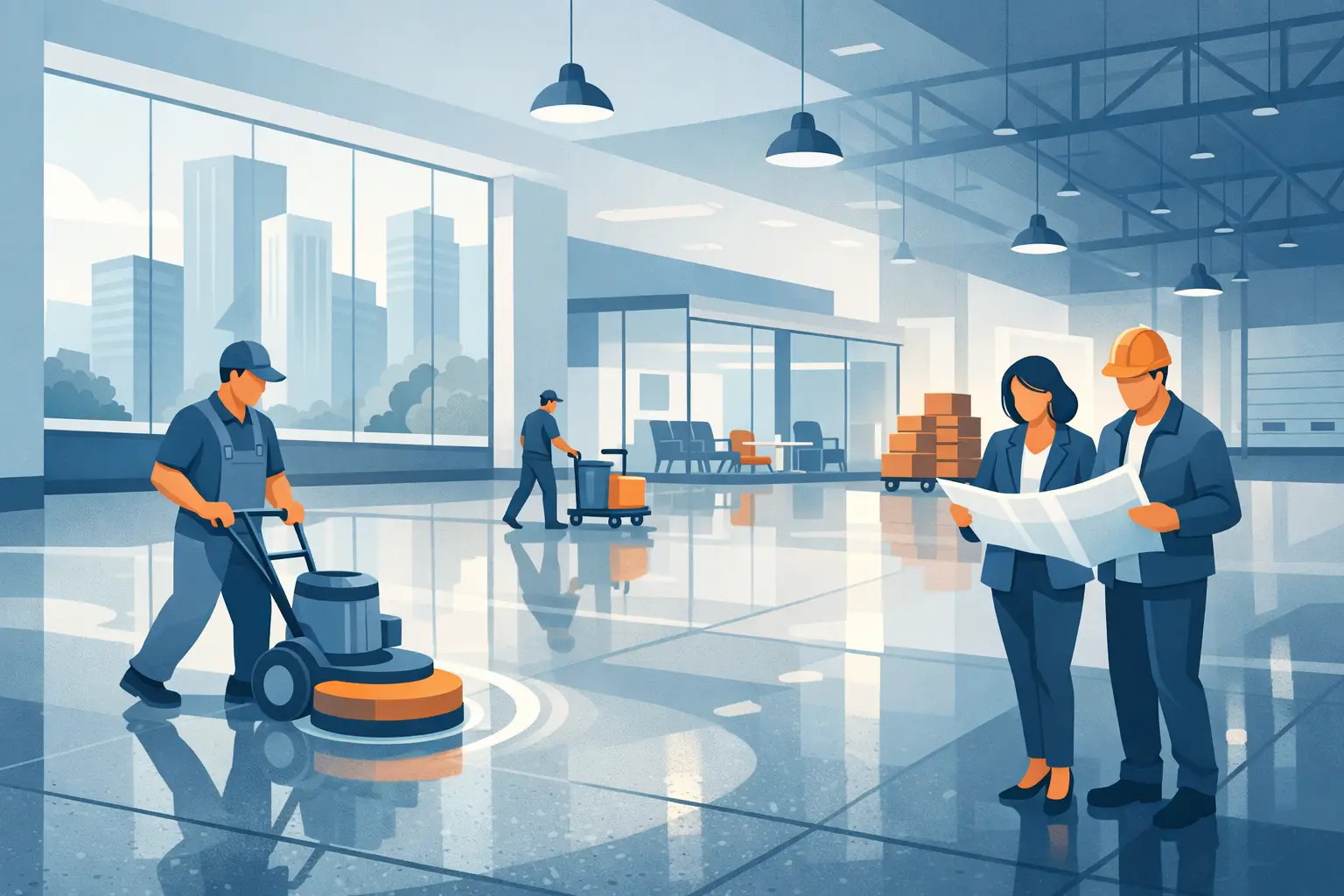
A warehouse floor can look acceptable on Monday and become a maintenance problem by Friday. Forklift lanes turn dusty, entry areas become slick when wet, old coatings peel at the edges, and every repair pulls attention from the operation. This commercial concrete flooring guide is built for property owners and facility managers who need a floor to carry real traffic without becoming a recurring expense.
The right answer is rarely just “polished concrete” or “epoxy.” Concrete flooring decisions should start with the condition of the slab, the loads it carries, exposure to moisture and chemicals, required traction, appearance goals, and the time available for installation. A beautiful floor that cannot handle pallet jacks or moisture vapor is not a value. A hard-wearing floor that creates cleaning headaches or looks neglected in a customer-facing space is not the right fit either.
Commercial Concrete Flooring Guide: Start With How the Space Works
Before choosing a finish, define what happens on the floor every day. A showroom with foot traffic, a distribution center running forklifts, and a commercial kitchen all place different demands on concrete. The same building may need different systems in different zones.
Traffic is the first question. Heavy forklifts, hard wheels, rolling loads, and repetitive turning can wear through weak coatings and expose soft or poorly finished concrete. High pedestrian traffic calls for abrasion resistance, easy cleaning, and a surface profile that supports safe movement. In retail, offices, restaurants, and lobbies, visual consistency also matters because the floor is part of the customer experience.
Next, identify what lands on the slab. Water alone can be a concern, particularly near entrances, loading docks, restrooms, and food service areas. Oils, solvents, cleaners, salts, and process chemicals raise the stakes. A mechanically polished surface can resist staining when properly densified and protected, but a space with regular chemical spills may need a high-performance coating system designed for that exposure.
Moisture is the decision point that too many projects skip. Concrete can release vapor long after it appears dry. When that vapor pressure is incompatible with a coating, the result can be blistering, peeling, or bond failure. Testing the slab and addressing moisture conditions before installation protects the budget and prevents a premature replacement cycle.
Choose the System That Matches the Risk
Commercial concrete flooring is not one product. It is a group of systems with different strengths, limitations, and cost profiles.
Mechanically polished concrete
Polished concrete is created by refining an existing slab with industrial diamond tooling. The process typically includes grinding to remove surface irregularities, applying a densifier to harden the concrete, then continuing through progressively finer diamond grits to reach the selected level of clarity and gloss. The finished surface can range from a practical satin appearance to a high-gloss architectural finish.
For warehouses, offices, retail stores, lofts, schools, and common areas, polished concrete offers strong long-term value. It does not rely on a thick film that can delaminate, and routine maintenance is generally straightforward: dust mop, scrub as needed, and use cleaners suited to the floor. It can also improve light reflectivity, which helps bright spaces feel cleaner and can support lighting efficiency.
The trade-off is that polished concrete does not hide every slab defect. Cracks, aggregate exposure, patchwork, old adhesive shadows, and variations in concrete placement can remain visible. That character works well in many modern commercial interiors, but it should be discussed early. Polishing also requires enough sound concrete at the surface. A slab with severe deterioration, contamination, or widespread spalling may need repairs, an overlay, or another system.
Protective coatings
Epoxy, urethane, polyaspartic, and other resinous coatings create a protective layer over concrete. The right coating can provide chemical resistance, color control, line striping, a more uniform visual finish, and added texture for traction. These systems are often the better choice for manufacturing areas, automotive operations, food-related spaces, laboratories, service bays, and other facilities where spills or sanitation requirements drive the specification.
Coatings are not interchangeable. Epoxy may provide excellent build and adhesion, while urethane can offer stronger resistance to abrasion or thermal movement. Polyaspartic systems can cure quickly in the right conditions, which can help when downtime is limited. The practical answer depends on substrate moisture, ambient conditions, required cure time, chemical exposure, and whether the floor needs a textured broadcast finish.
A coating is only as reliable as the preparation beneath it. Grinding or shot blasting must create the proper concrete surface profile, repairs must be completed correctly, and moisture concerns must be addressed. Applying a premium coating over improperly prepared concrete is not a shortcut. It is an expensive failure waiting to happen.
Cementitious toppings and overlays
Toppings can restore a worn, uneven, or visually inconsistent slab. They create a new working surface that may be polished, stained, sealed, or coated depending on the product and intended use. For commercial renovations, toppings are particularly useful when the existing concrete has extensive patching, failed finishes, surface damage, or a layout that needs a cleaner design direction.
The main consideration is thickness and compatibility. Some systems are designed as thin overlays, while others require more build to correct elevation changes or damage. Door clearances, drains, transitions, equipment bases, and ramp details all need review before work begins. A topping can solve a real substrate problem, but it must be engineered around the space rather than treated as cosmetic filler.
Plan for Safety Without Sacrificing Appearance
A shiny floor is not automatically a slippery floor, and a textured floor is not automatically safe. Slip resistance depends on the surface profile, contaminants, cleaning practices, footwear, and whether the area is wet or dry. The correct finish for a dry retail showroom may be very different from the finish needed near a loading dock or beverage station.
For polished concrete, the goal is to achieve the required visual result while maintaining practical traction. For coatings, traction additives or broadcast media can be incorporated where needed. More texture can improve grip, but excessive texture may trap dirt and make cleaning harder. The strongest specifications balance traction with cleanability and the actual risk profile of the area.
Safety also includes visibility. Clearly defined pedestrian routes, high-contrast striping, marked work zones, and bright reflective floors can help reduce preventable incidents. In active warehouses, these details should be integrated into the flooring plan rather than painted on as an afterthought.
Control Downtime With the Right Project Plan
Commercial flooring work should not be treated as a surprise shutdown. A qualified contractor can divide work into phases, schedule after-hours production where practical, protect adjacent operations from dust, and establish cure windows that match the chosen system. Polishing is often a strong option when operational disruption must stay low because it works with the existing slab rather than waiting on a full replacement.
The timeline still depends on the floor’s condition. Removing old coatings, repairing cracks, mitigating moisture, and preparing heavily contaminated concrete can add time. Fast installation promises mean little if the floor is returned to service before it is ready. Ask for a plan that identifies preparation, installation, cure time, access restrictions, and the handoff process for each area.
In Los Angeles and Orange County, facilities also need a contractor who understands the local realities of occupied buildings, active logistics sites, and demanding renovation schedules. Los Angeles Concrete Polishing evaluates the slab before recommending a system, because the best result begins with the facts underfoot, not a one-size-fits-all product pitch.
Budget for Life-Cycle Cost, Not Just Installation
The lowest initial bid can become the highest-cost floor if it needs frequent patching, recoating, or intensive cleaning. Compare flooring options over their expected service life. Include routine maintenance, shutdown costs, repair risk, lighting benefits, appearance retention, and the cost of future changes to the space.
Polished concrete can be an excellent long-term investment where the slab is sound and the environment is compatible. Coatings may justify their cost where chemical protection, color coding, or sanitation is essential. Toppings can prevent a full slab replacement when the substrate needs a new surface. The strongest choice is the one that solves the operational problem for the longest reasonable period.
Before approving a floor, walk the space with the people who clean it, operate equipment on it, and manage safety. Their daily experience will reveal more than a color sample ever can. A commercial concrete floor should make work easier, look deliberate, and keep performing after the opening-day shine has become ordinary.
Clients We Service
We provide our concrete polishing and related services to a wide variety of clients. Some of the types of clients that we provide service to include:


