
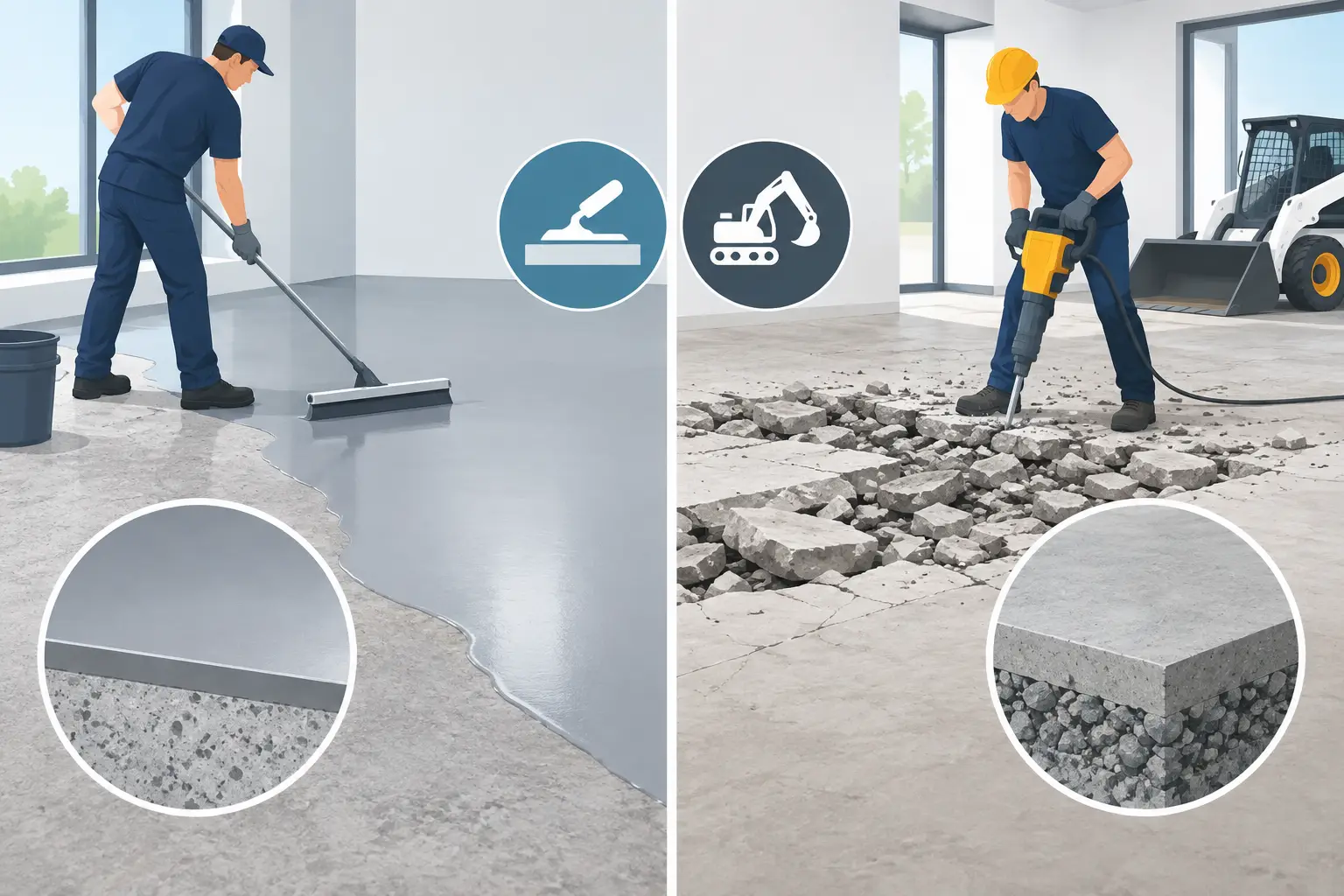
A floor can look beyond saving long before the concrete slab has actually reached the end of its service life. Dusting surfaces, old coatings, forklift scars, stains, shallow spalls, and uneven color are common problems in Southern California warehouses, retail spaces, offices, and homes. The real decision in resurfacing versus replacement is not which option looks better on day one. It is which option addresses the condition beneath the surface without wasting budget or creating unnecessary downtime.
For many properties, a professionally prepared and resurfaced concrete floor delivers a dramatic improvement at a fraction of the disruption of demolition. But resurfacing is not a cure for a slab with serious structural movement, deep deterioration, or chronic moisture failure. A qualified flooring specialist should identify the actual cause before recommending a finish.
What Resurfacing Actually Solves
Concrete resurfacing means restoring the usable face of an existing slab rather than removing and repouring the slab itself. Depending on the condition of the floor and the intended finish, the process may involve diamond grinding, crack repair, joint work, patching, a cementitious overlay, a self-leveling topping, protective coatings, or polished concrete refinement.
The right system depends on what the floor needs to do. A retail showroom may need a clean decorative finish with consistent color and light reflectivity. A warehouse may need a hard-wearing surface that stands up to pallet traffic, tire abrasion, and routine cleaning. A residential loft may benefit from a refined polished concrete finish that preserves the character of the original slab while eliminating dust and improving stain resistance.
Diamond grinding is often the first step. It removes failed coatings, weak surface paste, adhesives, and contaminants while opening the concrete for repairs or a new finish. For slabs with minor pitting or widespread wear, a topping can create a fresh, uniform surface. If the concrete is fundamentally sound and the owner wants to expose its natural variation, polishing with densifiers and progressively finer diamond grits may be the strongest long-term option.
Resurfacing works best when damage is primarily superficial. It can correct worn surfaces, shallow spalls, small cracks after proper repair, coating failure, minor level inconsistencies, and appearance problems. It also gives owners more control over texture, gloss level, color, slip-conscious finishes, and chemical resistance.
When Concrete Replacement Is the Better Call
Replacement is a structural decision, not simply an aesthetic upgrade. It requires demolition, removal of the existing slab, base preparation, reinforcement as needed, placement of new concrete, curing, and installation of the final finish. That scope brings higher cost and longer project timelines, but it can be the responsible choice when the existing concrete no longer provides a stable foundation.
Full replacement should be seriously considered when a slab has major settlement, heaving, active movement across large cracks, severe delamination, extensive deep spalling, or recurring failure caused by subgrade problems. If heavy industrial equipment has damaged the slab beyond the depth that repair materials can reliably restore, placing an overlay over it may only postpone another failure.
Moisture is another critical issue. Concrete naturally transmits moisture vapor, and some slabs have moisture conditions that can compromise coatings, adhesives, or certain toppings. The answer is not automatically replacement. A moisture evaluation may show that the slab can be managed with the right mitigation system and finish. However, if moisture is tied to drainage failures, hydrostatic pressure, or a compromised vapor barrier, the underlying cause must be addressed before investing in any new floor system.
Replacement may also make sense when the building use is changing substantially. A former light-duty commercial area being converted to support heavy forklift traffic, rack loads, or specialized manufacturing equipment may need a new slab design. In that case, resurfacing an underspecified floor does not solve the load-bearing requirement.
Resurfacing Versus Replacement: Cost and Downtime
Cost is where the difference becomes most visible. Resurfacing usually avoids demolition, hauling, new concrete placement, and much of the labor tied to rebuilding a floor from the ground up. That makes it the more budget-efficient route when the slab is sound. It also reduces material waste, an advantage for owners who want to improve an existing space without discarding usable concrete.
Downtime can be even more important than direct cost. Removing and replacing a slab can interrupt access, equipment movement, tenant improvements, and daily operations for an extended period. New concrete must also cure before it reaches the performance level required for traffic or additional finishes. For occupied commercial spaces, that delay can affect revenue and scheduling across the entire property.
Resurfacing is generally faster, but no professional should promise that every resurfacing project is immediate. Surface preparation, crack repair, moisture mitigation, topping cure times, and coating systems all influence the schedule. A high-performance installation moves efficiently because the contractor plans around site conditions, traffic patterns, staging, and cure requirements rather than rushing a floor that needs time to perform correctly.
For a facility manager, the better comparison is total ownership cost. A low-price patch that fails under forklift traffic is expensive when it must be repaired repeatedly. Likewise, replacing a sound slab because it looks worn can consume capital that would have delivered greater value elsewhere in the facility. The right solution is the one that matches the slab condition, traffic load, maintenance plan, and expected occupancy period.
Appearance, Durability, and Maintenance After the Work
Resurfacing gives owners exceptional design flexibility. Decorative toppings can create a consistent, contemporary surface where the original slab is heavily patched or visually inconsistent. Polished concrete can deliver a more natural look with a range of aggregate exposure and gloss levels. Protective coatings can add color, chemical resistance, and clear traffic control zones for industrial or commercial environments.
Replacement provides a blank slate, but it does not automatically create a maintenance-free floor. Fresh concrete still needs proper finishing, curing, joint planning, moisture consideration, and protection from staining or abrasion. If the final goal is polished concrete, the new placement must be designed and finished with polishing in mind. Poor finishing practices or uncontrolled curing can limit the clarity and consistency of the final polish.
A well-executed resurfaced floor can perform for years, especially when the system is selected for actual use. Polished concrete is popular for its dense, easy-to-clean surface and long service life. High-quality toppings and coatings can perform extremely well when substrate preparation and moisture control are handled correctly. The weak point is rarely the material alone. It is usually inadequate preparation, ignored movement, or a system chosen without regard for traffic and exposure.
Maintenance should also influence the decision. Polished concrete typically requires routine dust mopping and periodic cleaning with appropriate products. Coated floors may need more targeted care to protect their finish, particularly in areas exposed to chemicals, hot tires, or aggressive abrasion. Replacement does not remove the need for maintenance. It simply gives the owner a new starting point.
How to Make the Right Call for Your Property
The decision should begin with a site evaluation, not a preference for a specific product. A professional assessment looks at crack patterns, slab flatness, surface hardness, contamination, moisture conditions, existing coatings, joint behavior, traffic demands, and drainage. It should also consider the floor’s role in the business. A distribution center, salon, manufacturing area, office lobby, and residential garage do not need the same solution.
Ask whether the cracks are dormant or active. Determine whether surface damage is shallow or extends deep into the slab. Identify whether moisture is occasional, persistent, or driven by a larger building issue. Then establish the operational requirements: Will the floor carry forklifts? Does it need chemical resistance? Must the space remain partially open during construction? Is a high-gloss finish realistic for the condition of the existing concrete?
Los Angeles Concrete Polishing approaches these decisions with the full floor system in view, from diamond grinding and substrate repair to moisture control and final protection. That process prevents a cosmetic recommendation from becoming an expensive repeat project.
A worn concrete floor does not need to be condemned because it is unattractive. But it should not be covered over simply because a new finish is faster. Get the slab evaluated, define the demands of the space, and choose the solution that will still make sense after years of traffic, cleaning, and daily use.
Clients We Service
We provide our concrete polishing and related services to a wide variety of clients. Some of the types of clients that we provide service to include:


