
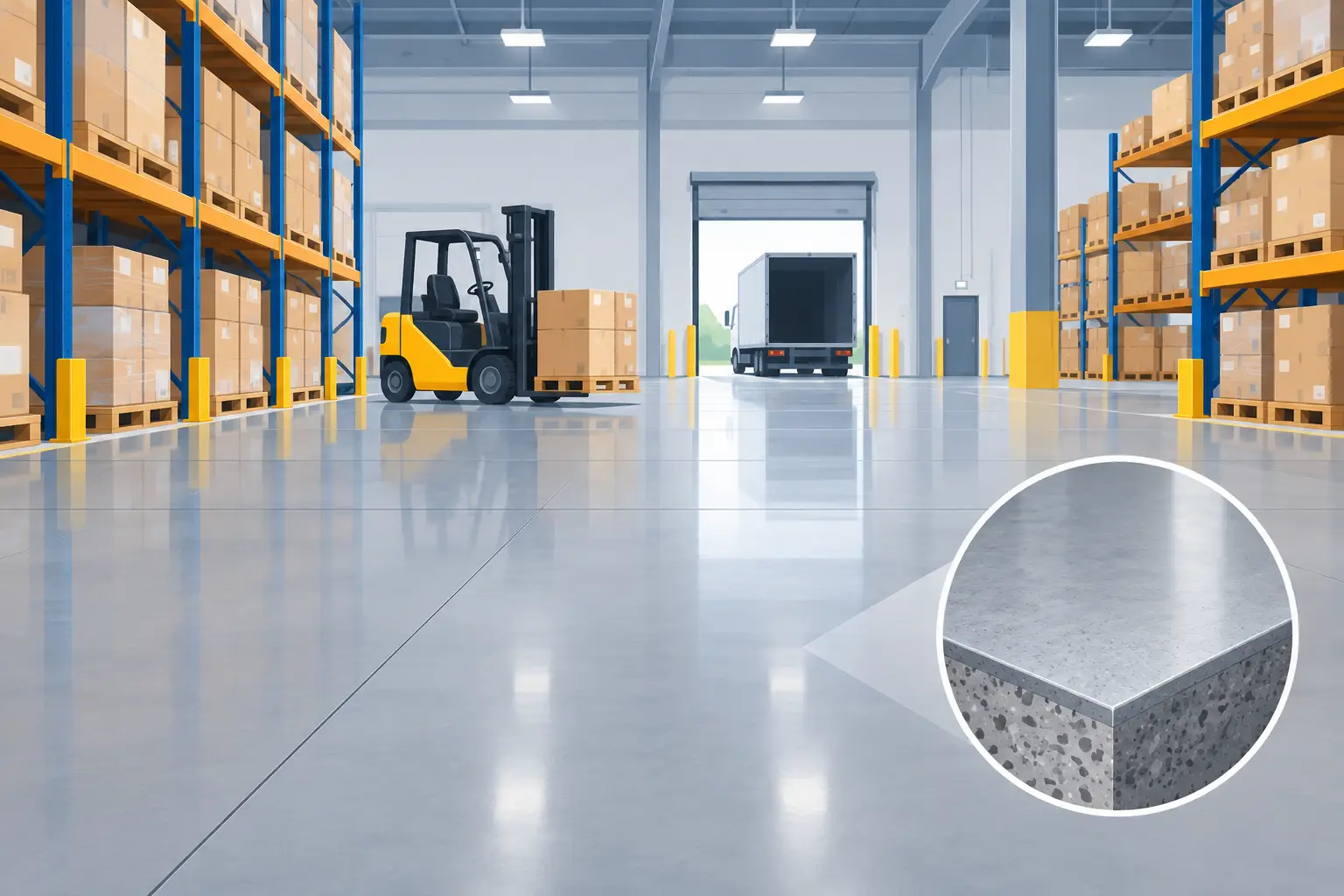
A distribution center floor is not a background surface. It is the operating platform for every pallet, forklift, loading route, pick lane, and employee shift. Choosing the best flooring for distribution centers means looking beyond a low installation price and asking what the floor will cost after years of wheel traffic, impact, abrasion, spills, and daily cleaning.
For most facilities, the existing concrete slab is the starting point. The right system either strengthens and refines that slab or protects it with a purpose-built coating or topping. There is no single finish that wins in every building, but there is a clear way to match the floor to the operation.
The Best Flooring for Distribution Centers Starts With the Slab
A floor can only perform as well as its preparation allows. Distribution centers commonly have joints, surface dusting, old coatings, tire wear, cracks, moisture vapor, and uneven areas created by years of traffic. Covering those conditions without correcting them is how a new floor becomes a short-term expense.
Before selecting a finish, evaluate the slab’s flatness, compressive strength, moisture condition, contamination, joint condition, traffic pattern, and exposure to chemicals. Forklifts do not wear a floor evenly. Receiving lanes, battery charging areas, racking aisles, and dock approaches usually demand more protection than low-traffic storage zones.
Professional diamond grinding removes weak material, opens the concrete surface, and creates the profile needed for a coating or overlay to bond properly. It also reveals defects that need repair before they become coating failures. This preparation phase is where experienced flooring contractors protect the budget and the schedule.
Polished Concrete: The Leading Choice for Dry, High-Traffic Facilities
For many distribution centers, polished concrete is the strongest long-term value. The process mechanically grinds the slab with industrial diamond tooling, applies a densifier to harden the concrete, and refines the surface to the specified level of clarity and gloss. The result is not a paint layer that can peel. It is a denser, more durable concrete surface.
Polished concrete handles heavy rolling traffic exceptionally well when the underlying slab is sound. Forklift tires, pallet jacks, carts, and foot traffic have less opportunity to grind down a properly densified surface than they do on untreated concrete. The finish also reduces dusting, brightens the facility by reflecting available light, and simplifies routine cleaning.
The maintenance advantage matters. A polished floor generally needs regular sweeping, auto-scrubbing with the correct cleaner, and occasional joint repair rather than repeated stripping and recoating. For an operator managing tens or hundreds of thousands of square feet, that can create substantial savings over the life of the building.
Polished concrete is not the automatic answer for every zone. It is best suited to dry warehouses, fulfillment centers, logistics facilities, and staging areas where appearance, abrasion resistance, low maintenance, and operational uptime are priorities. A highly polished finish may show tire marks or scuffs more readily than a lower-gloss finish, so many industrial clients choose a practical satin sheen rather than a showroom-like shine.
Safety and traction are part of the finish specification
A polished floor does not have to mean a slippery floor. Slip resistance depends on the surface condition, contaminants, cleaning practices, footwear, and the level of aggregate exposure, not simply whether the floor has shine. In active facilities, a properly specified polish can provide a cleanable, slip-conscious walking surface while avoiding an overly aggressive texture that makes equipment harder to roll.
Where water, oil, or process liquids are routinely present, traction additives, drainage, matting, or a different flooring system may be necessary. Safety is determined by the actual operating environment, not a generic product claim.
When Epoxy Flooring Makes More Sense
Epoxy coatings are a strong option when color, line striping, stain resistance, or a more uniform cosmetic appearance is required. They are often specified for defined work areas, maintenance rooms, battery stations, packing zones, and operations with moderate chemical exposure. A quality epoxy system can create a clean, professional surface that is easy to identify, organize, and maintain.
The trade-off is that epoxy is a coating system. It depends on proper surface preparation, correct moisture conditions, adequate film thickness, and realistic expectations about impact and tire traffic. If moisture vapor moves through the slab or the concrete was poorly prepared, adhesion problems can develop. Hot forklift tires, sharp impacts, and aggressive point loading can also damage a thin or improperly specified epoxy floor.
Epoxy should not be chosen solely because it looks good on installation day. In a high-volume distribution center, the coating must be engineered for the traffic load and prepared with industrial-grade grinding. A bargain coating can become an expensive shutdown when it starts to delaminate in main travel lanes.
Urethane Cement for Wet, Hot, or Chemically Demanding Areas
Urethane cement is often the better choice where a distribution center includes washdown areas, food handling, beverage operations, manufacturing support spaces, or sustained chemical exposure. This high-build system has excellent resistance to thermal shock, moisture-related conditions, and many harsh service environments.
It is more expensive than a basic epoxy coating, and it may be unnecessary for a conventional dry warehouse. But in the right setting, urethane cement delivers performance that polished concrete and standard epoxy systems cannot match. It can be installed with texture for better traction and is especially valuable where wet conditions are a normal part of the workday.
For facilities that need both a durable base and specific visual or chemical-resistance properties, a urethane cement system may also receive an additional topcoat. The specification should be built around exposure conditions, not copied from a neighboring facility with a completely different operation.
Overlays and Toppings for Damaged Concrete
Some slabs are too deteriorated, uneven, or contaminated to polish into a consistent finished floor. In those cases, a cementitious overlay or industrial topping can restore the surface and create a new wear layer. Toppings can correct localized damage, improve flatness, and prepare a worn facility for a polished or coated finish.
This approach requires judgment. An overlay is not a shortcut around unresolved slab movement, moisture, or structural cracking. Those conditions must be addressed first. When properly installed, however, a topping can extend the useful life of a facility floor without the cost and disruption of full slab replacement.
How to Choose the Right System
The best decision comes from matching the system to operating conditions. Consider four questions before approving a flooring scope:
- How much forklift, pallet-jack, and rolling load traffic will the floor receive each day?
- Is the area dry, or does it experience washdowns, spills, humidity, oils, or chemical exposure?
- Does the operation need color zones, safety striping, or a highly uniform visual finish?
- How much downtime can the facility tolerate during preparation, installation, and cure time?
A dry, high-traffic fulfillment center will often gain the most from mechanically polished concrete. A chemical-intensive maintenance area may require epoxy or urethane cement. A wet processing zone needs a system designed for moisture, traction, and thermal stress. Many of the best facilities use more than one flooring solution, placing each material where it delivers the highest return.
Do Not Ignore Moisture, Joints, and Downtime
Even in Southern California, concrete moisture cannot be judged by climate alone. Slabs can retain moisture or receive vapor from below, especially in older buildings or facilities with inadequate vapor barriers. Moisture testing should guide the system selection before a coating is installed. It is far less expensive to identify a moisture issue early than to repair widespread coating failure later.
Joints also deserve attention. Distribution center traffic repeatedly strikes joint edges, causing spalling that can damage wheels and create rough travel paths. Semi-rigid joint fillers and timely concrete repair help protect both the floor and the equipment moving across it.
Downtime must be planned with the same discipline. Polished concrete can often be phased around active operations, while coatings and toppings require cure windows that vary by product, temperature, and system thickness. The right contractor will sequence work by zones, maintain safe access routes, and limit disruption without compromising preparation standards.
A distribution center floor should make the operation easier to run, not create another recurring maintenance problem. Start with the slab, define the real traffic and exposure conditions, and select the finish that will still perform when the building is working at full speed.
Clients We Service
We provide our concrete polishing and related services to a wide variety of clients. Some of the types of clients that we provide service to include:


