
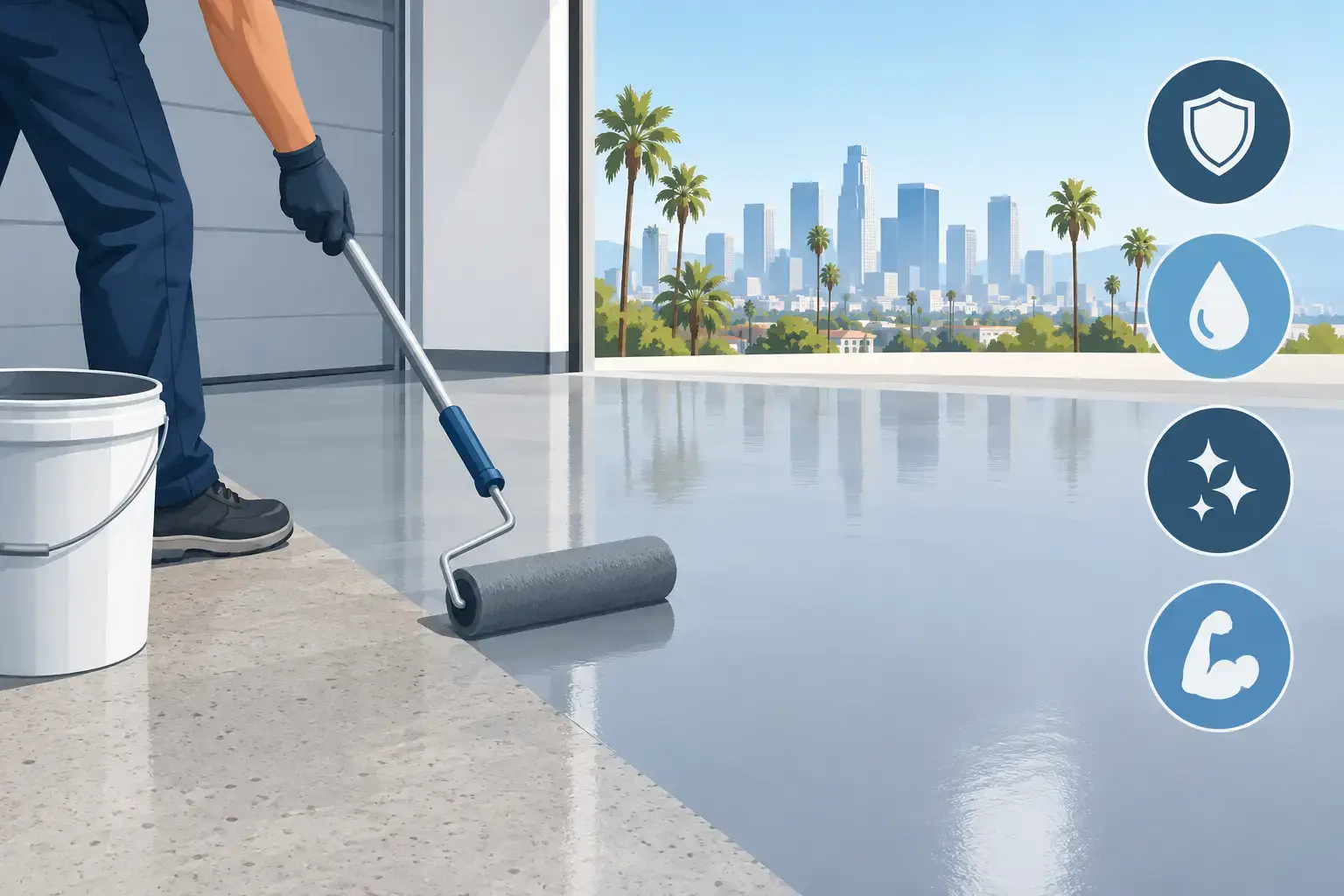
A coating failure rarely starts with the topcoat. It starts below the surface: moisture vapor pushing upward, oil buried in the slab, weak concrete paste, or a rushed preparation schedule. This protective concrete coatings guide helps property owners and facility managers choose a system that performs under real Southern California conditions, not just one that looks good on installation day.
What Protective Concrete Coatings Actually Do
Protective coatings create a wear layer over concrete, helping the floor resist abrasion, staining, chemical exposure, dusting, and daily traffic. In warehouses, production areas, garages, retail spaces, and commercial kitchens, the right system can make cleaning faster, improve light reflectivity, and protect the slab from expensive deterioration.
A coating is not automatically the best answer for every concrete floor. Polished concrete, densified concrete, toppings, and coatings solve different problems. A polished floor may be the stronger long-term choice for a dry showroom, office, loft, or retail environment where a refined appearance and low maintenance matter most. A coating may be the better choice where color zoning, chemical resistance, waterproofing, or a defined safety texture is required.
The best flooring decision begins with how the building operates. Forklifts, pallet jacks, dropped tools, hot tires, food oils, cleaning chemicals, direct sunlight, and constant foot traffic create very different demands. Selecting a coating based only on color or a low initial bid often leads to premature peeling, scratches, or a floor that is difficult to maintain.
Protective Concrete Coatings Guide: Match the System to the Risk
There is no single “best” coating. The right product depends on the slab, the exposure, the expected traffic, and the allowable downtime.
Epoxy coatings
Epoxy is a proven choice for many commercial and industrial floors because it can create a thick, attractive, chemical-resistant surface. It is commonly used in warehouses, medical spaces, retail back rooms, automotive areas, and light manufacturing facilities. Epoxy also accepts decorative flakes, colored quartz, and broadcast aggregate for added texture.
The trade-off is that standard epoxy can amber under prolonged UV exposure and may become slippery when wet if no aggregate is added. It also requires disciplined surface preparation. Epoxy applied over a damp or contaminated slab can lose adhesion regardless of how premium the material is.
Urethane and polyurethane topcoats
Urethane systems are often installed over epoxy to improve scratch resistance, chemical resistance, and UV stability. They are a practical choice in spaces with sunlight, frequent washdowns, or temperature movement. Their flexibility can help manage minor slab movement better than a rigid coating alone.
Because urethane is usually applied thinner than epoxy, it is not typically used to hide major surface defects by itself. It performs best as part of a properly specified multi-coat system.
Polyaspartic coatings
Polyaspartic coatings cure quickly and can reduce downtime, which makes them attractive for occupied facilities, retail spaces, and residential garages. They offer strong UV stability and can often be returned to service faster than conventional epoxy systems.
Fast cure times are an advantage only when the installer has the equipment, crew capacity, and site control to work within the material’s application window. A rushed installation or poor moisture evaluation can still produce failure. Fast does not replace proper preparation.
Cementitious urethane and heavy-duty systems
For food processing areas, commercial kitchens, breweries, manufacturing facilities, and other environments exposed to heat, moisture, impact, and aggressive cleaning, cementitious urethane systems are often worth the higher upfront investment. These systems can handle severe service conditions that would quickly damage decorative coatings.
They are not always necessary for a standard office or dry storage area. Overbuilding a floor wastes budget, while underbuilding it creates repeat repair costs. The system should fit the operation, not a generic product label.
Start With the Slab, Not the Finish Color
Concrete is not a blank canvas. Before specifying a protective floor, a professional evaluation should identify the slab’s condition, moisture profile, surface hardness, previous coatings, contamination, cracks, joints, and flatness. These factors determine whether the floor can receive a direct-applied coating or needs repair, moisture mitigation, grinding, or a topping first.
Moisture deserves particular attention in Los Angeles and Orange County properties. Even when the surface looks dry, moisture vapor can move through a slab and create pressure beneath an impermeable coating. The result may be bubbling, blistering, delamination, or white mineral deposits at edges and joints. A moisture test is not a formality. It is a risk-control step that protects the owner, the installer, and the long-term flooring investment.
Oil and grease contamination are equally serious. In auto service areas, warehouses, and older industrial buildings, contaminants can penetrate deeply into concrete. Mechanical grinding, shot blasting, degreasing, and targeted repairs may be necessary before a coating can bond correctly.
Surface Preparation Determines Coating Life
The strongest coating material cannot compensate for weak preparation. The concrete must be mechanically profiled so the coating can grip a clean, sound surface. Depending on the system, the installer may use diamond grinding or shot blasting to create the required concrete surface profile.
Cracks, spalls, and failed joints should be repaired before the main coating installation. Hairline cracks may still telegraph through some systems as the slab moves over time, so expectations should be realistic. A coating can protect concrete and improve appearance, but it cannot stop structural movement.
Preparation also affects the finished look. Decorative flake floors and high-gloss coatings can make patchwork, uneven repairs, and slab imperfections more visible if they are not addressed correctly. For a premium result, the repair plan must be part of the coating plan from the beginning.
Safety, Texture, and Cleanability Must Work Together
A glossy floor can improve brightness and create a clean, professional image, but gloss alone is not a safety feature. In areas exposed to water, oils, or frequent washdowns, a slip-conscious texture should be designed into the coating system. Fine aggregate can provide traction without creating a surface so rough that mops, carts, and cleaning equipment struggle to move across it.
This is a balancing act. More texture can improve traction but may hold dirt and increase cleaning time. Less texture is easier to clean but may not suit wet conditions. A warehouse aisle, restaurant entry, loading area, and residential garage each require a different level of texture.
Color can also support safer operations. High-visibility striping, pedestrian lanes, equipment zones, and work areas can be incorporated into a coating plan. These details help organize traffic and reinforce facility standards without relying on temporary tape that lifts or wears away.
Plan Installation Around Operations
A protective coating project should be planned around the facility’s real schedule. The process may include grinding, repairs, moisture mitigation, primer application, body coats, broadcast aggregate, topcoats, curing, and return-to-service timing. Each stage affects how quickly the area can reopen to foot traffic, carts, vehicles, or forklifts.
For active businesses, phased installation is often the practical solution. Completing one area at a time can limit disruption while maintaining access to essential operations. Los Angeles Concrete Polishing evaluates these constraints before work begins, because a high-performing floor is only valuable if the project can be executed safely and efficiently.
Owners should also ask what happens at transitions, drains, doorways, wall edges, expansion joints, and equipment bases. These details are where water, impact, and daily cleaning expose weak workmanship first.
Maintain the Floor You Specified
Coated concrete is low maintenance, not no maintenance. Use cleaning products that fit the installed system, remove abrasive debris regularly, and clean chemical spills promptly. Avoid harsh solvents or aggressive pads unless the coating manufacturer and installer recommend them.
High-traffic paths may eventually need a maintenance coat, especially where forklifts turn, carts pivot, or sunlight is intense. Planning for this service is smarter than waiting until the coating wears through to bare concrete. Routine inspections also catch failing joint sealant, impact damage, and drainage issues before they spread.
Choose Performance Over a Quick Cosmetic Fix
The right protective concrete coating protects more than the slab. It supports cleaner operations, safer movement, lower maintenance demands, and a better-looking property. The wrong one can trap moisture, complicate cleaning, and create a repair project far sooner than expected.
Before approving a coating, ask for a recommendation based on traffic, chemicals, moisture, safety needs, appearance goals, and downtime limits. A floor system built around those answers will deliver far more value than a one-size-fits-all finish.
Clients We Service
We provide our concrete polishing and related services to a wide variety of clients. Some of the types of clients that we provide service to include:


