
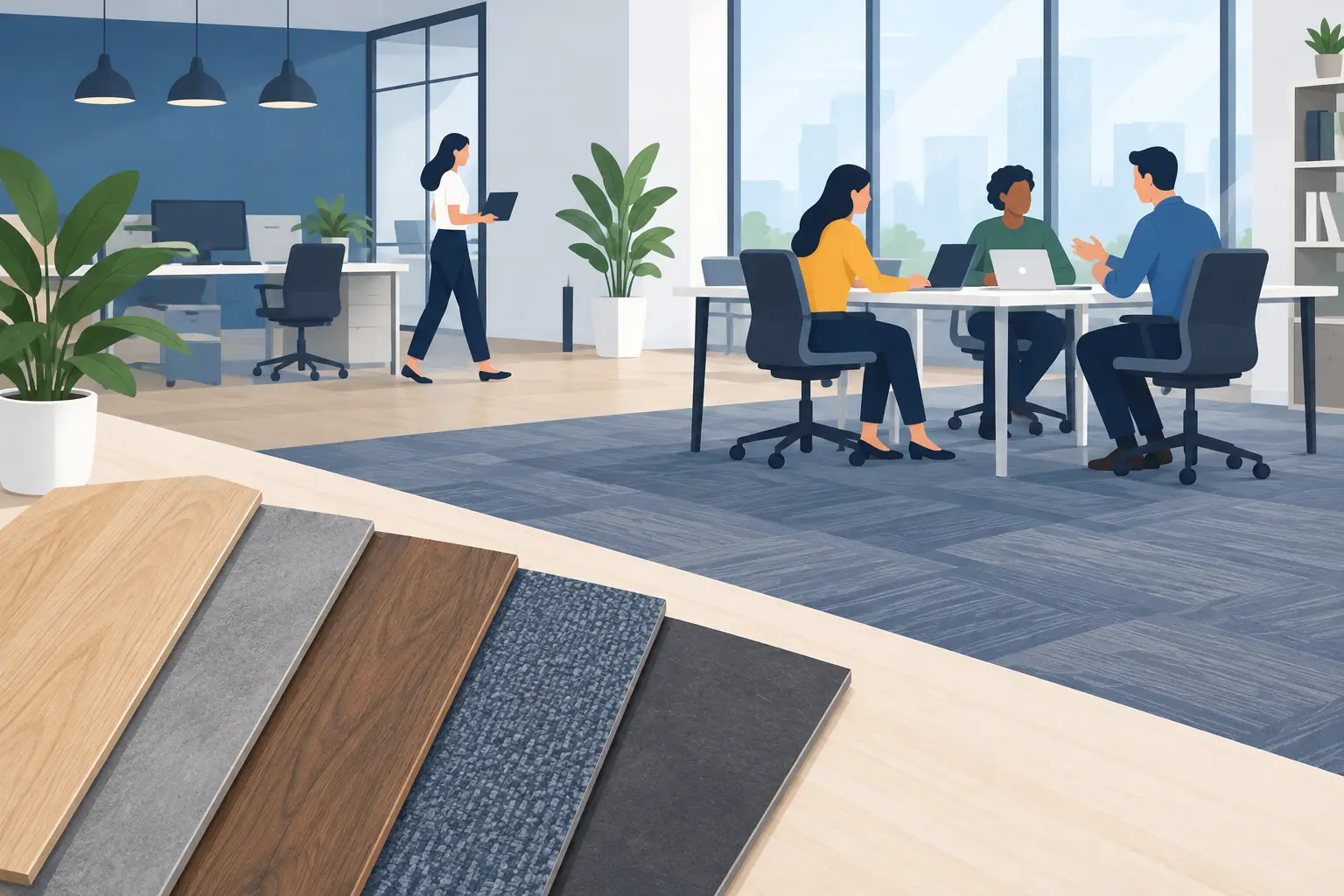
A floor can look polished on opening day and still become an expensive problem within a year. Scuffed paths from rolling chairs, stained break rooms, worn entryways, moisture issues, and repeated repairs all affect the real cost of an office finish. This office flooring selection guide focuses on what matters after installation: performance, cleaning demands, safety, appearance, and interruption to your business.
For Los Angeles and Orange County offices, the right answer is rarely based on color alone. A creative studio with an exposed-concrete aesthetic has different requirements than a medical office, call center, corporate headquarters, or mixed-use property lobby. Start with how the space works, then select the system that can handle it.
Start With the Way Your Office Is Actually Used
The best flooring decision begins with traffic patterns, not a product sample. Walk the space and identify where people enter, wait, work, eat, print, meet, and move equipment. High-traffic corridors, reception areas, copy rooms, kitchens, and paths between workstations take the most punishment. Those areas need stronger wear resistance than a private office used by one person.
Rolling office chairs deserve special attention. Chair casters can flatten carpet fibers, scratch softer surfaces, and expose weak wear layers on low-grade resilient flooring. If the office regularly moves carts, displays, filing systems, or equipment, specify a floor built for point loads and abrasion rather than relying on a residential-grade finish.
Also consider what reaches the floor. Rainwater at entrances, coffee in break rooms, toner near printers, cleaning chemicals, and occasional oil or grease in service-oriented offices all require different protection. A floor that is easy to clean may still need a sealer, densifier, or coating to resist the contaminants present in your facility.
Office Flooring Selection Guide: Compare the Main Options
There is no single best flooring material for every office. The strongest choice balances the image you want to project with the operating conditions you cannot ignore.
Polished concrete
Polished concrete is a leading choice for modern offices, showrooms, creative spaces, lobbies, and converted industrial buildings with an existing concrete slab. Diamond grinding removes surface imperfections, then progressively finer diamond grits refine the surface. A densifier hardens the concrete and helps create a durable, light-reflective finish.
Its primary advantage is long-term value. A properly prepared and polished slab does not have seams, grout lines, or fibers that trap dirt. Daily dust mopping and periodic wet cleaning are generally enough to maintain it, making it especially attractive for owners focused on lower maintenance costs. It also handles heavy foot traffic well and can deliver anything from a satin finish to a high-gloss presentation.
The trade-off is that concrete is not naturally soft or warm underfoot. Acoustic planning may be necessary in open offices, especially where calls and meetings take place at the same time. Area rugs, acoustic wall treatments, ceiling systems, and upholstered furnishings can address sound without giving up the durability of the floor. Existing slab condition matters too. Cracks, old adhesives, moisture vapor, and uneven areas must be evaluated before the final finish is selected.
Carpet tile
Carpet tile remains practical where sound absorption and underfoot comfort are top priorities. It works well in conference rooms, executive suites, and work areas where employees spend long periods seated or standing. Individual damaged tiles can often be replaced without removing the entire floor.
However, carpet is a maintenance commitment. It holds dust, allergens, spills, and odors more readily than hard-surface flooring. High-traffic lanes can become visibly worn, and commercial cleaning must be scheduled consistently to protect appearance. Carpet tile is usually strongest as a targeted solution, not necessarily as the best universal choice for an entire busy office.
Luxury vinyl tile and plank
LVT and LVP can provide a wide range of wood, stone, and contemporary visual styles at a moderate initial price. They are quieter and more forgiving underfoot than concrete, and quality commercial products can perform well in standard office environments.
The key word is quality. Thin products or poorly prepared subfloors can lead to telegraphing, edge damage, joint separation, and premature wear. In direct sun, temperature swings and heavy rolling loads can also test the material. Ask about wear-layer thickness, adhesive selection, subfloor moisture testing, and the manufacturer’s warranty for your specific application. Vinyl is often a sensible fit for tenant improvements, but it should not be treated as a no-prep shortcut.
Epoxy and protective coatings
Epoxy and urethane systems are valuable when an office includes back-of-house operations, loading areas, workshops, storage rooms, or spaces exposed to chemicals and moisture. These systems can create a uniform, cleanable surface with color options, decorative flakes, and added chemical resistance.
Coatings need disciplined surface preparation. Concrete must be mechanically profiled, cleaned, and tested for moisture before application. Skipping that work can cause peeling, bubbling, or bond failure. For spaces with heavy UV exposure, a urethane topcoat may be preferable because some epoxy products can amber over time.
Evaluate the Existing Slab Before You Set a Budget
In many offices, the concrete slab is either the finished floor or the foundation beneath every other flooring system. That makes slab evaluation one of the most valuable early project steps. A contractor should inspect for cracks, spalls, prior coatings, adhesive residue, flatness issues, and signs of moisture vapor transmission.
Moisture is not a minor technical detail. It can weaken adhesives, discolor finishes, and cause coating failures. Southern California buildings can still experience moisture challenges from slab age, site conditions, vapor barriers, plumbing leaks, or changes in indoor climate control. Proper testing helps determine whether polishing, a moisture-mitigation system, or another flooring assembly is appropriate.
Do not assume an older slab cannot become an attractive finished floor. Many can be transformed through grinding, patching, densifying, staining, and polishing. At the same time, a professional assessment should set realistic expectations. Aggregate exposure, patch color, existing cracks, and previous repairs may become part of the final visual character.
Price the Floor Over Its Service Life
The lowest installed price is not always the lowest-cost decision. A flooring material that requires frequent replacement, specialty cleaning, or repeated spot repairs can cost more over five to ten years than a more durable finish installed correctly at the outset.
When comparing proposals, separate the upfront scope from the lifecycle demands. Ask how often the floor will need deep cleaning, resealing, refinishing, tile replacement, or recoating. Account for disruption as well. Closing a reception area for repairs, moving furniture, or managing odors and cure times has a real operational cost.
Polished concrete often performs strongly in this comparison because it improves the slab you already own. There is no additional floor covering to delaminate or wear through. A coating system may be the better investment where chemical resistance or a specific color-coded safety finish is required. Carpet or vinyl may make sense when comfort, sound control, or a particular branded appearance outweighs their replacement cycle.
Protect Safety Without Sacrificing Appearance
Gloss does not automatically mean a floor is unsafe, and a matte floor is not automatically slip resistant. Traction depends on the surface profile, contaminants, cleaning practices, footwear, and how the area is used. Entrances, kitchens, restrooms, and beverage stations need particular attention because water and spills change the risk level.
Specify the right finish for the location. A highly polished lobby can be visually effective, while a workroom or service corridor may need a more texture-conscious coating or a lower-gloss concrete finish. Use entry mats where they are needed, clean spills quickly, and avoid maintenance products that leave a slick residue. Safety comes from the complete system, not from a single product claim.
Plan Installation Around Business Operations
A flooring project should be designed around access, furniture, noise, dust control, cure time, and employee schedules. Grinding and polishing can be managed in phases so an office does not have to shut down completely. Dust-control equipment, containment, and clear work sequencing protect occupied areas and reduce unnecessary disruption.
Before work begins, decide which rooms can be completed after hours or on weekends, where furniture will be staged, and when employees can return to each area. Coatings may require specific cure windows, while polished concrete can often be opened in stages as the work progresses. The right contractor will explain those differences before the schedule is locked in, not after your office is already moved around.
The strongest office floor is the one that continues to look professional after thousands of footsteps, rolling chairs, cleaning cycles, and busy workdays. Choose a system based on the demands beneath your feet, and insist on preparation and installation standards that protect your investment long after the project is complete.
Clients We Service
We provide our concrete polishing and related services to a wide variety of clients. Some of the types of clients that we provide service to include:


