
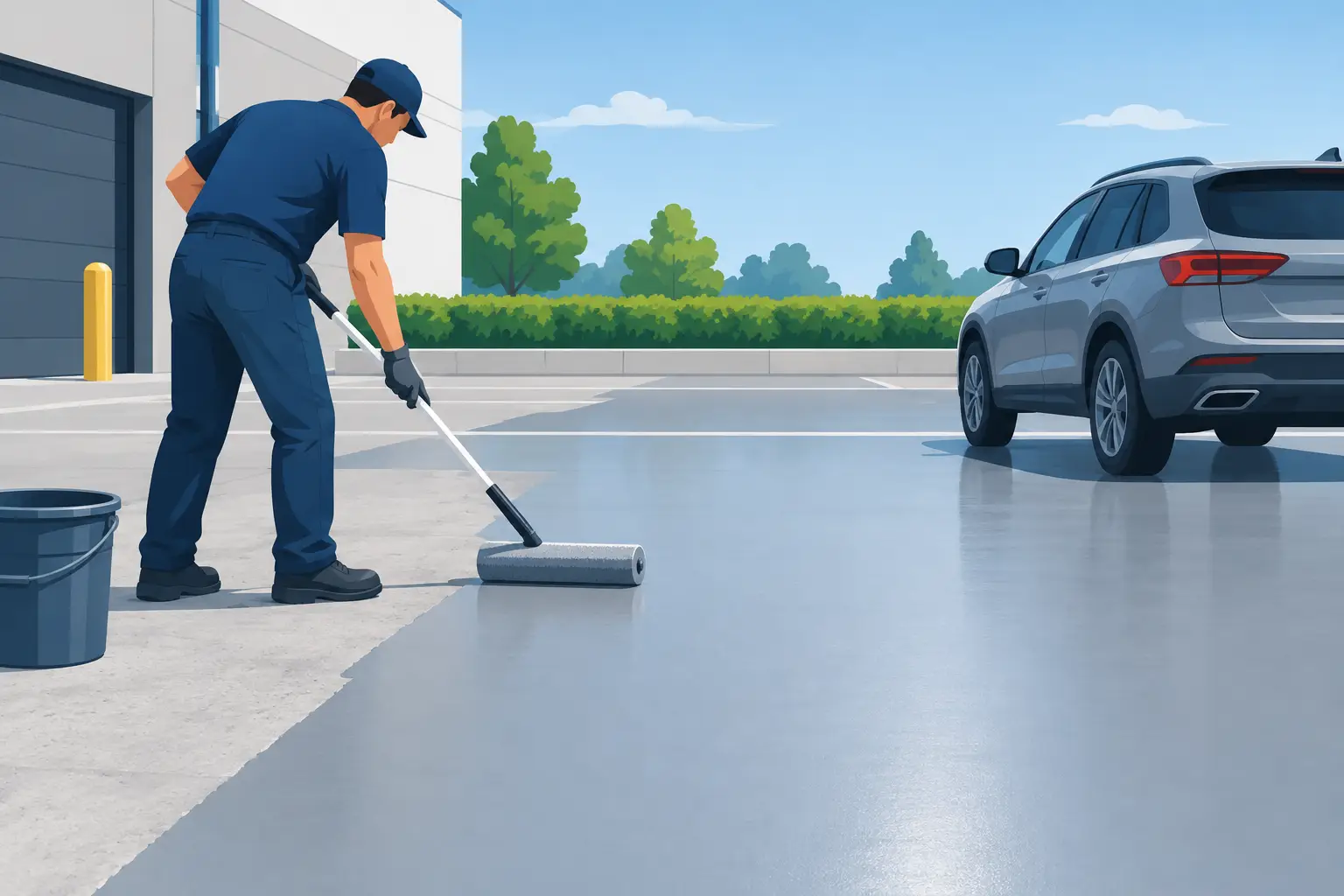
A warehouse slab does not fail all at once. It starts with tire wear in travel lanes, dust collecting along joints, stains that never quite come clean, and rough patches that make forklifts, carts, and customers feel every defect. Concrete resurfacing gives property owners a practical way to restore that surface without automatically taking on the cost, demolition, and extended downtime of full slab replacement.
For commercial properties, the right system is not simply about making concrete look newer. It must match traffic, moisture conditions, cleaning practices, chemical exposure, and the amount of time the space can be out of service. For homes, lofts, showrooms, and retail spaces, finish quality and color consistency may carry more weight. The best result comes from treating the existing concrete as a performance surface, not a blank canvas.
What Concrete Resurfacing Actually Fixes
Concrete resurfacing is the installation of a new cementitious or polymer-modified layer over properly prepared concrete. It can renew a worn, pitted, stained, lightly spalled, or cosmetically dated slab while creating a more uniform surface for polishing, coatings, decorative finishes, or everyday use.
It is a strong option when the original concrete is structurally sound but its top layer has deteriorated. Common candidates include warehouse floors with surface abrasion, office entries with worn aggregate exposure, retail floors with old adhesive residue, and residential patios or garage floors with shallow scaling.
Resurfacing does not solve every problem. If the slab is heaving, moving substantially, suffering from serious settlement, or showing active structural cracking, a thin overlay will not correct the underlying condition. Those issues need diagnosis before any finish system is selected. Covering movement with new material may produce a clean appearance at first, then lead to reflective cracking later.
Start With the Slab, Not the Finish
The most reliable resurfacing projects begin with a site assessment. Experienced contractors look beyond surface stains and visible cracks to evaluate moisture, soundness, contamination, flatness, joint condition, and the way the floor is used every day.
Moisture deserves particular attention in Southern California commercial buildings. A slab can look dry at the surface and still transmit moisture vapor that compromises an overlay, coating, or adhesive. Moisture testing helps determine whether the floor needs a mitigation system, a breathable material, or a different approach altogether. Skipping this step is one of the fastest ways to turn a budget-conscious floor upgrade into an expensive repair.
Surface contaminants also matter. Oil, curing compounds, paint, old coatings, tire residue, and adhesive can prevent proper bond. A durable resurfacing system depends on mechanical preparation, typically through diamond grinding, shot blasting, or other methods chosen for the slab and specified finish. The goal is to create a clean, sound profile that allows the new material to lock onto the concrete.
Cracks require a separate decision. Some can be routed, repaired, and incorporated into the finished surface. Others are moving cracks that need flexible treatment or may remain visible by design. A contractor who promises that every crack will disappear permanently is overselling the system. Concrete moves. The right plan controls risk and sets realistic expectations.
Choosing the Right Resurfacing System
There is no single best overlay for every property. The right material depends on the floor’s condition and the demands placed on it after installation.
A cement-based microtopping can create a refined, contemporary appearance with a thin application. It works well in retail spaces, offices, residences, and lofts where visual continuity is a priority. It may be polished or sealed depending on the design and performance goal. Because it is thin, it requires excellent preparation and a stable substrate.
Self-leveling underlayment or topping can improve floor profile where minor low areas, rough patches, or uneven transitions create operational problems. In facilities using carts, pallet jacks, or rolling equipment, correcting these areas can improve day-to-day movement and reduce impact on wheels and loads. It is not a substitute for correcting major slab movement or drainage failures.
High-build cementitious overlays are often selected for more demanding industrial or commercial conditions. They can restore areas with broader surface damage and may be finished with protective coatings or sealers that address chemical resistance, abrasion, or cleanliness requirements. The finished texture should be matched to the operation. A glossy, smooth floor may suit a showroom, while a slip-conscious texture may be the better choice for a service area or wet process zone.
Decorative resurfacing systems can add color, patterns, or a stone-like appearance to patios, pool decks, storefronts, and residential interiors. Design flexibility is a genuine advantage, but maintenance and traction still need to drive the decision. A beautiful finish that becomes difficult to clean or too slick in wet conditions is not the right finish.
Resurfacing, Polishing, Coatings, or Replacement?
Property owners often group these services together, but they solve different problems. Concrete polishing mechanically refines an existing slab through progressive diamond grinding and polishing. When the concrete has good integrity and the desired look is exposed aggregate or a high-clarity polished finish, polishing can deliver outstanding durability with low maintenance.
Resurfacing adds material. That makes it valuable when the surface is too damaged, uneven, or visually inconsistent for polishing alone. It can also create the uniform canvas needed for a decorative or architectural finish. The trade-off is that overlays are only as reliable as their bond to the underlying concrete, so preparation and moisture control become even more critical.
Protective coatings are often the right answer when chemical resistance, color coding, fast turnaround, or a specific safety texture is required. Epoxy, urethane, polyaspartic, and similar systems each have different strengths. They should be selected based on exposure, cure schedule, UV conditions, and cleaning chemistry, not because a certain product is fashionable.
Full replacement becomes the smarter investment when the slab has widespread structural failure, severe settlement, extensive delamination, or drainage problems that cannot be resolved at the surface. It is the most disruptive option, but forcing a cosmetic repair onto a failing substrate rarely saves money over the long term.
What a Professional Installation Looks Like
A disciplined installation sequence protects both floor performance and project schedule. First, the team evaluates access, work zones, operating hours, and protection needs for adjacent areas. In active warehouses, retail spaces, and offices, phased work can often limit disruption by keeping sections of the facility operational.
The slab is then prepared mechanically. Damaged material is removed, cracks and joints are addressed according to the system design, and the surface is cleaned of bond-breaking contaminants. The resurfacing material is mixed and placed within its working time, then spread, leveled, textured, or troweled to the required finish.
Cure time is not an inconvenience to ignore. It is part of the system. Some products support quick return to service, while others need more time before traffic, polishing, sealing, or coating. Rushing forklifts, rolling loads, or cleaning equipment onto a floor before it reaches the required strength can damage an otherwise excellent installation.
After curing, the floor may be ground, polished, sealed, or coated. Final choices should reflect the space. A distribution facility may need abrasion resistance and clear traffic markings. A retail environment may prioritize a clean, elevated appearance. A residential floor may benefit from a satin finish that is easier to live with than a mirror-like gloss.
Performance Depends on Maintenance
A resurfaced floor is not maintenance-free, but it can be far easier to maintain than neglected concrete or failing tile. Dry debris should be removed regularly because grit acts like sandpaper under foot traffic and vehicle tires. Use cleaners compatible with the floor’s sealer or coating, and avoid aggressive chemicals unless the system was specifically designed for them.
Facility managers should also watch joints, entryways, loading areas, and repeated turning zones. These are high-stress locations where early attention can prevent small issues from spreading. In commercial settings, a maintenance plan should be part of the flooring decision, not an afterthought once the crew has left.
The Cost Question: Focus on Lifecycle Value
Concrete resurfacing costs vary with preparation requirements, moisture mitigation, repair volume, material thickness, access, finish level, and project phasing. A simple cosmetic overlay in an open residential garage is fundamentally different from a moisture-managed, chemical-resistant flooring system installed around an operating facility.
The lowest upfront price is rarely the most useful comparison. Ask what preparation is included, how cracks and joints will be handled, whether moisture testing is part of the scope, what downtime is expected, and what maintenance the finished floor will require. Clear answers signal a contractor who understands the full floor system rather than only the visible finish.
For Los Angeles and Orange County property owners, a properly specified resurfacing project can extend the useful life of existing concrete, improve safety and appearance, and avoid unnecessary demolition. The right next step is a thorough slab evaluation that identifies what the floor needs before a finish is promised.
Clients We Service
We provide our concrete polishing and related services to a wide variety of clients. Some of the types of clients that we provide service to include:


