
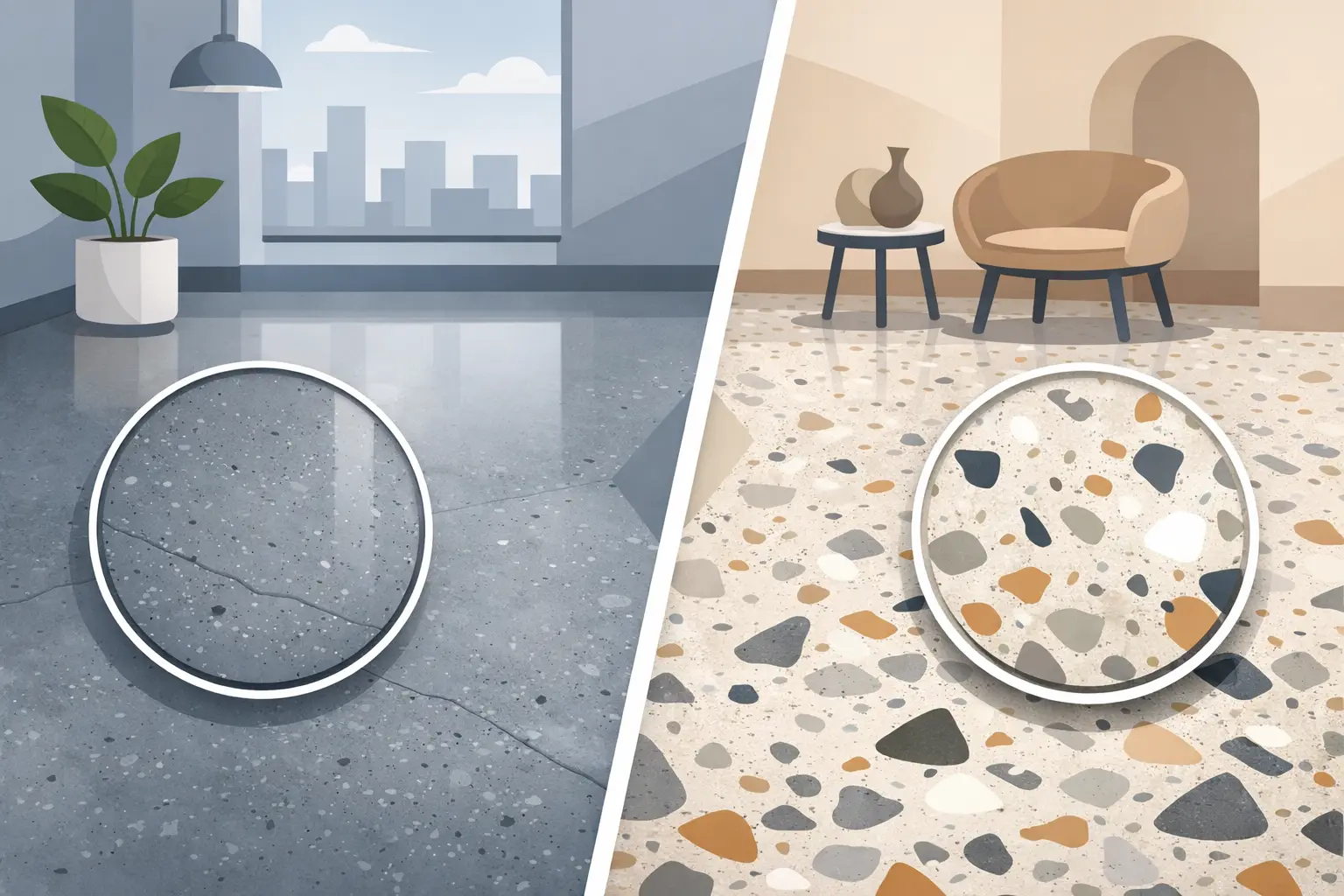
A warehouse aisle, retail showroom, office lobby, or modern loft floor has to do more than look good on opening day. It has to tolerate traffic, cleaning crews, rolling loads, spills, and the occasional change in use without becoming an expensive maintenance problem. In the polished concrete versus terrazzo decision, both materials can create a premium-looking surface. The right choice comes down to what is already underfoot, how the space operates, the available budget, and how much design customization matters.
For many Los Angeles and Orange County commercial properties, polished concrete delivers the strongest value because it improves the slab already in place. Terrazzo remains an exceptional architectural finish when decorative freedom and a highly specified appearance justify a more involved installation.
Polished Concrete Versus Terrazzo: The Core Difference
Polished concrete is an existing concrete slab, or a cementitious topping, mechanically refined with progressively finer diamond abrasives. A professional crew repairs joints and cracks as appropriate, removes contaminants, densifies the concrete, and polishes it to the selected gloss level. The finished floor is concrete itself, enhanced for improved appearance, abrasion resistance, and easier cleaning.
Terrazzo is a composite flooring system. Decorative chips, commonly marble, glass, quartz, or recycled materials, are embedded in a binder and then ground and polished. The binder may be cement-based or epoxy-based. Metal divider strips can create geometric fields, borders, logos, and detailed patterns that are difficult to achieve with conventional polished concrete.
That difference shapes the whole project. Concrete polishing works with the character and limitations of the slab. Terrazzo creates a new decorative surface designed to a specific visual concept.
Appearance: Natural Variation or Controlled Design
Polished concrete has a clean, contemporary appearance that fits industrial facilities, retail environments, restaurants, offices, homes, and converted lofts. Clients can choose a low-sheen, satin, or high-gloss finish. Aggregate exposure can range from a cream polish, which leaves most of the surface intact, to a deeper cut that reveals more sand or larger aggregate.
No two slabs polish exactly alike. Previous patches, old adhesive, trowel marks, aggregate distribution, and variations in concrete placement can remain visible. That individuality is a major part of the appeal for many projects. It can also be a surprise when a client expects a perfectly uniform, showroom-like field. A slab assessment before work begins is the best way to set realistic expectations.
Terrazzo offers greater control over color, chip blend, pattern, and branding. It can be understated, with a neutral aggregate blend, or highly expressive, with custom colors and complex layouts. For a hospitality lobby, luxury retail space, institutional corridor, or flagship office, that design latitude can be worth the investment.
If the goal is a refined floor with honest material character, polished concrete is often the better fit. If the floor itself needs to function as a major design feature, terrazzo has the advantage.
Installation, Downtime, and Existing Conditions
Installation is where commercial decision-makers often see the most meaningful separation. Polished concrete can be efficient when the existing slab is structurally sound and accessible. The process still creates noise, vibration, and dust, but experienced contractors use industrial vacuum systems and carefully sequence work to control disruption. In many active facilities, areas can be completed in phases so operations can continue.
The slab must be evaluated first. Moisture, failing surface concrete, deep cracks, curing compounds, heavy coatings, and uneven areas affect both the schedule and the final result. Polishing cannot make a severely compromised slab behave like new decorative concrete. In those cases, a topping, repair program, or another flooring system may be the smarter recommendation.
Terrazzo usually requires more preparation and a longer installation path. Substrate preparation, moisture mitigation when required, divider-strip layout, material placement, cure time, multiple grinding stages, grouting, and sealing all need to be coordinated. Cement terrazzo generally has longer cure requirements than epoxy terrazzo, while epoxy systems bring their own moisture and substrate-preparation requirements.
For a tenant improvement project with a fixed opening date, polished concrete can be a practical advantage when the slab is suitable. For a new build or major renovation where the flooring system is designed early and the schedule can support it, terrazzo becomes more feasible.
Durability Under Real Traffic
Both systems can last for decades when properly specified and maintained. The operational details matter more than the label.
Polished concrete performs extremely well in warehouses, distribution areas, showrooms, offices, and high-traffic retail spaces. Densification strengthens the concrete surface and diamond polishing produces a tight, durable finish that resists dusting and routine wear better than untreated concrete. It handles rolling traffic well when the slab, joints, and traffic conditions are properly addressed.
It is not indestructible. Concrete can chip from sharp impacts, crack with slab movement, and stain if spills are ignored or the protective treatment is not maintained. Forklift routes, hard-wheel traffic, chemical exposure, and joint movement should all be reviewed before a finish is selected.
Terrazzo is also highly wear-resistant, especially in pedestrian-heavy settings such as schools, airports, public buildings, and retail interiors. Epoxy terrazzo offers excellent color consistency and can provide strong resistance to many stains and chemicals. Cement terrazzo is a traditional, durable system, but it is more porous and generally needs more attention to sealing and stain prevention.
For heavy industrial use, the question is not simply whether terrazzo is durable. It is whether its decorative value makes sense in an environment where dropped tools, pallet jacks, and point impacts are routine. In many working facilities, polished concrete provides the more direct and cost-conscious performance solution.
Maintenance and Cleaning Requirements
Neither floor should be treated as maintenance-free. Both reward consistent cleaning with the right products and equipment.
Polished concrete maintenance is straightforward: remove abrasive grit frequently, damp mop with a neutral cleaner, and avoid harsh acidic or alkaline chemicals that can dull the surface. Larger facilities often benefit from an automatic scrubber with non-aggressive pads. Over time, high-traffic lanes may need burnishing, re-polishing, or a protective treatment refresh to maintain the intended appearance.
Terrazzo also requires neutral cleaning and routine grit removal. The key concern is protecting the binder and preserving the polish. Cement-based terrazzo is more vulnerable to staining and moisture-related discoloration than epoxy terrazzo. Aggressive cleaners, neglected spills, and improper pads can damage either system’s finish.
A glossy floor is not automatically slippery, and a matte floor is not automatically safer. Slip resistance depends on surface texture, contaminants, cleaning practices, footwear, drainage, and the exact conditions of use. For entries, food-service areas, restrooms, and locations exposed to water or oil, the flooring specification should address traction and cleaning procedures from the start.
Cost: Initial Budget Versus Lifecycle Value
Polished concrete is typically the more economical option when a usable slab already exists. It eliminates the cost of covering the concrete with a separate finish while producing a durable, visually upgraded surface. Actual cost varies with slab repairs, coating removal, desired aggregate exposure, access, project size, moisture conditions, and the required gloss level.
Terrazzo usually carries a higher initial cost because it is a new specialty floor system with more materials, labor, layout work, and installation time. Custom colors, intricate divider patterns, and challenging site conditions add further cost. It can deliver excellent lifecycle value in a prominent long-term space, but it is rarely the lowest-cost path to a polished finish.
The cheapest bid is not always the lowest-cost floor. A rushed polishing job can leave inconsistent gloss, visible scratch patterns, weak joint repairs, or a surface that does not clean well. A terrazzo system installed without proper substrate and moisture planning can face adhesion or appearance issues that are far more expensive to correct later.
Which Floor Is Right for Your Property?
Choose polished concrete when you have a viable slab and need a durable, low-maintenance floor that supports daily operations without adding an unnecessary layer of material. It is particularly strong for warehouses, industrial spaces, offices, retail stores, garages, showrooms, and residential interiors seeking a modern, efficient finish.
Choose terrazzo when the floor must carry a highly customized design, accommodate elaborate patterns or branding, and serve as a long-term architectural statement. It is often best suited to lobbies, high-visibility retail, hospitality, education, healthcare, and civic spaces where visual consistency and decorative detail are central to the project.
The strongest flooring decision begins with an on-site evaluation, not a color sample. Review the slab condition, moisture profile, traffic type, cleaning plan, desired appearance, and project schedule before committing to either system. That early analysis gives property owners a floor that performs as confidently on year five as it does on day one.
Clients We Service
We provide our concrete polishing and related services to a wide variety of clients. Some of the types of clients that we provide service to include:


