
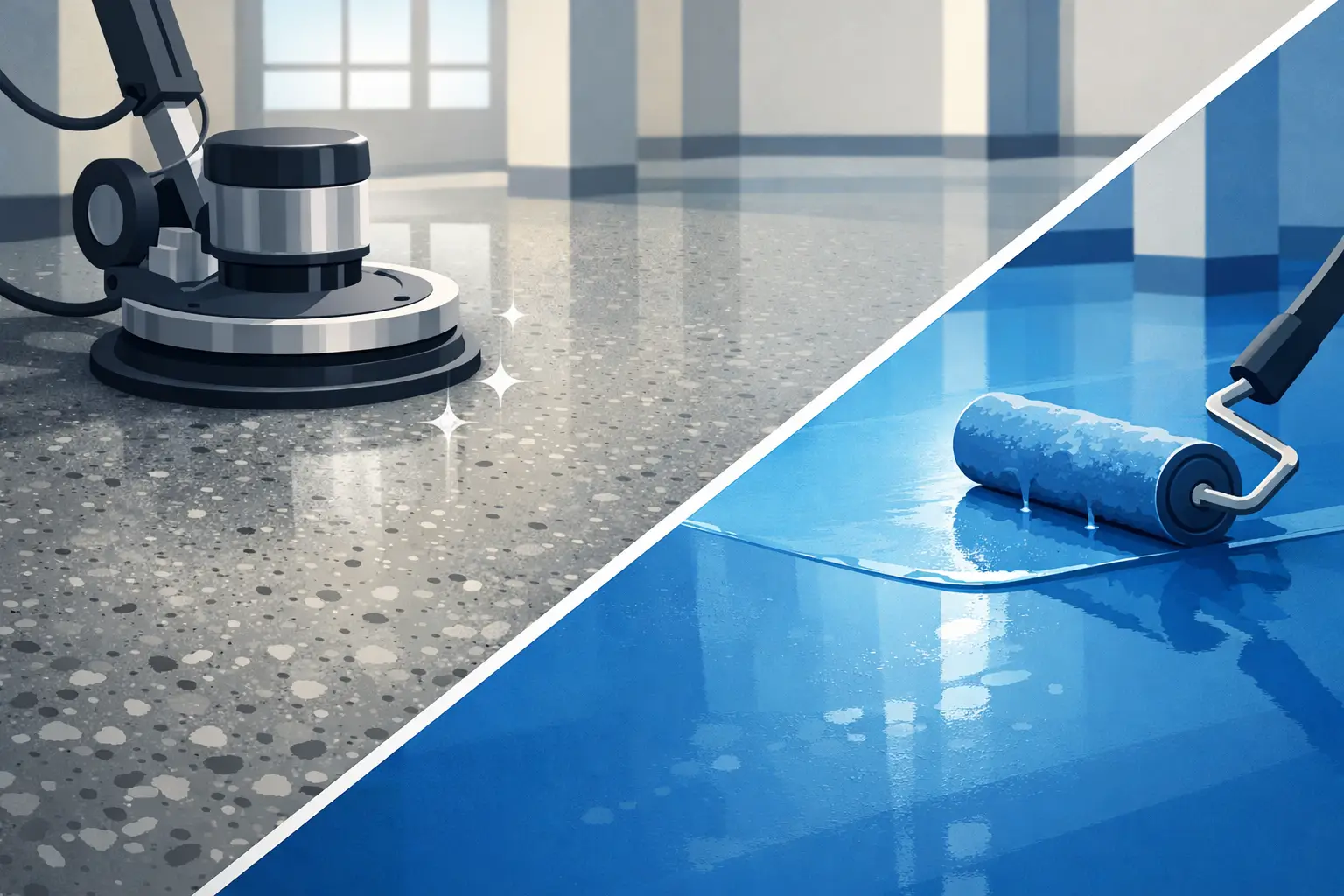
A warehouse floor that looks great on day one can become a maintenance problem by year three. That is why polished concrete versus epoxy is not just a style decision. It is a performance decision that affects downtime, cleaning labor, moisture issues, repair costs, and how well your floor holds up under real traffic.
For property owners and facility managers, the right answer depends on how the space works every day. A showroom, distribution center, office, retail store, and residential loft all place different demands on a floor. The strongest flooring choice is the one that matches traffic, moisture conditions, cleaning routines, chemical exposure, and long-term budget – not the one with the best sales pitch.
Polished concrete versus epoxy: the core difference
Polished concrete and epoxy are often compared as if they do the same job. They do not. Polished concrete is your existing concrete slab mechanically refined through grinding, honing, densifying, and polishing. The final surface is part of the slab itself. It is not a coating sitting on top.
Epoxy is a resin-based coating system applied over the concrete surface. Depending on the system, it can create a glossy, uniform finish with added color, texture, and chemical resistance. It changes the surface by adding a layer rather than transforming the slab below.
That difference matters. Polished concrete relies on the condition and quality of the slab. Epoxy relies heavily on surface prep, moisture control, and bond strength. Both can perform well, but they fail in different ways and under different conditions.
Appearance and finish expectations
If you want a clean, modern, high-end concrete look, polished concrete is hard to beat. It delivers depth, light reflectivity, and a refined finish without hiding the character of the slab. Aggregate exposure can be adjusted, gloss levels can be controlled, and the finished floor often feels more architectural than decorative.
Epoxy creates a more uniform, coated appearance. That can be a major advantage if the slab has stains, patching, or cosmetic inconsistency that you do not want to feature. It also allows for a wider range of colors, flakes, and specialized looks. In garages, back-of-house spaces, and some commercial interiors, that decorative flexibility is appealing.
The trade-off is authenticity versus coverage. Polished concrete showcases the slab. Epoxy covers it. If the concrete has strong bones and you want a premium industrial-modern finish, polishing usually wins. If visual consistency matters more than exposing the slab, epoxy may make more sense.
What clients often misunderstand about shine
A high-gloss polished floor and a high-gloss epoxy floor can look similar in photos, but they behave differently over time. Polished concrete does not peel because there is no topical film to delaminate. Its shine comes from mechanical refinement. Epoxy shine comes from the coating itself, which means wear patterns, scratching, and adhesion issues show up differently as the floor ages.
Durability under traffic and daily use
In high-traffic commercial settings, polished concrete is often the stronger long-term choice. Forklifts, carts, pallet jacks, foot traffic, and constant cleaning are exactly where a properly polished and densified concrete floor proves its value. It resists abrasion well, does not trap dust like raw concrete, and holds up without the coating wear issues common to lower-grade systems.
Epoxy can also be durable, especially in well-built industrial systems, but durability depends heavily on thickness, product quality, installer skill, and the environment. Under heavy traffic, some epoxy floors begin to show tire wear, scratching, hot-tire pickup, chipping, or peeling at weak points. In a facility that runs hard every day, those repairs can become a recurring expense.
That does not mean epoxy is weak. It means epoxy is more system-dependent. A basic decorative epoxy in a busy warehouse is not the same as a high-build industrial resin floor. Buyers should be careful not to compare premium polished concrete to entry-level epoxy pricing and expect an honest performance match.
Moisture can decide the whole project
This is where many floor decisions go wrong. Southern California properties, especially older slabs or buildings with moisture vapor issues, can create major problems for epoxy coatings. If moisture pressure moves up through the slab, epoxy may blister, bubble, or delaminate. That risk is real, and it is one of the biggest reasons coating failures happen.
Polished concrete generally handles vapor transmission better because it is not relying on a film bond in the same way. That makes it a smarter solution for many slabs where moisture is present or likely. Proper testing still matters, but polished concrete is often more forgiving in moisture-sensitive environments.
For property owners trying to avoid future disruption, this is not a minor technical detail. Moisture mitigation can add significant cost and schedule time to an epoxy project. On the right slab, epoxy performs well. On the wrong slab, it can turn into an expensive callback.
Maintenance and life-cycle cost
A floor is never just an installation cost. It is a maintenance program whether you plan for one or not.
Polished concrete is known for low maintenance, which is one reason it performs so well in offices, retail environments, schools, warehouses, and mixed-use spaces. It typically needs dust mopping, wet mopping with the right cleaner, and occasional burnishing or maintenance polishing depending on traffic. There is no wax to strip and no coating layer to reapply in the usual sense.
Epoxy is easy to clean, but over time it often requires more repair planning. Scratches, wear paths, chips, and coating failures can call for patching or recoating. In some environments, that may be acceptable because the floor also needs chemical containment or color coding. But if your priority is minimizing long-term maintenance labor and recoating cycles, polished concrete often delivers better value.
This is where experienced buyers look beyond the upfront proposal. A cheaper installation can become the more expensive floor if it needs repeated shutdowns, touch-ups, or full replacement sooner than expected.
Chemical resistance and special-use spaces
Epoxy has a real advantage in environments with heavier chemical exposure. If the floor will regularly face oils, solvents, acids, or harsh wash-down conditions, a properly specified resinous system may be the better fit. Auto facilities, certain manufacturing areas, labs, and process spaces often need that extra chemical barrier.
Polished concrete is durable and easier to maintain than untreated concrete, but it is not the same as a specialty chemical-resistant coating system. Densifiers and stain guards improve performance, but they do not turn polished concrete into a full containment surface.
This is a classic it-depends category. If your biggest concern is abrasion, traffic, and low maintenance, polished concrete has a strong edge. If your biggest concern is chemical attack, epoxy may be worth the added complexity.
Slip resistance is not as simple as gloss level
Many people assume shinier means more slippery. In practice, slip resistance depends on contaminants, surface profile, maintenance, and the environment. A properly finished polished concrete floor can be slip-conscious and perform well when maintained correctly. Epoxy can also be adjusted with texture or additives, especially in areas prone to spills.
The wrong comparison is visual only. The right comparison looks at what ends up on the floor – water, dust, grease, cleaners, or powder – and how employees or customers move through the space.
Installation timing and disruption
For active businesses, schedule matters almost as much as performance. Polished concrete can often be a strong fit where owners want to improve an existing slab with minimal added material and a cleaner long-term system. It avoids some of the cure and recoat variables associated with multi-layer coating systems.
Epoxy installation can be efficient in the right conditions, but it is generally more sensitive to temperature, humidity, surface prep, and cure timing. If moisture mitigation or extensive repairs are required first, the project can stretch further than expected.
That is one reason many facility managers prefer polished concrete in occupied commercial spaces. It offers strong durability, low maintenance, and a professional finish without creating a coating-dependent floor system that may need more future intervention.
Which one is better for your property?
If you manage a warehouse, retail store, office, showroom, or loft with a solid concrete slab and heavy daily traffic, polished concrete is usually the more cost-efficient long-term investment. It looks sharp, handles wear, reduces maintenance demands, and avoids many of the bond and peeling problems associated with coatings.
If you need decorative color uniformity, specialized texture, or stronger chemical resistance, epoxy may be the better system. It is also useful when the slab appearance is poor and the goal is to conceal rather than highlight the concrete.
The best contractors will not force one answer onto every space. They will evaluate slab condition, moisture, traffic, exposure, appearance goals, and operational demands before making a recommendation. That is the standard serious buyers should expect. In Los Angeles and Orange County, where properties range from polished retail interiors to hard-working industrial floors, the smartest flooring choice is the one built around real use – not assumptions.
If you are deciding between the two, start with how your floor needs to perform five years from now, not just how it needs to look next month.
Clients We Service
We provide our concrete polishing and related services to a wide variety of clients. Some of the types of clients that we provide service to include:


