
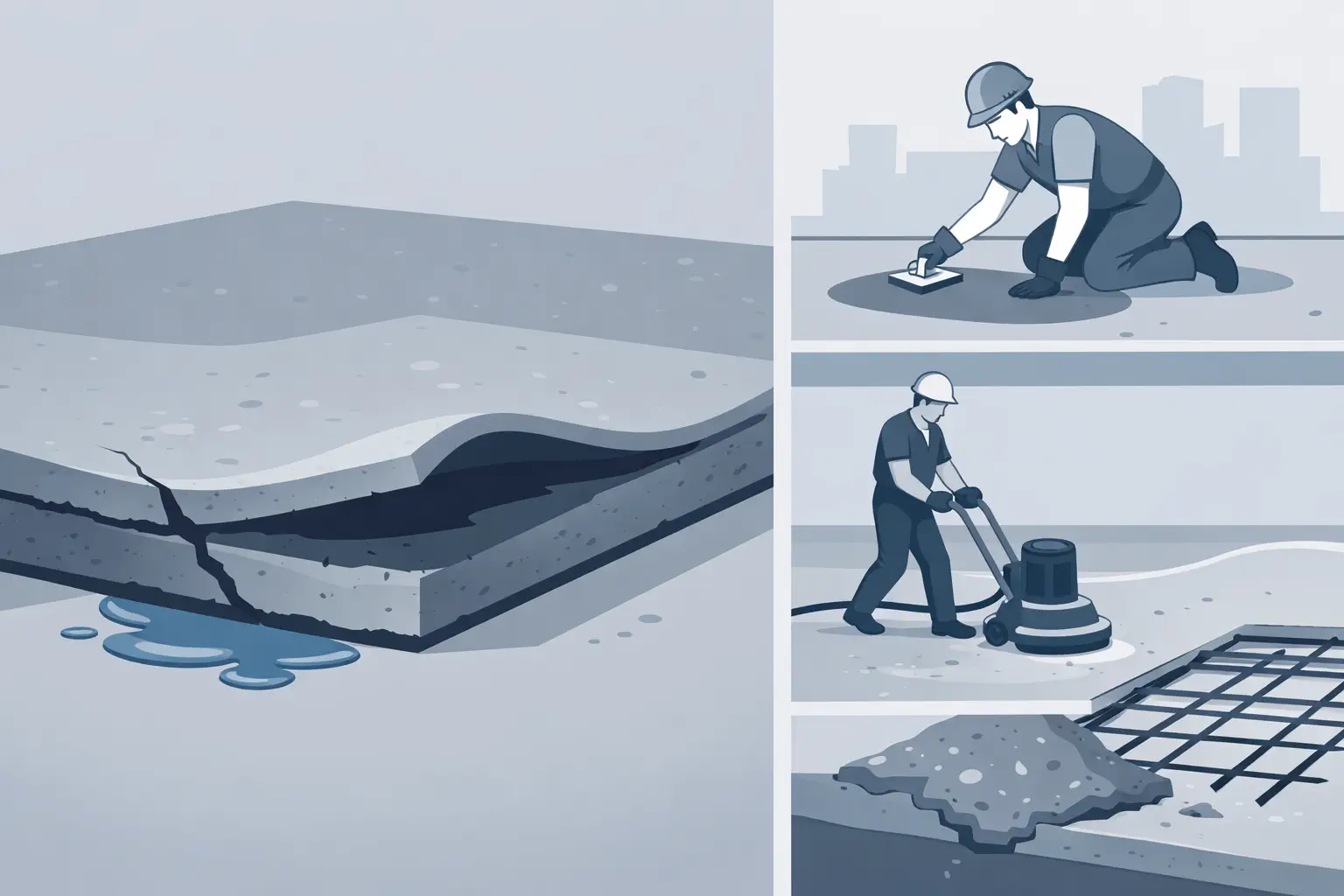
A warehouse floor can appear perfectly serviceable until pallet jacks begin catching at joints, racks start rocking, or sunlight reveals lifted slab corners. Concrete floors curling is not merely a cosmetic issue. It can affect traffic flow, safety, joint performance, equipment operation, and the success of any polishing or coating project installed over the slab.
Curling is a predictable concrete behavior, but the severity varies widely. Some slabs experience a slight edge lift that causes no operational concern. Others develop pronounced elevation changes that become a daily maintenance problem. The right response depends on why the slab moved, how much it moved, and what the facility needs the floor to do.
Why Concrete Floors Curling Happens
Concrete curls when one portion of a slab changes dimension more than another. The most common driver is a moisture difference through the slab thickness. As the top surface dries, it shrinks. If the bottom remains wetter for longer, it does not shrink at the same rate. That imbalance can cause slab edges and corners to lift upward.
Temperature differences can produce a similar effect. A hot top surface and cooler underside may cause temporary upward curling, while the opposite temperature gradient can push slab edges downward. In Southern California, open warehouses, loading areas, and buildings with strong afternoon sun can see noticeable thermal movement, especially near doors and perimeter walls.
Concrete mix design and placement practices also matter. Higher water content generally means more drying shrinkage. Excessive paste, poorly managed curing, inconsistent finishing, and rapid surface drying can all increase the risk. Thin slabs are typically more susceptible than thicker slabs, although thickness alone does not eliminate the problem.
The slab’s restraint condition is another major factor. Friction against the subbase, reinforcing steel, dowels, walls, columns, and adjacent slabs can limit movement in one area while allowing it in another. That restraint may turn normal shrinkage into cracking, joint stress, or uneven slab behavior.
Curling Is Not Always a Construction Defect
A degree of curling can occur even when a floor is designed and placed correctly. Concrete is not a static material. It continues to gain strength, dry, shrink, and respond to environmental conditions long after placement.
The real question is whether the condition exceeds the floor’s intended performance requirements. A lightly curled residential garage slab may be acceptable. A distribution center with hard-wheeled forklifts, narrow-aisle equipment, automated storage, or high-gloss polished concrete has less tolerance for joint elevation changes and unevenness.
The Operational Risks of a Curled Slab
The first sign is often a lifted joint edge or corner. Foot traffic may feel a slight lip, while forklifts and carts produce a repeated impact as they cross the joint. Over time, that impact can chip the concrete, damage joint fillers, loosen rack components, and increase maintenance costs.
For industrial facilities, curled slabs can create wheel-path deterioration and joint spalling. Each hard-wheel strike concentrates force at the slab edge. Once the edge begins to break down, the condition accelerates. Filling the joint without addressing the damaged concrete or traffic demand usually creates a short-term patch rather than a durable repair.
Curling also complicates floor finishing work. A polished concrete floor is created by progressively refining the surface with diamond abrasives, densifiers, and carefully controlled grits. If the slab is significantly uneven, aggressive grinding may be required to reduce high points. That can expose more aggregate than intended, alter the visual consistency of the floor, reduce cover over reinforcement in extreme cases, or create an impractical amount of material removal.
Coatings and toppings deserve the same caution. A coating can improve chemical resistance and appearance, but it will not flatten a curled slab. A thin overlay may telegraph movement or crack if the underlying slab remains unstable. Moisture conditions, bond preparation, and joint design must be evaluated before any protective system is specified.
How to Tell Curling From Other Floor Problems
Curling is frequently confused with settlement, heaving, random cracking, or general poor flatness. The distinction matters because the repair approach changes with the cause.
A curled slab often shows elevated corners or joint edges, sometimes with a hollow sound beneath portions of the slab. The amount of lift may change with weather, HVAC operation, or moisture conditions. In contrast, settlement usually presents as a localized low area caused by subgrade movement or loss of support. Heaving is an upward movement driven by expansive soils, moisture changes below the slab, roots, or other forces from beneath.
A professional evaluation should document slab elevations, joint conditions, cracking, traffic patterns, moisture readings, and signs of voids or subbase failure. In a large commercial building, the assessment should also consider rack loads, forklift wheel types, floor flatness needs, and whether the area will receive polishing, epoxy, urethane cement, or another finish.
Repairing Concrete Floors Curling Without Creating New Problems
There is no single repair that fits every curled floor. The best solution is based on slab movement, use conditions, budget, and the required finished appearance.
Where curling is minor and the primary issue is a localized trip edge, controlled diamond grinding can reduce the abrupt transition. This approach works best when removal is limited and the slab has adequate thickness. It is not a cure for the underlying moisture gradient, but it can improve safety and traffic flow with minimal disruption.
When joint edges are damaged, the repair may include removing unsound concrete, rebuilding the edge with a high-strength repair material, and installing a properly selected joint filler. In forklift environments, the filler must support hard-wheel traffic and protect the joint arris. Soft fillers in high-impact locations can tear or crush prematurely.
If testing confirms voids beneath the slab, slab stabilization may be appropriate. Cementitious grout or specialized resin injection can restore support in selected situations. However, raising or supporting a slab does not automatically reverse drying-shrinkage curling. The repair team must confirm whether loss of support is the actual problem before injection work begins.
For floors with widespread movement, cracking, or severe flatness issues, a more comprehensive approach may be necessary. Options can include localized replacement, a bonded topping engineered for the condition, or a new floor system in the affected area. These choices involve more downtime, but they may be the most cost-effective route when repeated patching is no longer protecting operations.
What to Consider Before Polishing a Curled Concrete Floor
Polished concrete can be one of the most durable, low-maintenance finishes available, but only when surface preparation is honest about the slab’s condition. A contractor should not promise a uniform high-gloss result without first measuring high and low areas, reviewing joints, and identifying repairs that will remain visible after polishing.
There is a trade-off between flattening the floor and preserving the desired concrete appearance. More grinding can improve transitions, yet it can also increase aggregate exposure and create variation from one area to another. Some owners prefer a refined salt-and-pepper finish with limited removal. Others accept a more exposed aggregate look in exchange for better flatness. The right choice should be made before the first grinding pass.
Moisture testing is equally critical when coatings, densifiers, or toppings are part of the plan. Surface moisture conditions can affect bond, cure, and long-term performance. For occupied facilities, scheduling also matters. Experienced crews can phase work around active operations, but access, dust control, equipment routes, and cure times need to be planned rather than assumed.
Reducing the Risk on Future Slabs
The strongest strategy begins before concrete placement. A well-designed mix, controlled water addition, proper subbase preparation, accurate joint layout, timely curing, and protection from rapid evaporation all help reduce curling potential. For high-tolerance floors, the specification should clearly address flatness, traffic loads, finishing expectations, and the intended final floor system.
Owners should also avoid treating all slabs alike. A decorative loft floor, a retail showroom, and a heavy-duty warehouse have different tolerances for joint movement and surface variation. Designing for the actual use is far less expensive than trying to force a light-duty slab to perform like an industrial floor after the fact.
When curled joints, rocking equipment, or visible edge lift begin affecting your property, act before routine traffic turns a manageable condition into widespread slab damage. A precise assessment and the right diamond-grinding, repair, or stabilization strategy can protect both the floor and the operation built on it.
Clients We Service
We provide our concrete polishing and related services to a wide variety of clients. Some of the types of clients that we provide service to include:


