
A warehouse floor can look clean and still fail a new coating within months. The usual cause is not the coating itself – it is inadequate surface preparation. Grinding versus shot blasting is therefore not a cosmetic choice. It determines the concrete profile, the condition of the slab after preparation, the dust-control plan, and whether the finished floor is built for the traffic it will carry.
For facilities, retail spaces, offices, and homes, the right method depends on the existing surface and the intended result. Shot blasting is a high-production preparation method. Diamond grinding is a more controlled process that can remove material, level concrete, refine the surface, and create the foundation for polished concrete. The strongest flooring decisions begin by matching the method to the floor system rather than treating either process as a one-size-fits-all solution.
Grinding Versus Shot Blasting: The Core Difference
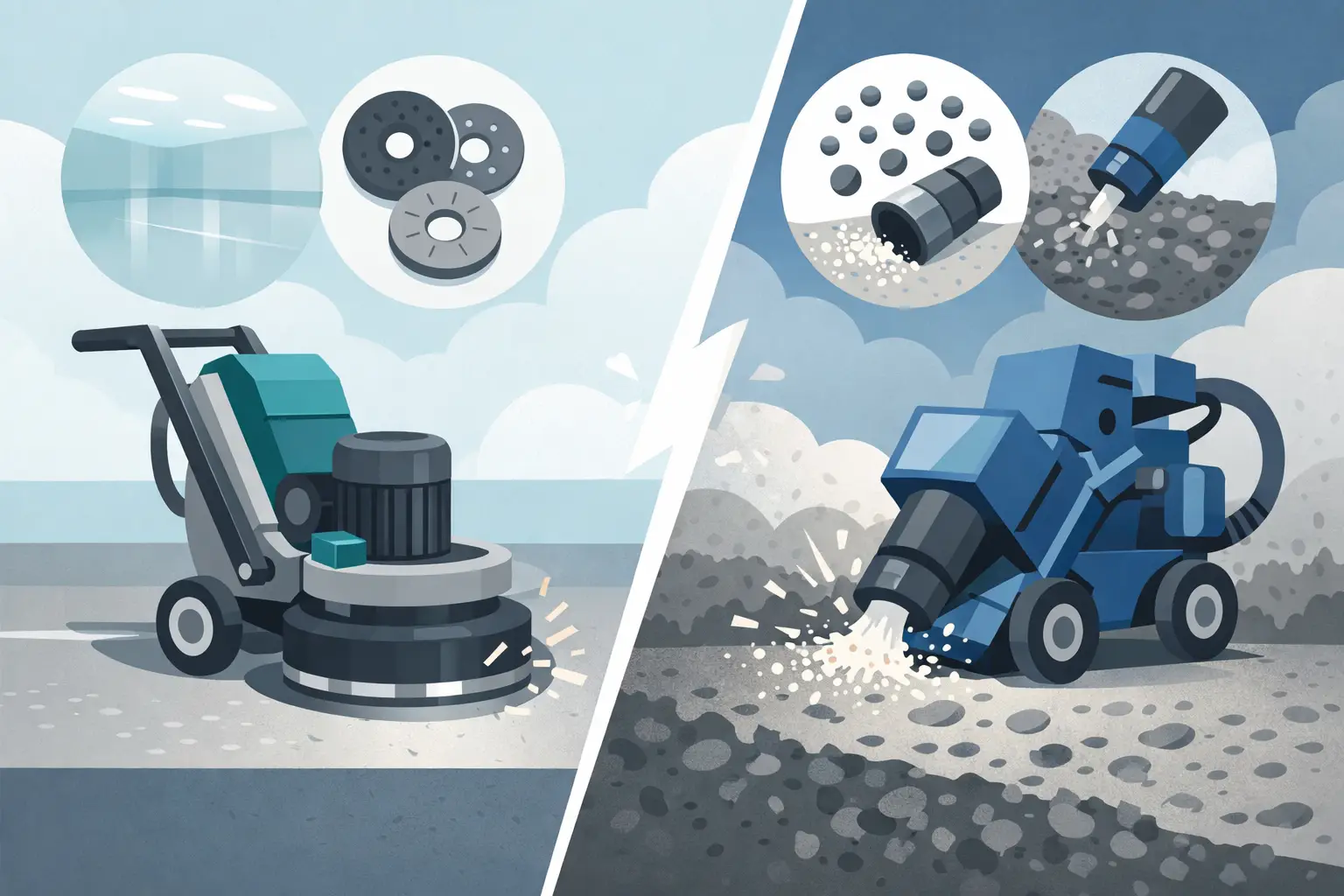
Shot blasting propels small steel shot at the concrete surface inside a contained machine. The impact breaks away weak surface paste, dirt, light coatings, and contaminants while creating a textured profile. The machine then recovers the shot and debris for reuse and collection. It is fast, aggressive, and particularly effective across large, open floor areas.
Concrete grinding uses diamond-abrasive tooling mounted on specialized equipment. Rather than striking the slab, diamond segments cut and abrade it. This gives experienced technicians greater control over how much material is removed and how the concrete is left behind. Grinding can flatten high spots, open the surface for coating adhesion, remove thick adhesives, and progress through finer grits for a honed or polished finish.
Both methods can prepare concrete for a new floor system. The difference is what they leave behind. Shot blasting creates a more pronounced, impact-textured surface. Grinding can create a profile while also producing a flatter, more uniform plane. That distinction matters when appearance, smoothness, rolling traffic, and coating thickness are part of the specification.
When Shot Blasting Is the Better Choice
Shot blasting earns its place on expansive industrial projects where production speed and a defined surface profile are the priority. A warehouse, manufacturing space, parking structure, or distribution facility may need thousands of square feet prepared efficiently before a high-build epoxy, urethane cement, or other protective system is installed.
It is especially useful when the slab has sound concrete but a weak or contaminated top layer. By removing laitance and opening the pores of the concrete, shot blasting gives many coating systems a mechanical bond they need to perform under forklift traffic, pallet jacks, chemicals, and daily abrasion.
The method also produces relatively little airborne dust when the equipment is properly maintained and connected to industrial vacuum collection. That makes it a practical option for occupied commercial environments, although any serious contractor should still isolate the work area and manage dust carefully around inventory, equipment, and employees.
Shot blasting has limits. It does not level a floor, remove significant peaks, or create the smooth visual finish associated with polished concrete. It can also leave a texture that is too aggressive for thin-film coatings or for a floor intended to look refined under showroom lighting. Edges, corners, column bases, and areas beneath fixed equipment require separate handwork or complementary preparation methods.
When Diamond Grinding Delivers Better Results
Diamond grinding is the clear choice when the floor needs correction as well as preparation. If a slab has uneven transitions, trowel marks, curled joints, stubborn mastic, old coatings, or localized high spots, grinding gives the installer the control to address those conditions directly.
For polished concrete, grinding is not optional. The process begins with metal-bond diamond tooling to cut the surface and remove defects, then advances through progressively finer grits. Densifiers harden and strengthen the concrete matrix, while final polishing steps develop the selected sheen. Shot blasting may be useful for certain removal tasks, but it cannot replace the precision needed to create a consistent polished finish.
Grinding is also often preferable when a thin coating or decorative overlay requires a smoother substrate. A heavily blasted profile can telegraph through thin materials or consume more product than expected. Grinding lets the contractor tailor the surface to the coating manufacturer’s profile requirement while maintaining better visual uniformity.
That precision comes with a trade-off. Grinding can move more slowly than shot blasting on large, unobstructed areas, particularly when major material removal is needed. It also requires the right diamond bond, machine weight, vacuum capacity, and operator judgment. Using the wrong tooling can glaze the diamonds, leave inconsistent scratch patterns, or fail to remove contamination deeply enough for reliable adhesion.
Surface Profile Should Drive the Decision
The conversation should not begin with, “Which machine is cheaper?” It should begin with, “What does the finished floor require?” Concrete coatings are commonly specified around concrete surface profile, often called CSP. A thin coating generally needs a lighter, more controlled profile than a thick mortar system. Polished concrete requires an entirely different sequence focused on flatness, refinement, and clarity.
A properly specified process considers more than profile alone. Moisture vapor transmission, slab hardness, cracks, oil contamination, previous repairs, and the condition of joints can change the plan. For example, a shot-blasted floor may look ready for coating, yet vapor issues can still cause a bonded system to blister or delaminate. A beautiful ground surface can also fail if oil has penetrated beyond the depth of removal.
The best contractors test and inspect before selecting equipment. This protects the project budget because it identifies issues before a crew starts preparing several thousand square feet under an assumption that proves wrong later.
Appearance, Safety, and Daily Operations
For a back-of-house industrial floor receiving a thick protective coating, a shot-blasted profile may be exactly what the system needs. For a creative office, retail showroom, residential loft, or lobby, diamond grinding provides the control needed for a clean, contemporary concrete finish.
Neither method automatically makes a floor slip resistant or chemical resistant. Those outcomes come from the complete flooring system: the surface texture, the sealer or coating selected, the gloss level, contaminants expected in the space, and the maintenance program. A highly polished floor can perform well when designed and maintained correctly, but it should be evaluated for its specific use rather than chosen on appearance alone.
Operational disruption also deserves attention. Large ride-on shot blasters can prepare broad, open spaces quickly, which can shorten a shutdown window. Grinding may be more adaptable around racking, walls, drains, and obstacles. On an active site, crews may phase the work by zone, coordinate access routes, and use professional dust collection to keep the project moving without compromising the preparation standard.
A Better Way to Compare Costs
The lowest initial preparation price is not always the lowest project cost. A fast method that leaves the wrong profile can require extra coating material, more corrective labor, or early replacement. Conversely, specifying extensive grinding for a basic heavy-duty coating in a wide-open warehouse may add cost without improving performance.
Ask for a recommendation tied to the actual floor system, not just square footage. The proposal should account for coating removal, crack and joint repairs, moisture mitigation if needed, edge preparation, dust control, and the desired finish. It should also clarify whether the price assumes a sound slab or includes allowances for hidden conditions.
At Los Angeles Concrete Polishing, we evaluate the concrete, the traffic demands, and the finish expectation before recommending a preparation path. That disciplined approach is how commercial and residential clients avoid paying for a process that looks impressive but does not serve the floor’s long-term purpose.
The Right Method Is Often a Combination
Many successful projects use both methods. Shot blasting can efficiently prepare the main field of a large floor, while diamond grinding handles edges, transitions, repairs, and areas where a smoother profile is necessary. Grinding may also follow removal work when the final system requires greater flatness or a more refined appearance.
The decision is not about declaring one method superior. It is about making sure the concrete is clean, sound, properly profiled, and ready for the finish that will protect it. Before approving a flooring scope, ask what profile the chosen system needs, how the slab will be tested, and how the contractor will handle the details that machines cannot reach. Those answers reveal far more about expected floor performance than the name of the equipment alone.
Clients We Service
We provide our concrete polishing and related services to a wide variety of clients. Some of the types of clients that we provide service to include:


