
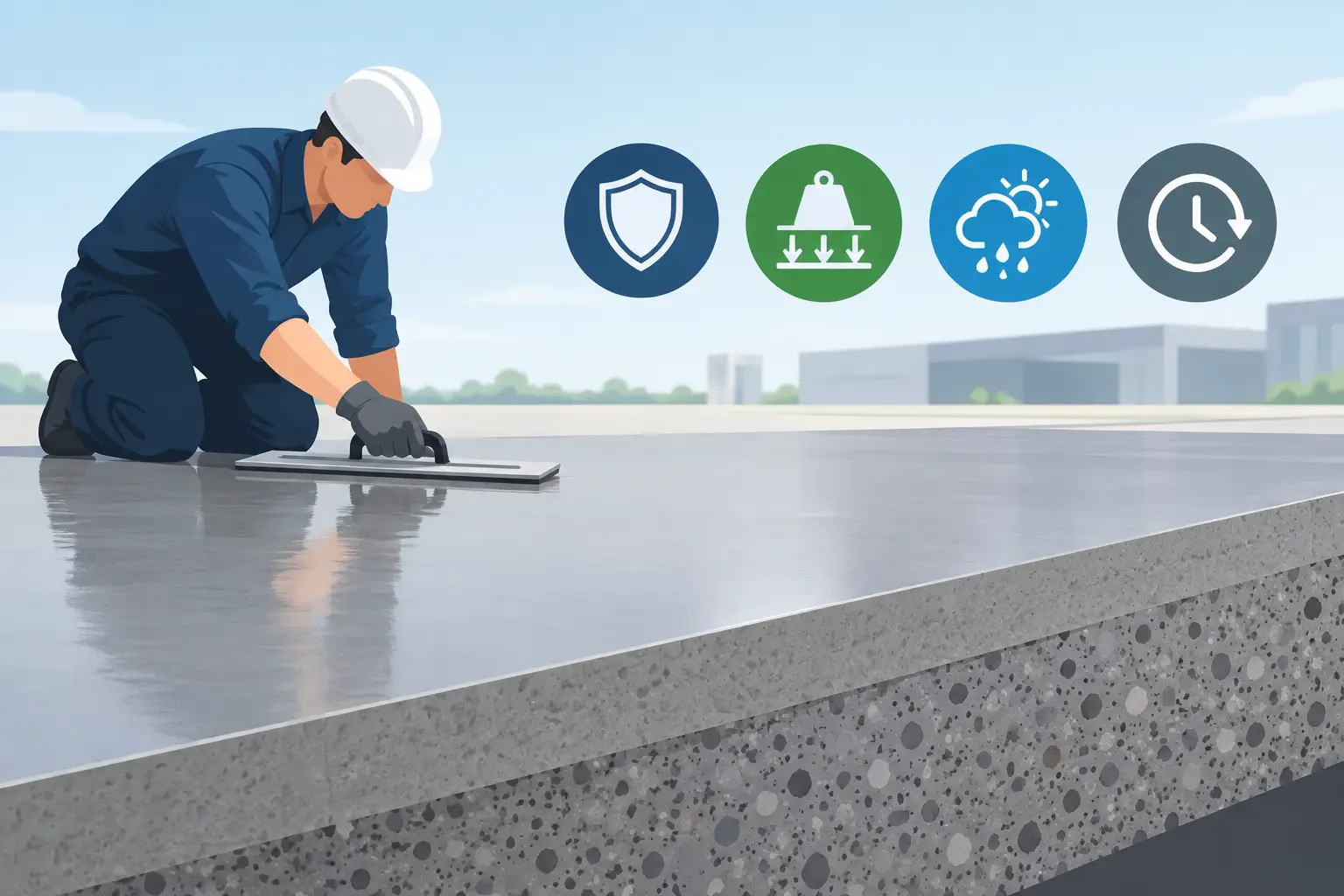
A topping can look flawless on opening day and still fail before the first year is over. Concrete topping durability is decided long before the final finish is applied: at the existing slab, in the material specification, and in the contractor’s preparation process. For warehouses, retail floors, offices, commercial kitchens, and modern residential spaces, the real question is not whether a topping looks good. It is whether it can handle the traffic, moisture, abrasion, cleaning routine, and operational demands placed on it every day.
A properly installed topping can create a hard-wearing, refined floor with far less demolition than a full slab replacement. A poorly specified or poorly bonded system can crack, delaminate, dust, stain, or wear unevenly. That difference is why experienced evaluation matters.
What Determines Concrete Topping Durability?
A concrete topping is a new cementitious layer placed over an existing concrete slab. It may be used to correct surface damage, improve flatness, create a decorative finish, prepare a floor for polishing, or add protection in a high-use environment. Its longevity comes from the entire flooring system, not simply the compressive strength printed on a product data sheet.
The existing concrete must be structurally sound and properly profiled. If the base slab has hidden moisture issues, weak surface paste, active movement, oil contamination, or unresolved cracks, a new topping will not erase those conditions. It can inherit them.
Bond is the first line of defense. Mechanical diamond grinding or shot blasting opens the slab surface and removes weak material so the topping can grip clean, sound concrete. Skipping or rushing this step is one of the fastest ways to create a floor that later peels or separates under rolling loads.
Material choice also matters. A thin feather-finish product has a very different role from a high-build, polymer-modified overlay or a structural repair mortar. The appropriate system depends on thickness, desired appearance, moisture conditions, thermal exposure, and the type of traffic the floor will receive. A forklift aisle, a boutique showroom, and a residential loft should not automatically receive the same specification.
Start With the Slab, Not the Finish
Property owners often focus on color, sheen, and texture first. Those decisions matter, but slab conditions determine whether the finish has a foundation worth building on.
A qualified assessment should identify cracks, spalls, hollow areas, previous coatings, adhesive residue, surface contaminants, and slab flatness. It should also consider joint layout. Concrete moves, and joints are designed to manage that movement. Covering an active joint with a rigid topping without a proper joint strategy can lead to a visible crack directly through the new surface.
Moisture deserves particular attention in Southern California. Even where the climate is dry, concrete slabs can transmit moisture vapor from below or retain moisture after water intrusion, cleaning, or construction activity. Excess moisture can interfere with bond, discolor some finishes, and create failures beneath coatings or dense protective systems. Testing and moisture-control planning are not optional details when the floor’s long-term performance is on the line.
Thickness Changes the Performance Equation
Topping thickness affects impact resistance, repair capability, and how much variation can be corrected. Thin toppings are efficient when the slab is generally sound and the goal is cosmetic renewal or minor surface correction. They are not the right answer for deep deterioration, major elevation changes, or repeated heavy equipment impacts.
Thicker bonded toppings can restore worn slabs and provide more material for grinding, polishing, or creating a uniform finish. They require careful placement, curing, and attention to shrinkage. More thickness is not automatically better. An overly thick system may add cost and downtime without improving performance if the underlying problem is moisture, movement, or poor concrete quality.
For demanding industrial settings, the topping must also be designed around point loads and rolling loads. Forklift tires, pallet jacks, loaded carts, and hard wheel traffic concentrate force in small areas. A topping that performs well under foot traffic may chip at joints or wear prematurely in a loading path if it was not built for that use.
The Installation Details That Make a Topping Last
The best materials cannot compensate for poor execution. At Los Angeles Concrete Polishing, surface preparation, moisture evaluation, and finish selection are treated as performance decisions, not add-ons. The goal is a floor that supports the operation after the crew has left.
A durable installation begins with a clean, mechanically prepared substrate. Existing coatings, sealers, paint, glue, oils, and weak concrete must be removed. Repairs should be completed with compatible materials and allowed to cure as required. The topping is then mixed, placed, and finished within the manufacturer’s working-time limits.
Curing is equally critical. Cement-based materials gain strength through hydration. Rapid moisture loss, excessive heat, direct sun, or improper ventilation can cause shrinkage cracking, weak surface zones, and inconsistent color. A controlled curing plan protects the topping while keeping the project schedule realistic.
Timing between installation stages must also be respected. Grinding or polishing too early can damage green material. Applying a protective treatment before the topping has properly cured may trap moisture or compromise adhesion. Fast turnaround matters for active businesses, but false speed is expensive when it creates rework.
Wear, Chemicals, and Cleaning Practices
Concrete toppings do not all resist abrasion, impacts, chemicals, and stains to the same degree. The desired level of protection should match the actual environment.
A polished cementitious topping can be an excellent choice for offices, retail spaces, showrooms, lofts, and many light-to-medium commercial areas. Densification and diamond polishing strengthen the surface, refine the appearance, and reduce the amount of dusting associated with softer concrete. The result is a clean, modern floor that is easier to maintain than many traditional finishes.
In spaces exposed to oils, acidic cleaners, food production residues, automotive fluids, or frequent washdowns, a topping may need a chemical-resistant protective system. A penetrating treatment can improve stain resistance without creating a visible film, while a coating can provide stronger chemical protection. The trade-off is that coatings require periodic inspection and eventual renewal, especially in heavy traffic lanes.
Daily maintenance has a direct effect on service life. Dirt and grit act like sandpaper under shoes and wheels, gradually dulling a polished surface or wearing protective layers. Neutral cleaners, clean pads, regular debris removal, and quick spill response protect both appearance and performance. Harsh acidic cleaners and abrasive scrub pads can shorten the life of an otherwise high-quality floor.
Cracking Does Not Always Mean Failure
Concrete and cement-based toppings can develop hairline cracks. Some are cosmetic and stable. Others indicate slab movement, shrinkage stress, insufficient joint treatment, or bond loss. The right response depends on the cause, not just the appearance.
A contractor should distinguish between existing cracks reflected through the topping, random shrinkage cracks, and cracks associated with active structural movement. Filling every crack with a rigid material may not solve the problem if the slab continues to move. In some cases, honoring joints, using flexible fillers, or selecting a more suitable system is the better long-term decision.
For decorative and polished applications, honest expectations matter. A cementitious floor has natural variation. Minor tonal changes, aggregate exposure, and controlled crack repair can be part of the character. Clients seeking a completely uniform, joint-free visual result may be better served by a different flooring system.
How to Specify for Real-World Traffic
Before approving a topping, define how the space will actually operate. Consider whether the floor will receive foot traffic only, carts, forklifts, vehicles, dropped tools, shelving loads, chemicals, or frequent wet cleaning. Ask whether the space needs a high-gloss polished appearance, a matte slip-conscious finish, or a protective coating with a more industrial look.
Downtime should be part of the conversation as well. Some systems can be installed and returned to light service quickly, while others need longer curing periods before heavy use. A phased installation may keep part of a warehouse, retail floor, or office operational during the project. The lowest initial price is rarely the best value if the system cannot support the facility’s use or requires early repair.
Protect the Investment From Day One
Concrete topping durability is not a promise made by one product. It is the result of correct diagnosis, disciplined preparation, compatible materials, controlled installation, and maintenance that fits the space. When those pieces are aligned, a topping can deliver years of dependable service while improving the floor’s appearance, safety, and maintenance profile.
Before choosing a finish, have the slab and operating conditions evaluated with the same care you would give any major facility investment. The right topping should earn its place under every foot, wheel, cart, and workday that follows.
Clients We Service
We provide our concrete polishing and related services to a wide variety of clients. Some of the types of clients that we provide service to include:


