
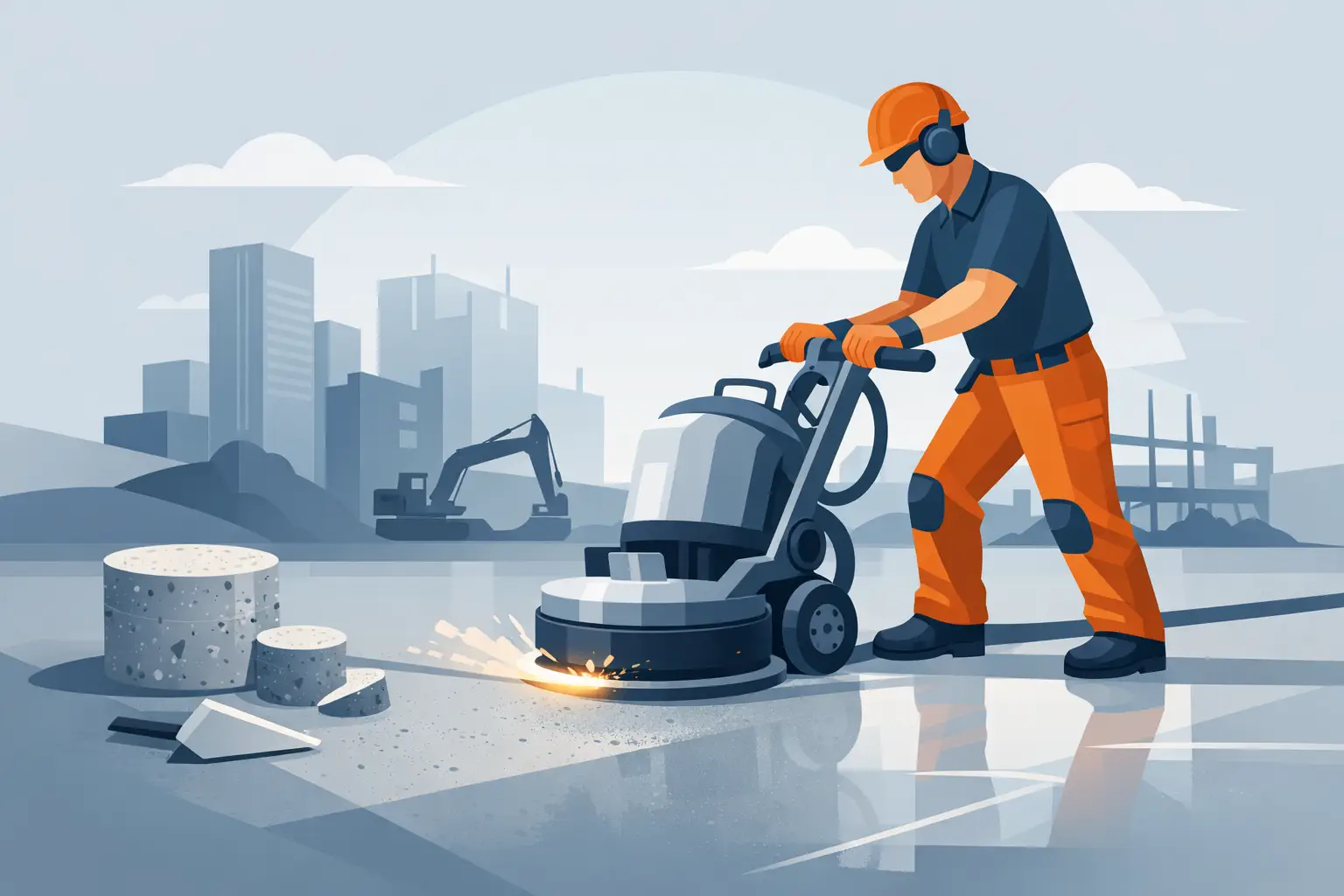
A concrete floor rarely fails all at once. It starts with tire marks that do not clean out, uneven joints that catch pallet jacks, old coatings peeling at the edges, or a dusty surface that keeps coming back no matter how often it is swept. That is exactly where concrete grinding services make a measurable difference. When grinding is done correctly, the floor does not just look better – it performs better under traffic, cleaning, impact, and daily use.
For property owners and facility managers, that distinction matters. Grinding is not cosmetic cleanup. It is a precision process that removes surface damage, corrects inconsistencies, opens the slab for repairs or coatings, and creates the foundation for a longer-lasting floor system.
What concrete grinding services actually do
Concrete grinding is the controlled removal of the top layer of concrete using industrial grinders fitted with diamond tooling. The goal can vary from project to project. In one warehouse, the priority may be flattening high spots and preparing the slab for an epoxy system. In a retail space, it may be removing mastic and adhesive residue before polishing. In a residential loft, it may be refining the surface enough to expose aggregate and create a clean, modern finish.
The process sounds simple, but the execution is where weak contractors separate themselves from specialists. Diamond grit sequence, machine weight, slab hardness, moisture conditions, and the intended final finish all affect the result. Grind too aggressively and you can leave deep scratches, gouge soft concrete, or create unnecessary aggregate exposure. Grind too lightly and contamination stays in the slab, coatings fail early, and polished finishes never reach the clarity they should.
That is why concrete grinding should be treated as a technical flooring service, not a basic surface pass.
When concrete grinding services are the right choice
Some floors need replacement. Many do not. Grinding is often the smarter option when the slab itself is structurally sound but the surface has become uneven, contaminated, damaged, or visually tired.
This is common in offices converting from carpet to polished concrete, warehouses removing old coatings, restaurants dealing with worn traffic paths, and commercial spaces where appearance matters but downtime and budget still need to stay under control. Grinding can strip away failed materials, smooth rough areas, and prepare the floor for polishing, densifying, staining, sealing, or protective coatings.
It is also the right move when the floor has become a maintenance problem. A rough, porous slab traps dirt and holds onto marks. An uneven one increases wear on wheels and creates avoidable safety issues. A properly ground surface is easier to clean, more consistent underfoot, and better suited for whatever finish comes next.
Surface prep is where floor systems succeed or fail
One of the biggest misconceptions in commercial flooring is that the coating or polish is the main event. In reality, surface preparation decides whether the system holds up. If the concrete is not opened correctly, if contaminants remain in the pores, or if previous coatings are only partially removed, the finish on top is already compromised.
Grinding creates mechanical profile and uniformity. That matters for epoxy, urethane, polyaspartic, and other resinous systems because adhesion depends on a properly prepared substrate. It matters for polished concrete because clarity and reflectivity depend on a consistent starting point. It matters for repairs because fillers and patching products bond better to a properly ground surface than to dirt, laitance, or old adhesive residue.
For high-traffic facilities, this is not a detail. It is the difference between a floor that holds up and one that starts failing before it should.
Not every floor needs the same level of grinding
This is where experience matters. A light grind for coating prep is not the same as a multi-step grind for decorative polish. A slab with moisture issues requires a different approach than one in stable interior conditions. Soft concrete behaves differently from a dense industrial slab. Old glue from tile removal needs different tooling than a paint overspray problem.
There is no one-size-fits-all setting. A contractor who treats every floor the same will either oversell the process or underdeliver on performance.
The real benefits of a properly ground concrete floor
A well-executed grinding process improves more than appearance. It creates practical value that building owners and operators can feel almost immediately.
First, it improves usability. Smoother floors reduce vibration under carts, pallet jacks, and forklifts. That can help with operational efficiency and reduce wear in busy environments. In commercial and industrial settings, floor flatness and consistency are not just nice upgrades – they affect daily movement and safety.
Second, it reduces maintenance pressure. Once roughness, contamination, and failing surface materials are removed, the floor becomes easier to clean and maintain. If the slab is then densified, polished, or coated, upkeep becomes even more manageable. That matters in retail, office, and warehouse settings where labor costs add up fast.
Third, it supports better long-term performance. Grinding is often the step that allows the next treatment to work as intended. Whether the project calls for a low-sheen utility finish or a high-gloss polished floor, the finished result depends on how well the slab was prepared.
Grinding can also improve appearance, but expectations matter
Yes, grinding can dramatically improve the look of a floor. It can remove years of wear, expose clean concrete, and set the stage for a refined polished finish. But appearance depends on slab condition, past repairs, aggregate distribution, and previous coverings. Some floors polish beautifully into a decorative statement. Others are better suited for a more uniform, matte, performance-first finish.
Strong contractors set those expectations early. That protects the client from surprises and keeps the project aligned with budget and use.
What to expect during a professional grinding project
A serious contractor starts with the slab, not a generic sales pitch. The floor should be evaluated for hardness, moisture, contamination, damage, and end-use requirements. That assessment guides tooling selection, grit progression, repair strategy, dust control, and schedule.
On the job, industrial grinders with dust-managed systems are used to control debris and keep the work area as clean as possible. This is especially important in active commercial properties where minimizing disruption matters. In many occupied spaces, the quality of containment and staging is just as important as the grinding itself.
Repairs may be completed before, during, or after initial grinding passes depending on joint condition, cracks, spalls, and the final finish target. If the floor is being polished, the grinding process continues through finer steps and often includes densifier application to strengthen the surface and improve reflectivity. If the floor is being coated, grinding usually stops once the proper profile is achieved.
In markets like Los Angeles and Orange County, where facilities range from creative office conversions to heavy-use industrial spaces, this flexibility is critical. Different buildings demand different outcomes, and the contractor should be able to match the process to the property rather than force the property into a preset package.
Choosing a contractor for concrete grinding services
This is not the place to shop on price alone. Grinding quality is tied directly to equipment, crew skill, project planning, and understanding of concrete behavior. A low bid often means rushed prep, weak dust control, limited repair work, or a finish that looks acceptable for a week and disappointing after a month of use.
Look for a contractor who can explain the process in plain language, identify trade-offs, and recommend a finish based on traffic, maintenance goals, and budget. If a warehouse needs durability and speed, that answer may be different from what works in a showroom or custom home. That is a good sign, not a problem.
The best providers approach grinding as part of a complete floor strategy. They understand how prep affects polishing, coatings, moisture management, slip resistance, and lifecycle cost. That is the level of thinking clients should expect from a specialist. It is also why many property owners turn to experienced teams like Los Angeles Concrete Polishing when the floor has to look right, hold up, and stay on schedule.
A concrete floor does not need to be brand new to deliver strong performance. If the slab has good bones, the right grinding process can turn a worn, uneven, high-maintenance surface into one that works harder, looks cleaner, and supports the demands of the space for years to come.
Clients We Service
We provide our concrete polishing and related services to a wide variety of clients. Some of the types of clients that we provide service to include:


