
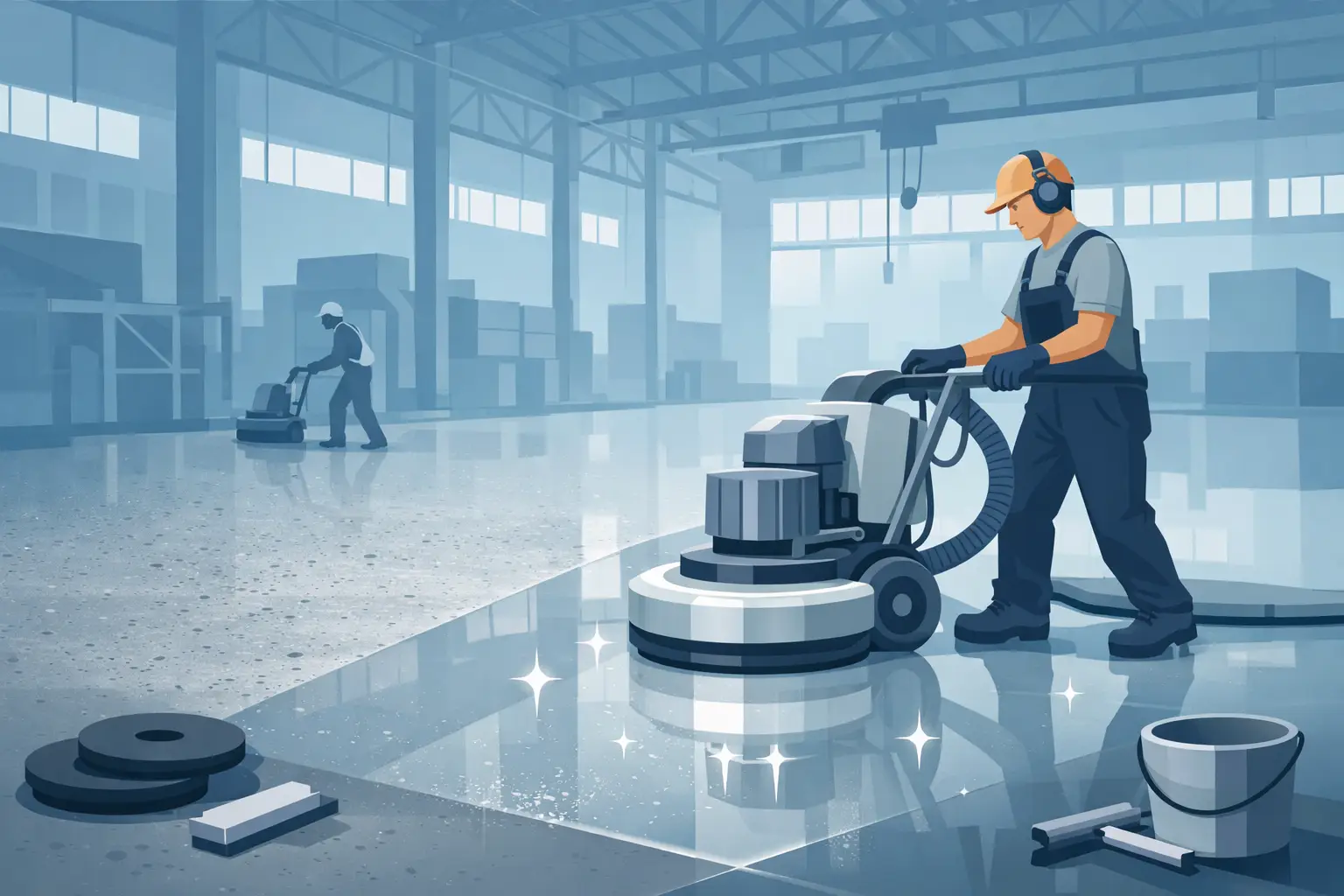
A warehouse floor tells the truth fast. If it dusts under forklift traffic, stains easily, or turns routine cleaning into a constant expense, the slab is not working hard enough for the operation sitting on top of it. Industrial concrete floor polishing solves that problem by turning ordinary concrete into a dense, durable, low-maintenance surface built for real production environments.
For facility managers, property owners, and operations teams, this is not just about getting a better shine. It is about reducing wear, improving light reflectivity, controlling dust, and extending the life of the slab you already have. Done correctly, polished concrete gives industrial spaces a cleaner look and stronger day-to-day performance without the recurring headaches that come with many surface coatings.
What industrial concrete floor polishing actually does
Industrial concrete floor polishing is a mechanical process that refines the concrete surface using heavy-duty grinders and progressively finer diamond abrasives. In most projects, the floor is also treated with a densifier that reacts with the concrete to harden the surface from within. The result is not a thin layer sitting on top of the slab. It is a transformed concrete surface with improved abrasion resistance, reduced porosity, and a finish tailored to the demands of the building.
That distinction matters. In industrial settings, floors take punishment from pallet jacks, carts, foot traffic, dropped materials, tire friction, and regular cleaning chemicals. A topical system can be the right choice in some environments, especially where strong chemical exposure requires a barrier coating, but it can also peel, chip, or wear unevenly. Polished concrete avoids many of those issues because the finish is part of the concrete itself.
The right polishing approach depends on the slab condition and the facility use. A distribution center has different needs than a manufacturing floor, and a showroom attached to an industrial facility may require a higher gloss than the loading area behind it. That is why experienced contractors do not treat floor polishing like a one-size-fits-all service.
Why industrial concrete floor polishing makes financial sense
The biggest mistake buyers make is judging flooring by installation cost alone. Industrial floors should be evaluated by lifecycle cost – how they perform over years of traffic, maintenance, repair, and downtime.
Polished concrete is strong in that comparison. It reduces concrete dusting, which helps protect products, equipment, and indoor air quality. It lowers maintenance demands because the surface is easier to clean and does not require waxing to maintain appearance. It also improves reflectivity, which can make large facilities feel brighter and may help support more efficient lighting use.
There is also a practical budget advantage in using the slab you already have. If the existing concrete is structurally sound, polishing can eliminate the need for additional finish materials. That keeps the system lean. Instead of paying for repeated re-coating cycles, many facilities invest once in proper grinding, densification, and polishing, then maintain the floor with straightforward cleaning methods.
Of course, it depends on the floor you start with. A badly damaged slab with major spalling, moisture issues, or deep contamination may need repairs, resurfacing, or a different treatment in selected areas. Strong contractors say that upfront. They do not promise a high-gloss finish on concrete that is not ready to support it.
Where polished concrete performs best in industrial settings
Industrial concrete floor polishing works especially well in warehouses, logistics centers, light manufacturing facilities, storage buildings, distribution spaces, and mixed-use commercial environments with heavy daily traffic. It is a strong fit where durability and low maintenance matter more than hiding the floor under a thick decorative layer.
Forklift traffic is a major reason many operators choose polished concrete. A dense, smooth surface can help reduce tire wear and minimize surface dust that otherwise spreads across inventory and machinery. In facilities where cleanliness affects operations, that benefit is not minor.
It also performs well in spaces that need to look professional to customers or tenants. A polished industrial floor can give a warehouse showroom, production facility, or commercial back-of-house area a cleaner, more modern appearance without sacrificing toughness. That balance is one reason polished concrete remains one of the smartest upgrades for high-traffic properties across Los Angeles and Orange County.
The process behind a high-performance finish
Good results start long before the final sheen. First, the slab has to be evaluated for flatness, cracks, previous coatings, contamination, and moisture conditions. Moisture is especially important. If vapor issues are ignored, the floor may develop performance problems later, especially in spaces where other treatments or adjacent materials are involved.
Next comes surface preparation. Existing coatings, adhesives, paint, or weak surface material must be removed completely. Repairs are then made to address cracks, joints, pits, or damaged sections. This step is where many cheap jobs fail. If repairs are rushed or blended poorly, they remain visible and can compromise long-term wear.
After prep, the grinding and honing stages begin. Contractors move through a sequence of diamond grits to cut, refine, and smooth the concrete. A chemical densifier is applied at the right stage to harden the slab and improve polishability. From there, the surface is refined further until it reaches the specified finish, whether that is a lower-sheen utility polish or a higher-gloss finish for spaces where appearance matters more.
Industrial concrete floor polishing is not all the same
This is where expertise separates real specialists from generic flooring crews. Industrial concrete floor polishing should be matched to the building use, not sold as a standard package.
A food-adjacent workspace may prioritize easy cleaning and slip-conscious performance under regular washdowns. A warehouse may focus on abrasion resistance and dust reduction. A commercial property owner preparing a facility for lease may want a finish that improves appearance quickly while keeping future maintenance predictable.
Gloss level is part of that decision, but it is not the only one. Aggregate exposure, surface hardness, stain resistance, and expected traffic all matter. Higher shine can look impressive, but not every industrial floor needs a showroom-level finish. In some cases, a satin or medium-sheen result is the better operational choice because it balances appearance, traction, and budget more effectively.
What to watch out for before approving a project
Not every slab is a polishing candidate in the same way, and not every contractor has the equipment or technical discipline to do this work properly. If the proposal skips moisture evaluation, repair planning, or a clear explanation of the grinding stages, that is a warning sign.
You should also be cautious of pricing that sounds too good for the amount of preparation involved. True industrial polishing is equipment-intensive and detail-driven. It requires experienced operators, commercial-grade grinders, dust control systems, and a clear process for managing active job sites. If a contractor underestimates prep, the final floor will show it.
Downtime planning matters too. In occupied facilities, the work needs to be phased intelligently so operations can continue as much as possible. The best crews know how to sequence sections, manage dust, protect surrounding areas, and keep the project moving without creating unnecessary disruption. That is one of the reasons experienced regional specialists like Los Angeles Concrete Polishing continue to stand out in demanding commercial markets.
Maintenance is simple, but it still matters
One of the strongest selling points of polished concrete is that maintenance is straightforward. The floor does not need waxing to stay functional, and routine cleaning is far easier than with many traditional surfaces. Dry dust mopping and auto-scrubbing with the right cleaning products usually handle most day-to-day conditions.
Still, low maintenance does not mean no maintenance. Using harsh chemicals, dirty pads, or the wrong cleaning routine can dull the finish over time. High-traffic industrial zones may also need periodic touch-up work depending on use patterns. The advantage is that maintenance is predictable, and the floor does not force a constant cycle of stripping and reapplying surface products.
The smartest flooring decisions are the ones that keep working long after the installation crew leaves. If your facility needs a floor that can handle traffic, improve appearance, and cut maintenance headaches, polished concrete is not a trend purchase – it is a performance upgrade.
Clients We Service
We provide our concrete polishing and related services to a wide variety of clients. Some of the types of clients that we provide service to include:


