
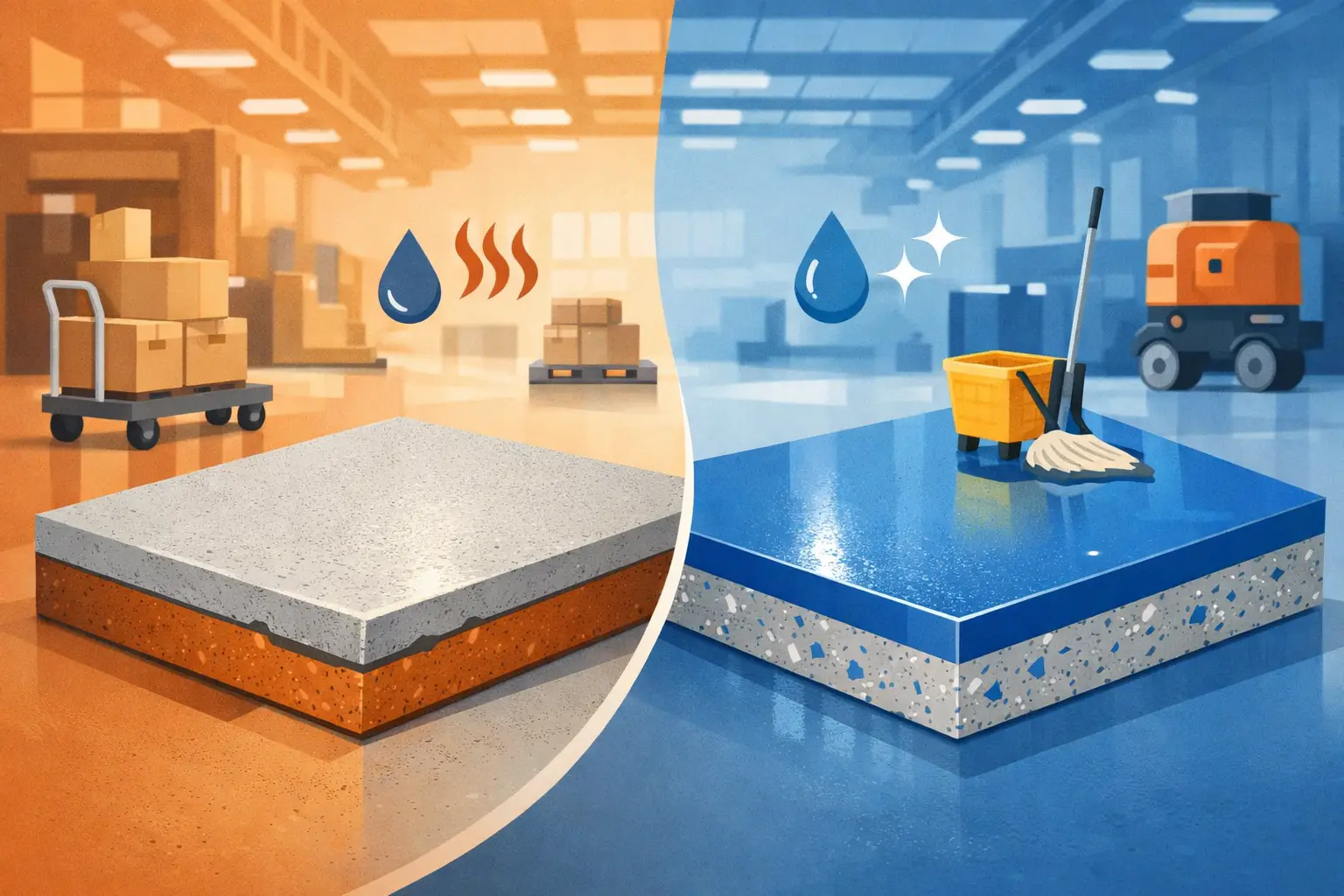
A warehouse floor can look perfectly acceptable on opening day and still become a maintenance problem within a year. Forklift turns, dropped tools, wet mopping, hot equipment, cleaning chemicals, and slab moisture expose weaknesses fast. In the urethane cement versus epoxy decision, the right answer is not about which material is universally better. It is about matching the flooring system to the abuse your facility, retail space, commercial kitchen, or home will actually deliver.
Both systems can protect concrete, improve cleanability, and create a more professional surface. Yet they behave very differently under heat, moisture, impact, and changing temperatures. Choosing on initial price alone is how property owners end up paying twice.
Urethane Cement Versus Epoxy: The Core Difference
Epoxy is a resin-based coating or mortar system applied over prepared concrete. It is widely used because it can be highly decorative, chemical-resistant, easy to clean, and available in many colors, flake blends, and gloss levels. A standard epoxy coating is commonly installed in mils, while epoxy mortar systems can be built much thicker for heavy industrial conditions.
Urethane cement, also called cementitious urethane, combines polyurethane resins with cement, aggregates, and other components. It is generally a thicker, more industrial-grade flooring system. Its chemistry gives it a major advantage where concrete and the finished floor will experience rapid temperature changes, wet service, or significant moisture pressure.
That difference matters because concrete is never static. It expands, contracts, holds moisture, and moves with the building. A coating that performs beautifully in a conditioned office may not be the best fit for a washdown area or a facility with hot processes.
When Epoxy Is the Better Flooring Choice
Epoxy remains one of the strongest options for many Southern California commercial and residential projects. In the right environment, it offers excellent value and a sharp finished appearance that urethane cement does not always provide on its own.
Appearance, color, and custom design
If visual impact is a leading priority, epoxy has the edge. It can be installed in solid colors, decorative quartz systems, metallic effects, and broadcast flake finishes. Retail floors, showrooms, offices, garages, lobbies, and lofts often benefit from epoxy because it creates a clean, intentional appearance that supports the rest of the space.
Epoxy also works well when a property needs color-coded work zones, safety borders, directional markings, or a bright, reflective floor that improves interior light levels. The system can be specified with a satin, gloss, or textured finish depending on maintenance and slip-resistance requirements.
Chemical exposure without thermal shock
A properly specified epoxy can resist many oils, fuels, automotive fluids, and common industrial chemicals. That makes it a dependable choice for warehouses, maintenance areas, light manufacturing, laboratories, commercial garages, and distribution spaces where chemical resistance matters but extreme heat does not.
The phrase “properly specified” is doing real work here. Chemical resistance changes based on the exact material being spilled, its concentration, the exposure time, floor temperature, and cleaning method. A floor that sees occasional motor oil needs a different specification than one exposed to acids, caustics, or aggressive solvents every day.
Controlled indoor environments
Epoxy performs best when the slab is dry enough, the temperature is stable, and the use is predictable. Many office, retail, and standard warehouse floors meet those conditions. With professional diamond grinding, crack repair, moisture testing, and correct primer selection, epoxy can deliver years of service at a favorable installed cost.
Its limitation is that standard epoxy can become brittle when exposed to repeated thermal cycling. Hot water, steam, freezer-to-room-temperature transitions, and sudden temperature swings can stress the bond or cause cracking. Epoxy can also amber or yellow with direct UV exposure, so sunlit exterior-facing areas may need a UV-stable topcoat or another finish strategy.
Where Urethane Cement Takes the Lead
Urethane cement is built for harder service conditions. It is not automatically necessary for every industrial floor, but it becomes the stronger investment when heat, moisture, and repeated washdown are part of normal operations.
Thermal shock and high-temperature service
This is urethane cement’s defining advantage. In facilities where hot liquids, steam cleaning, ovens, cook lines, or hot equipment are routine, urethane cement can tolerate thermal movement far better than conventional epoxy. Commercial kitchens, food and beverage plants, breweries, food-processing areas, and certain manufacturing operations are common applications.
A hot washdown on a cool floor is not a minor event for a coating system. The concrete and top layer expand at different rates. Over time, that stress can lead to delamination, cracks, or failed joints if the wrong material was selected. Urethane cement is designed to better accommodate those conditions.
Moisture tolerance and demanding slabs
Moisture vapor transmission is a leading cause of coating failure. A concrete slab may look dry at the surface while vapor is moving upward from below. In parts of Los Angeles and Orange County, older slabs, slabs without an effective vapor barrier, and ground-level facilities can require careful moisture evaluation before any coating is installed.
Urethane cement is more forgiving than standard epoxy in damp-service environments and can handle higher moisture conditions when correctly designed. That does not eliminate the need for testing, substrate preparation, or moisture control. It means the system has a wider performance range when slab conditions are challenging.
Heavy abuse and washdown service
Urethane cement provides a tough, thicker wearing surface that stands up well to impact, abrasion, and constant cleaning. It is frequently used where sanitation matters and floors are exposed to water, food byproducts, cleaning agents, pallet jacks, and heavy carts.
It can also be broadcast with aggregate to create a safer traction profile. The goal is not to make a floor aggressively rough. Over-texturing can trap dirt and complicate cleaning. The right finish balances slip resistance with the ability to wash and maintain the surface efficiently.
Cost, Downtime, and Long-Term Value
Urethane cement usually has a higher upfront cost than a basic epoxy coating. It is a specialized system, often installed at greater thickness, and demands experienced preparation and application. If your floor only needs an attractive, chemical-resistant coating in a stable environment, a full urethane cement system may be more than the project requires.
But lower installation cost is not the same as lower ownership cost. Recoating a failed floor can involve removing damaged material, repairing concrete, shutting down work areas, moving inventory, and rescheduling operations. For a wet processing room or high-heat kitchen, selecting urethane cement at the start can prevent a far more expensive interruption later.
Downtime depends on the system design, slab repairs, environmental conditions, and the number of coats required. Urethane cement can cure rapidly, which is valuable for facilities that cannot close for long. Still, speed should never replace proper surface preparation. Mechanical diamond grinding, contamination removal, joint treatment, and moisture assessment determine whether a new floor bonds for the long haul.
The Hybrid Approach: Urethane Cement With an Epoxy or Urethane Topcoat
The choice does not always have to be one material or the other. In demanding facilities, a urethane cement base can provide thermal and moisture performance, while a compatible topcoat supplies additional color retention, chemical resistance, or a more refined appearance.
This approach can make sense for food-service operations, production rooms, and areas that need both high performance and clear visual organization. It requires a contractor who understands product compatibility and recoat windows. Mixing systems without a tested specification can create bond failures just as easily as installing the wrong system from the start.
Questions That Should Drive Your Selection
Before selecting a floor system, look beyond the room name. A “warehouse” can mean light foot traffic and boxed inventory, or it can mean forklift traffic, battery charging, loading dock moisture, and daily chemical cleaning. The operating conditions matter more than the label on the door.
Ask what reaches the floor: water, steam, oils, acids, solvents, food products, or hot materials. Consider whether the slab has a history of moisture issues, whether the area has direct sunlight, and whether the operation can tolerate a future shutdown for repairs. Also account for appearance, traction, cleanability, and the service life you expect from the investment.
For a decorative garage, showroom, office, retail environment, or stable warehouse, epoxy may deliver the best combination of appearance and cost control. For high heat, wet processing, steam cleaning, thermal shock, and moisture-challenged concrete, urethane cement is usually the more dependable specification.
A floor should support your operation, not force your operation to work around it. The best next step is a site-specific evaluation of the concrete, traffic, moisture, cleaning practices, and performance demands before any material is selected. That is how Los Angeles Concrete Polishing helps clients invest in a floor designed to stay in service.
Clients We Service
We provide our concrete polishing and related services to a wide variety of clients. Some of the types of clients that we provide service to include:


