
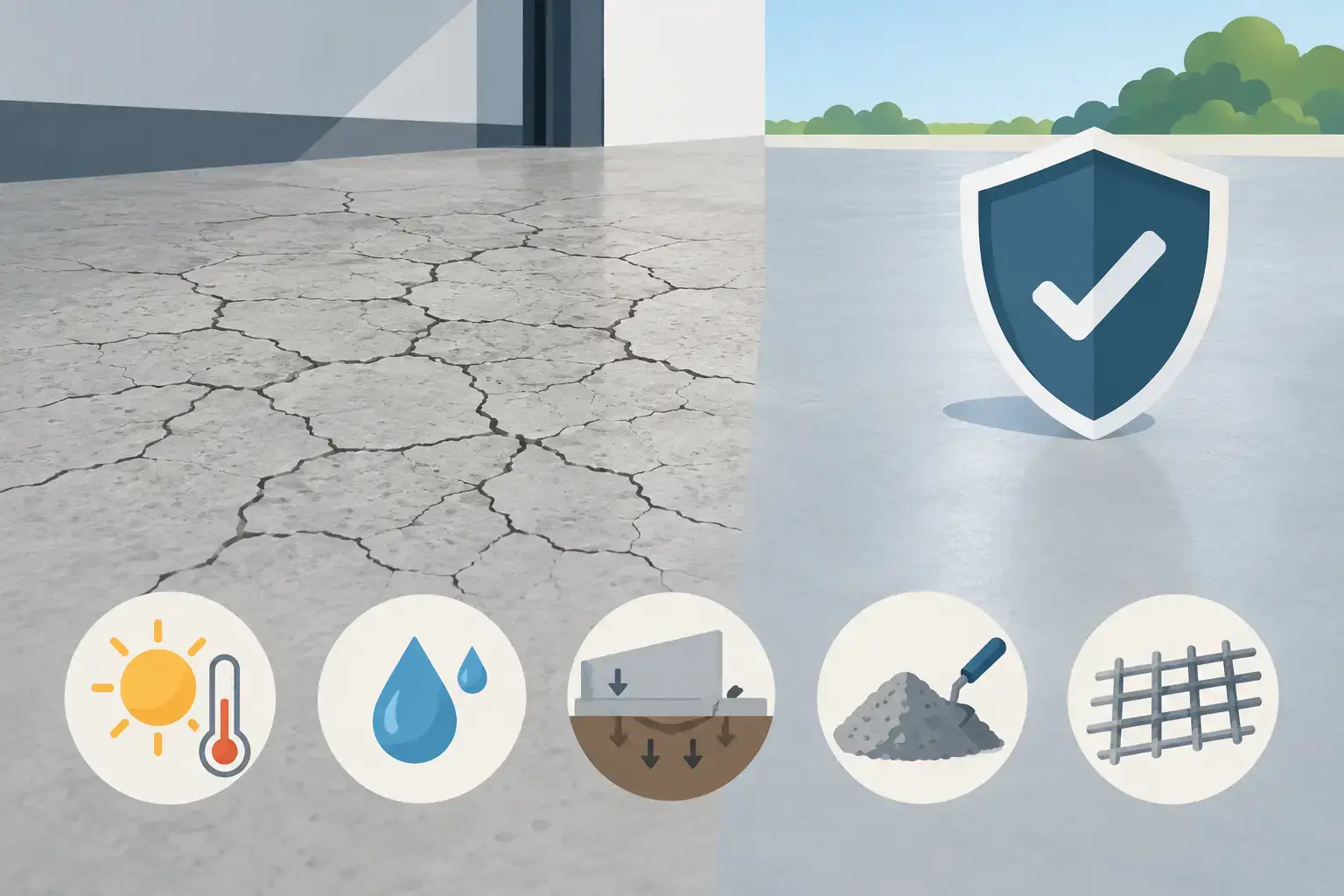
A newly poured slab can look excellent at first, then reveal a web of fine, shallow lines as it dries and cures. That pattern is called crazing, and understanding concrete crazing causes matters before assuming the slab has failed. In most cases, crazing is a surface-level defect rather than a structural crack. It can still compromise the appearance of a polished floor, decorative finish, warehouse slab, retail space, or residential patio – and it often points to placement or curing practices that need attention.
For property owners and facility managers, the right response depends on the floor’s intended use. A few hairline craze cracks may be largely cosmetic under a matte industrial finish. On a high-gloss polished concrete floor, however, the same cracks can become more visible after grinding and densification. A professional evaluation should look beyond the pattern itself to determine the slab’s hardness, moisture condition, surface integrity, and long-term service demands.
What Concrete Crazing Looks Like
Concrete crazing appears as a network of very fine, random cracks near the top of the slab. It is often compared to cracked glaze on pottery or a spiderweb pattern. The lines are usually shallow, short, and interconnected, rather than long, isolated, or continuous across a room.
That distinction is critical. Crazing generally affects the cement paste at the surface, while structural cracking may indicate shrinkage stress, movement, subbase problems, overloading, inadequate joints, or reinforcement-related issues. Crazed concrete can often remain sound and serviceable. Deep cracks with vertical displacement, widening gaps, moisture migration, or edge deterioration deserve a more comprehensive assessment.
Crazing may not show immediately. It can become noticeable within days of placement, after the slab loses surface moisture, or after cleaning, sealing, and changing light conditions make the fine lines more apparent. Strong side lighting in offices, lofts, showrooms, and retail environments frequently exposes surface defects that were easy to miss during construction.
The Main Concrete Crazing Causes
Most crazing begins when the top of the slab shrinks faster or behaves differently than the concrete beneath it. Concrete is not a uniform material at every depth. The quality of the finished surface is heavily affected by water content, finishing timing, evaporation rate, curing, and the skill of the placement crew.
Finishing While Bleed Water Is Still Present
Fresh concrete releases water upward during placement and early setting. This is called bleed water. If finishers begin troweling before that water has evaporated or been reabsorbed, they can work excess water and cement fines into the surface. The result is a weak, water-rich paste layer that is more likely to shrink, craze, dust, or delaminate.
This is one of the most common concrete crazing causes on slabs that were aggressively machine-troweled for a smooth appearance. A tight-looking finish is not automatically a durable finish. Proper timing matters more than speed, especially on large commercial placements where schedules can pressure crews to close the surface too soon.
Excess Water in the Mix or Added at the Site
Adding water makes concrete easier to place and finish, but it also raises the water-cement ratio. Higher water content creates more drying shrinkage and a weaker surface zone. The risk increases when water is added at the truck without a controlled mix adjustment, or when a crew sprays water on the slab to help with finishing.
A workable mix should be designed for the placement method, weather, required strength, and final floor system. For floors intended for polishing, coatings, or high traffic, mix design and batch consistency deserve careful attention. The surface will eventually reveal shortcuts that seemed harmless during a fast pour.
Rapid Surface Drying in Hot, Dry, or Windy Conditions
Southern California concrete work often faces high temperatures, low humidity, direct sun, and wind. Those conditions can pull moisture from the surface faster than the slab can replace it from below. The top layer shrinks early, creating the fine cracking associated with crazing.
Rapid evaporation is especially problematic for exterior flatwork, loading areas, exposed patios, and open warehouse slabs with airflow through large doors. It can also affect indoor placements where HVAC systems, fans, or dehumidification create aggressive air movement. Hot-weather concrete planning should account for placement time, wind control, evaporation reducers when appropriate, and immediate curing protection.
Overworking the Surface
Every pass of a trowel changes the surface. Too much troweling, excessive blade pressure, or repeated finishing after the concrete has started to set can create a dense, brittle top skin. It may look refined at turnover, but it can shrink differently from the material below and develop craze cracking.
Overworking also tends to concentrate fine paste at the surface. This becomes a concern when the slab is later ground for polishing. A diamond grinder may remove the weak skin and expose a better substrate underneath, but the scope, aggregate exposure, and final visual result can change. That is why the desired finish should be discussed before placement whenever possible.
Inadequate or Uneven Curing
Concrete needs moisture and stable temperature conditions to develop strength properly. Curing is not a final cleanup task. It is a central part of slab performance. When curing compounds are applied inconsistently, wet curing ends too soon, or a slab is left exposed after finishing, the surface can dry and shrink prematurely.
Uneven curing can create a patchy appearance as well as crazing. Some areas may remain hard and intact while others are softer, more porous, or heavily cracked. Before specifying a polished finish, clear sealer, coating, or thin topping, a contractor should identify these variable conditions. A finish system is only as reliable as the surface supporting it.
Finishing Aids Used Incorrectly
Certain finishing aids can be useful when selected and applied according to manufacturer directions. Problems arise when they are treated as a substitute for proper mix design, finishing timing, or curing. Adding unapproved water, using products too heavily, or mixing incompatible materials into the surface can weaken the paste and increase cracking risk.
The same caution applies to curing compounds. A product that works for a conventional broom-finished slab may not be suitable for a floor that will later receive a bonded coating, overlay, or polished concrete treatment. Removal requirements, bond compatibility, and moisture conditions should be addressed before the slab is placed.
Is Crazing a Structural Problem?
Usually, no. Surface crazing is commonly cosmetic, particularly when the cracks are extremely fine and there is no curling, movement, spalling, or loss of surface material. But “usually” is not a diagnosis. A warehouse manager should not dismiss cracks simply because they resemble crazing if forklifts, point loads, chemical exposure, or slab movement are part of daily operations.
A closer inspection is warranted when cracks are wider than hairline, extend through the slab, collect dirt or moisture, show differential height, or continue to grow. It is also wise to investigate if the floor is dusting, flaking, hollow-sounding, or developing coating failures. Those symptoms can signal surface weakness, bond failure, or a deeper condition beyond ordinary crazing.
For polished concrete, crazing deserves an early review because polishing does not hide every defect. Fine cracks can remain visible, and higher gloss can make them more noticeable. In some projects, that character is acceptable or even preferred. In others, particularly high-end retail, hospitality, and modern residential interiors, crack repair and mockups help set realistic expectations before full production begins.
How to Prevent Crazing Before It Starts
The strongest prevention plan begins before the ready-mix truck arrives. Specify a mix appropriate for the slab’s performance requirements rather than relying on jobsite water to improve workability. Coordinate the pour with weather conditions, crew size, equipment capacity, joint layout, and the required final finish.
During placement, protect the slab from rapid evaporation and avoid finishing until bleed water is gone. Finish only as much as needed to achieve the specified texture or flatness. A floor designed for polishing, for example, needs disciplined placement and curing, not excessive troweling in pursuit of an artificial early shine.
Cure immediately and consistently after final finishing. The exact approach depends on the project: wet curing, curing blankets, compatible membrane-forming compounds, and environmental controls each have a place. The key is maintaining conditions that allow the slab to gain strength without losing moisture too quickly.
For larger commercial floors, document the placement plan. Confirm who controls water additions, who monitors weather, how curing will be applied, and whether products are compatible with future polishing or coatings. These details reduce avoidable risk and support predictable results with less operational disruption.
Can a Crazed Concrete Floor Be Repaired?
Repair options depend on depth, severity, appearance goals, and floor use. When crazing is superficial and the concrete beneath is sound, a penetrating densifier may harden the surface and reduce dusting. A protective sealer can improve stain resistance, though it will not erase visible cracks. For a polished floor, diamond grinding may remove weak surface paste and create a more consistent finish, but it can also reveal aggregate and alter the floor’s visual character.
If the surface is extensively weak, scaling, or contaminated, a cementitious topping or coating system may be the better solution. This is not a one-size-fits-all decision. Coatings can deliver chemical resistance and fast visual improvement, while polished concrete offers long-term wear performance and low maintenance when the slab is suitable. Moisture testing and substrate preparation are essential before either route.
At Los Angeles Concrete Polishing, we evaluate the actual condition of the slab before recommending grinding, polishing, a protective treatment, or a resurfacing system. The goal is not to cover a problem quickly. It is to specify a floor that matches the traffic, maintenance plan, appearance standard, and budget of the property.
A few shallow lines do not automatically mean a failed slab. What matters is whether the surface is stable, whether the cracks are truly limited to the paste layer, and whether the chosen finish will perform as expected. Address crazing early, before it becomes a visible issue under bright lighting, heavy traffic, or a high-gloss finish, and the floor will have a far better path to lasting performance.
Clients We Service
We provide our concrete polishing and related services to a wide variety of clients. Some of the types of clients that we provide service to include:


