
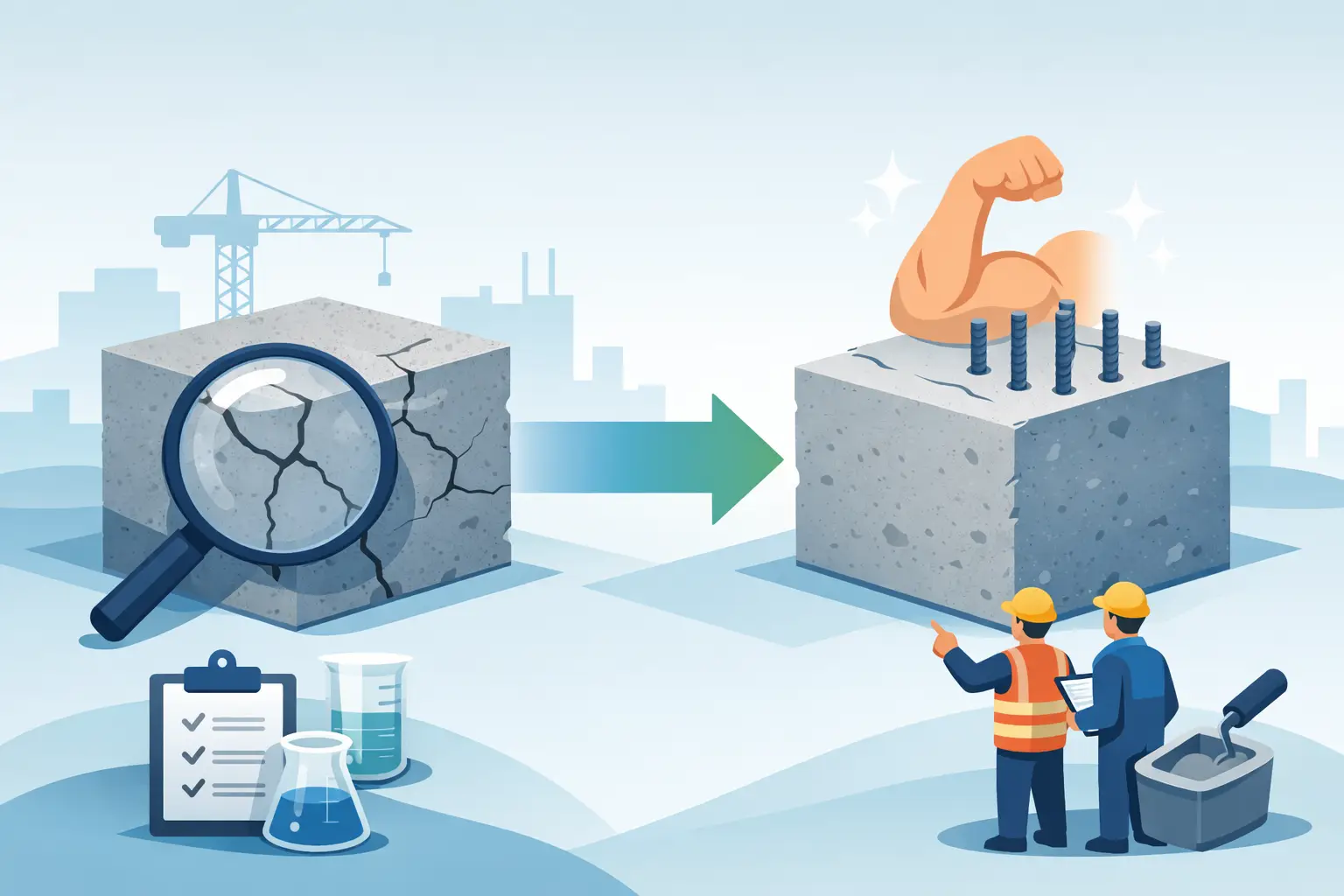
A soft concrete floor shows itself fast. Forklift tires leave tracks, dust reappears after every cleaning, a key scratches the surface, or the top layer breaks down into sandy grit at doorways and traffic lanes. For property owners, the question is not only how to harden soft concrete. It is whether the weak material is limited to the surface or extends deep enough to require a more substantial repair.
That distinction controls the right solution, the project budget, and the floor’s long-term performance. A quality densifier can transform a sound but porous slab. It cannot turn badly understrength concrete into an industrial-grade floor by itself. The most reliable approach starts with diagnosis, then uses the repair system that matches the slab’s actual condition.
First, determine why the concrete is soft
Concrete is not supposed to feel powdery, scratch easily, or shed dust under ordinary foot traffic. When it does, the cause usually traces back to installation conditions, curing, moisture, or a weak surface layer created during finishing.
A common problem is laitance. This is a fragile, cement-rich layer at the top of the slab, often caused when excess water rises during placement or when finishers work bleed water into the surface. Over-troweling wet concrete can create a smooth-looking floor that later becomes weak, dusty, and prone to peeling.
Other causes include an overly wet mix, insufficient cement content, poor curing, early exposure to freezing temperatures, chemical attack, or years of abrasion. In warehouses and industrial spaces, hard-wheel traffic can wear through a marginal surface much faster than normal office foot traffic. Moisture vapor moving upward through a slab can also damage coatings and contribute to surface deterioration.
New concrete deserves special consideration. Concrete continues gaining strength for weeks, and a slab that has not cured properly may need evaluation before any corrective treatment begins. Do not confuse normal early-age curing with a floor that remains soft after it should be serviceable.
Test the slab before choosing a repair
The fastest way to waste money is to apply a clear sealer or densifier over loose, contaminated, or failing concrete. The material may look better briefly, but traffic will expose the same weakness again.
Start with a practical surface assessment. Check several locations, especially loading areas, entrances, windows, plumbing zones, and places where equipment turns. Look for dusting, scaling, delamination, exposed aggregate, dark moisture marks, cracking, and previous coating failure. A screwdriver or sharp tool can reveal whether the surface scratches only in isolated spots or crumbles across the floor.
A professional evaluation goes further. Concrete grinding can expose the depth of weak material, while adhesion testing, hardness testing, and moisture testing help determine whether the slab can support a polished finish, coating, overlay, or repair mortar. In active facilities, this step is critical because the floor system must fit real traffic, cleaning chemicals, rolling loads, and downtime limits.
The key question is simple: after weak material is removed, is there solid concrete underneath? If the answer is yes, hardening and refinement may be highly effective. If the entire slab is low strength, the repair scope changes.
How to harden soft concrete when the slab is structurally sound
For a slab with a weak or porous surface but sound concrete below, mechanical preparation followed by a penetrating densifier is often the strongest solution. This is the same principle behind high-performance polished concrete systems.
Remove the weak surface first
Grinding is not cosmetic preparation. It removes laitance, failed coatings, surface contamination, and soft paste that would prevent a treatment from performing correctly. Diamond tooling is selected based on the floor condition. A severely dusty slab may need more aggressive metal-bond grinding before finer tooling can refine the surface.
The goal is not always to remove large amounts of concrete. It is to reach a consistent, competent substrate. On a commercial floor, the contractor should also address cracks, joints, spalls, and damaged edges before moving into densification or polishing.
Trying to save time by applying a liquid hardener over dust is a poor trade-off. Proper grinding adds upfront cost, but it prevents a short-lived finish and avoids repeated shutdowns later.
Apply a penetrating concrete densifier
Concrete densifiers, commonly lithium-, sodium-, or potassium-silicate based, react with components in the concrete to create additional mineral structure within the surface. In practical terms, a properly selected and applied densifier can reduce dusting, improve abrasion resistance, and make the floor easier to clean.
Lithium silicate densifiers are frequently preferred for polished concrete because they penetrate well and are less likely to leave problematic residue when used correctly. Product selection still depends on slab density, porosity, environmental conditions, and the planned finish. A floor intended for a high-gloss polish may receive densifier at a different stage than a floor receiving a low-sheen, guard-protected finish.
Densifier is not a topical coating. It should not form a thick film on the surface. The concrete must be clean, open enough to accept the product, and allowed to react according to the manufacturer’s process. Excess material must be worked in or removed correctly to avoid streaking, residue, or inconsistent appearance.
Refine and protect the surface for its use
After densification, the floor can be honed or polished through progressively finer diamond grits. This process closes the surface, improves reflectivity when desired, and creates a dense finish that performs well in retail, offices, lofts, warehouses, and many production environments.
A penetrating stain guard or protective guard may be appropriate where oil, food, tire marks, or routine spills are concerns. It improves cleanability, but it does not replace sound concrete or correct ongoing moisture issues. For spaces exposed to aggressive acids, solvents, or constant chemical washdown, a chemical-resistant coating or lining may be a better system than polished concrete.
When densifier alone will not fix soft concrete
There are situations where the floor is too damaged for a simple hardening treatment. A densifier strengthens mineral concrete near the surface. It does not bridge deep cracks, rebuild missing sections, stop slab movement, or compensate for an underdesigned mix.
If grinding reveals widespread weak concrete, severe scaling, deep delamination, or areas that break apart under moderate pressure, the floor may need a cementitious overlay, repair mortar, or partial replacement. Overlays can create a new, durable wearing surface, but only when the underlying slab is prepared properly and moisture conditions are controlled. A beautiful overlay installed over a failing substrate will eventually fail with it.
For heavy-duty warehouses, manufacturing areas, and loading zones, the selected system should be based on traffic loads rather than appearance alone. Forklifts, pallet jacks, hard casters, and point loads place demands on concrete that a residential garage or office lobby may never see. The best finish is the one that stays intact under the actual operation.
Avoid the shortcuts that make the problem worse
Paint and acrylic sealers can temporarily hide dusting, but they do not harden weak concrete. If the surface is chalky, the coating bonds to the chalk rather than to sound material. Peeling is the predictable result.
Acid washing is another poor substitute for preparation. It can create an uneven profile, introduce moisture, and leave salts or residues that interfere with later treatments. Mechanical diamond grinding is cleaner, more controllable, and far more reliable for professional floor restoration.
Avoid adding water to the surface during repairs, applying products without moisture testing, or assuming every hardener works on every slab. Concrete floors respond to site conditions. Southern California properties can face moisture vapor challenges even where the climate feels dry, particularly in older slabs, ground-level spaces, and buildings with changed interior conditions.
Build the repair around long-term floor performance
The right answer to how to harden soft concrete is rarely a single product from a shelf. It is a sequence: identify the failure, remove unsound material, verify slab conditions, densify where appropriate, and select a finish that fits the building’s traffic and maintenance plan.
For a dusting warehouse floor, that may mean grinding, lithium densification, joint repair, and a practical low-maintenance finish. For a retail showroom or loft, it may mean additional polishing steps for clarity and gloss. For a chemically demanding facility, a properly specified coating system may offer the better return.
Los Angeles Concrete Polishing evaluates these conditions before recommending a finish because long-term performance matters more than a quick cosmetic fix. A floor should work as hard as the business or home built around it – stay cleanable, safe underfoot, and ready for the traffic ahead.
Clients We Service
We provide our concrete polishing and related services to a wide variety of clients. Some of the types of clients that we provide service to include:


