
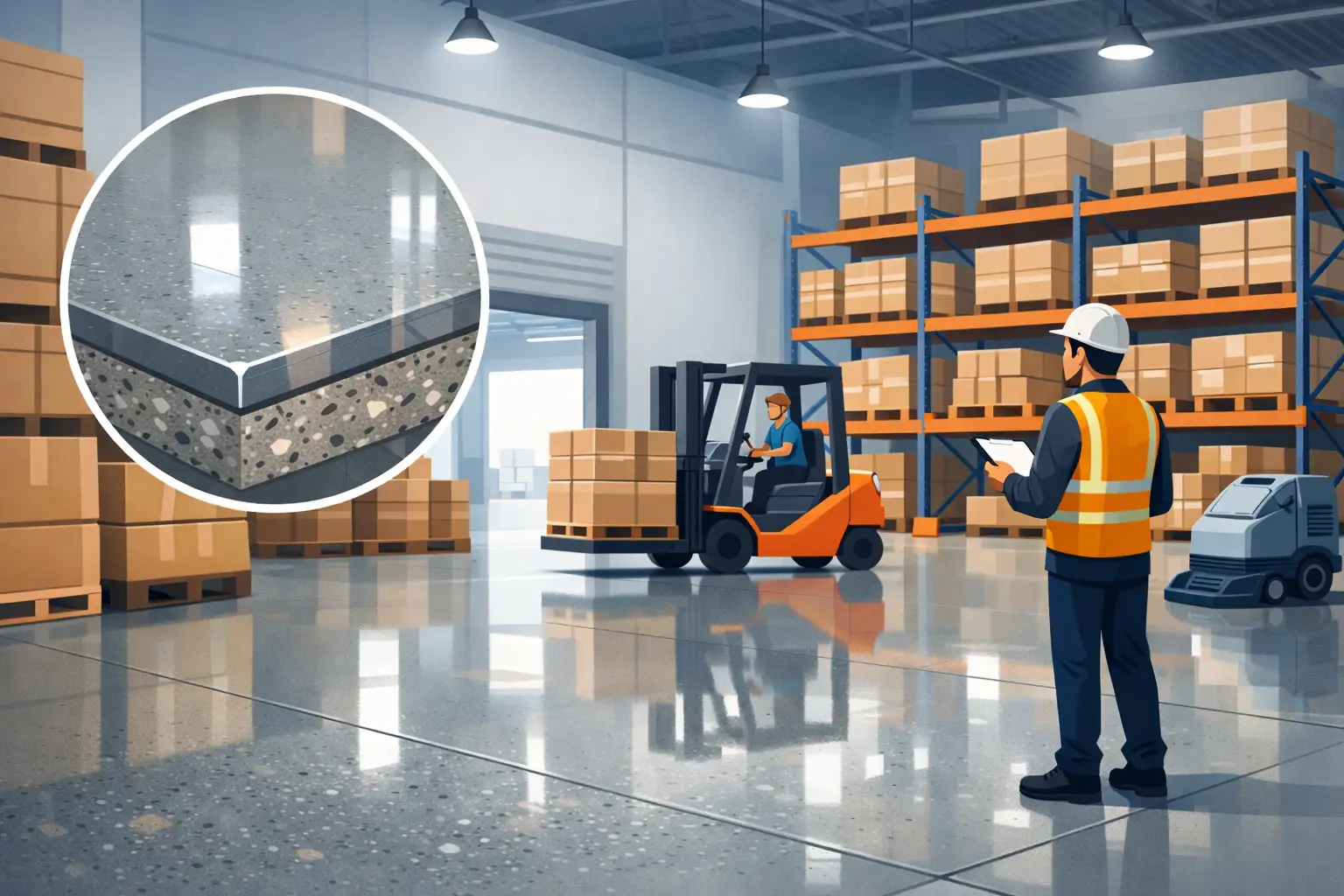
A warehouse floor is not judged by how it looks on opening day. It is judged after forklifts have turned across the same travel lanes for months, pallets have dragged across staging areas, and crews have cleaned up dust, oil, and daily traffic. So, can warehouses use polished concrete? Yes – and for many facilities, it is one of the smartest long-term flooring decisions available. The right answer, however, depends on the slab, the operation, and the performance expectations.
Polished concrete is not a decorative shortcut placed over a warehouse floor. It is a mechanical refinement process that uses progressively finer diamond tooling, hardeners, densifiers, and optional guard products to improve the existing concrete surface. When the slab is sound and the polishing system is matched to warehouse use, the result is a dense, durable, low-maintenance floor built to perform under demanding traffic.
Why Polished Concrete Works in Warehouses
Warehouses need floors that reduce operational headaches. Concrete polishing strengthens the wear surface, reduces dusting, improves light reflectivity, and eliminates the recurring failure points common with many film-forming coatings. Rather than relying on a layer that can chip or peel, polished concrete develops its performance through the slab itself.
That matters in facilities with forklifts, pallet jacks, carts, racking aisles, loading zones, and constant foot traffic. A properly densified and polished floor resists abrasion better than unfinished concrete and is easier to keep clean. Its reflective finish can also improve ambient lighting across large floor plates, which may reduce the need for additional fixtures or improve visibility in work areas.
For Los Angeles and Orange County operators, polished concrete is especially attractive when a facility needs a professional appearance without taking on the maintenance cycle of wax, paint, or frequent coating repair. It gives distribution centers, light manufacturing sites, showrooms, and mixed-use warehouse spaces a clean industrial finish that holds up to real work.
Can Warehouses Use Polished Concrete in Heavy-Traffic Areas?
They can, but traffic patterns must drive the specification. A warehouse with light forklift movement and packaged goods has different needs than a high-volume logistics operation with loaded pneumatic-tire forklifts, steel-wheeled carts, battery charging areas, and frequent loading activity.
In busy travel lanes, the concrete must have adequate strength and surface integrity before polishing begins. Weak, soft, heavily spalled, or delaminated concrete will not become dependable simply because it is ground and shined. Diamond grinding can remove surface contaminants and expose stronger concrete beneath, but major deterioration may require patching, topping installation, or a different flooring system altogether.
A skilled contractor also evaluates flatness, joint conditions, aggregate exposure, previous repairs, and the type of equipment running on the floor. Forklifts do not just create vertical pressure. Repeated turning and braking create lateral abrasion that can wear down weak surfaces, especially near rack ends, dock doors, and high-traffic intersections. Those areas may need targeted repairs, joint fillers, or a more protective finish strategy.
The finish level should be practical, too. Warehouses do not always need a high-gloss, mirror-like floor. A matte or satin polish can provide the density, dust control, and cleanability operators want while keeping the appearance appropriate for industrial use. Higher gloss levels can work beautifully in warehouse showrooms, flex spaces, and customer-facing areas, but gloss should never be selected before traffic and safety requirements are understood.
The Floor Must Be a Good Candidate
Polished concrete performs best on structurally sound slabs with manageable cracking, limited surface contamination, and enough concrete depth for mechanical grinding. Existing coatings, adhesives, paint, tire marks, and curing compounds can usually be removed, but removal adds time and may reveal repairs or slab inconsistencies beneath.
Concrete with extensive patchwork can still be polished, but it will not look perfectly uniform. That is not always a problem in a working warehouse. Many owners prefer an honest industrial appearance, provided the floor is smooth, dense, cleanable, and professionally repaired. If visual consistency is a priority, a cementitious topping or another enhancement system may be the better investment.
Moisture Is the Deciding Factor Many Owners Miss
Moisture vapor does not disappear because a floor has been polished. This is a major advantage and a major reason professional evaluation matters.
Unlike many coatings, polished concrete is breathable. It does not create the same impermeable film that can blister, bubble, or delaminate when moisture vapor moves through the slab. That makes polishing a strong option for many ground-level warehouse floors, particularly older buildings where moisture conditions make coating failures more likely.
Still, high moisture conditions can affect repairs, joint fillers, stains, toppings, and any protective products used as part of the system. A proper assessment may include relative humidity testing, moisture vapor evaluation, and inspection for hydrostatic pressure, drainage failures, or active water intrusion. If water is entering through walls, joints, or slab cracks, that building issue must be addressed before any floor finish can be expected to perform at its best.
Polishing is not a substitute for correcting poor site drainage or an active leak. It is a durable floor enhancement method, not a cure for a compromised building envelope.
Slip Resistance, Chemicals, and Daily Safety
A polished floor can be slip-conscious, but it should not be described as automatically slip-proof. Safety depends on the finish, surface profile, contaminants, footwear, cleaning practices, and whether the floor is dry or wet during normal operations.
Mechanically polished concrete often provides reliable traction in dry conditions because it retains microtexture even when it has a refined appearance. But water, oil, grease, and fine dust can change the equation. Warehouse managers should identify wet-process areas, exterior entry points, battery charging stations, maintenance bays, and loading docks before selecting the final finish.
Where liquids or chemicals are common, polished concrete may need additional protection or may not be the primary solution. Densifiers improve hardness and dust resistance, while stain guards can increase resistance to spills and make cleaning easier. They are not the same as a thick chemical-resistant coating. Facilities exposed to aggressive acids, solvents, standing oils, or harsh industrial chemicals may need a specialized coating system in those zones.
This does not rule out polished concrete for the rest of the building. A smart warehouse design can use polished concrete throughout general storage and circulation areas, then specify higher-build protection where chemical exposure is concentrated. The best flooring plan is often a targeted system, not one product forced into every square foot.
Maintenance Is Simple, Not Optional
One reason warehouse owners choose polished concrete is the lower maintenance burden. There is no wax program to maintain, and there are no coating layers that need routine recoating solely to restore appearance. But low maintenance does not mean no maintenance.
Dust and abrasive grit should be removed regularly with microfiber pads or auto scrubbers fitted with appropriate pads and neutral cleaners. Harsh cleaners, dirty mop water, and aggressive degreasers can leave residues or reduce the effectiveness of protective guards. Fast spill cleanup is equally important, particularly around oils, chemicals, and food products.
In high-use facilities, periodic burnishing and reapplication of a compatible guard can help preserve appearance and cleanability. This is far less disruptive than stripping and recoating an entire warehouse floor, but it should be planned as part of the facility maintenance program.
Plan the Installation Around Warehouse Operations
The strongest polished concrete projects are planned around the business, not the other way around. A warehouse rarely has the luxury of shutting down every dock, aisle, and storage zone at once. Experienced concrete polishing crews can divide work into phases, coordinate access routes, and schedule noisy grinding work around critical operations where possible.
Before work begins, the contractor should establish the scope for crack repair, joint treatment, coating removal, slab flattening, grinding level, aggregate exposure, gloss level, and final protection. Clear expectations prevent a common problem: assuming every existing slab will polish into a uniform showroom floor.
Los Angeles Concrete Polishing approaches warehouse work with that operational reality in mind. Advanced diamond-polishing methods, moisture awareness, and disciplined project planning help facility teams gain a higher-performing floor without unnecessary disruption.
When Another System May Be Better
Polished concrete is an excellent warehouse option, but it is not the answer for every facility. Severe chemical exposure, constant standing water, major slab movement, deeply damaged concrete, or a need for bright safety colors may point toward epoxy, urethane cement, specialty coatings, or a new topping system.
The key is to avoid choosing a floor by appearance alone. A glossy finish can look impressive, but the real value comes from matching the system to tire traffic, loading conditions, moisture behavior, cleaning procedures, and the expected service life of the space.
Start with an honest slab evaluation. If the concrete is sound and the warehouse needs a durable, dust-resistant, easy-to-maintain surface, polished concrete can turn an underperforming slab into one of the hardest-working assets in the building.
Clients We Service
We provide our concrete polishing and related services to a wide variety of clients. Some of the types of clients that we provide service to include:


